Aurore (Low Voice) Sheet Music Preview

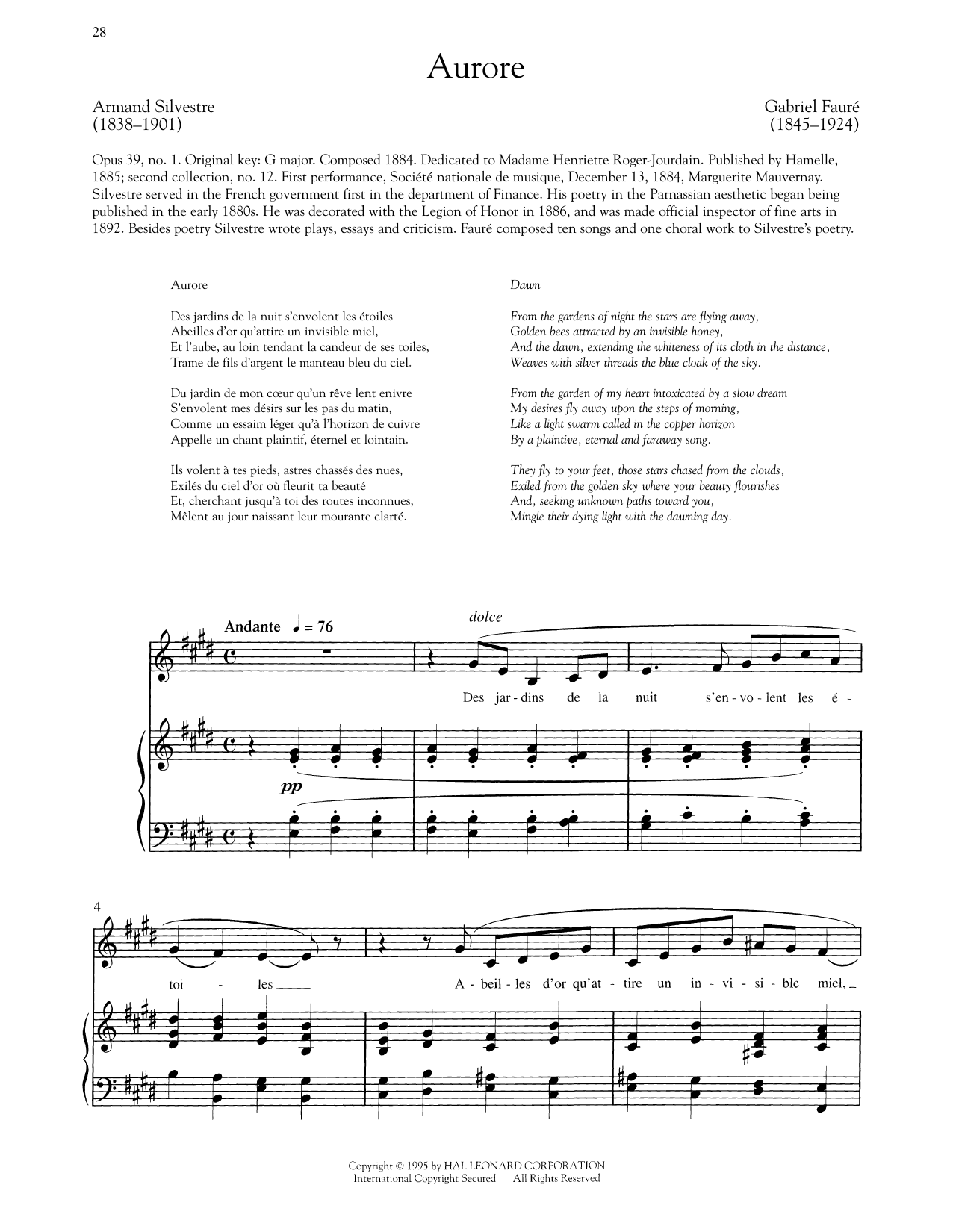
Aurore (Low Voice): Piano Vocal

By Gabriel Fauré

Item: 35-DS01827450

Digital Download
$5.99
Description

Aurore (Low Voice): Piano Vocal isn't in MakeMusic Cloud just yet...but it could be. Let us know you'd like to see it, and you'll help shape what comes next. In the meantime, start a free trial and dive into thousands of interactive titles your students can play along with today.

Sample Audio
No sample audio found.
Sample Video
Additional Details
Publisher: Hal Leonard
Page Count: 5
SKU: 35-DS01827450

More about this title

About the Composer: Gabriel Fauré

Gabriel Fauré (1845-1924) shaped French vocal music through an approach that prized subtlety and harmonic innovation over dramatic gestures. His songs, or mélodie, set new standards for how text and music could interact with restraint and intimacy. Fauré's gift lay in matching music to poetry without overshadowing either one, making him essential listening for anyone teaching art song or exploring the French vocal tradition.

Why we love this

Fauré's 'Aurore' sits at the intersection of accessibility and sophistication. Low voice singers often struggle to find lyrical material that doesn't demand dramatic extremes, and this piece offers genuine poetic substance without requiring an operatic instrument. The accompaniment unfolds with harmonic elegance that rewards pianist and singer alike, making it ideal for collaborative recitals or competitions where artistry matters more than virtuosity.

What to expect

Dawn breaks with quiet contemplation rather than fanfare. The music unfolds in soft light, with gentle harmonic shifts that suggest awakening consciousness. There's an intimate quality throughout, as if the song exists in a private moment between the singer and listener.

Who it's for

Mezzo-sopranos, baritones, and bass baritones seeking French art song material that builds confidence and musicianship without excessive technical demands. Advanced high school singers and undergraduate voice students benefit from Fauré's restrained approach, learning how to communicate meaning through nuance rather than volume. Pianists develop sensitivity to collaborative listening and harmonic awareness through the accompaniment.

How to get the most out of it

  • Shape the opening melody through subtle dynamic changes rather than relying on tempo variations; Fauré's language rewards a steady pulse with expressive phrasing underneath.
  • Balance the voice with the piano's independent lines instead of treating it as mere accompaniment; the piano often carries thematic material that shouldn't disappear.
  • Attend closely to the text's imagery and sentiment throughout, since Fauré's musical ideas follow the emotional arc of the poem rather than any abstract formal scheme.

How to use it

Pair 'Aurore' with other works from the French mélodie tradition to build a coherent recital segment, or use it to open a concert with a calming, introspective tone. It works particularly well on programs pairing art song with chamber works, since the accompaniment demands the same musical sophistication expected of chamber collaborators. Consider programming it alongside Debussy or Ravel to trace evolving approaches to French vocal writing across generations.

Skills your students will build

  • Singing with sustained legit tone at soft dynamic levels
  • Responding to harmonic movement in the accompaniment
  • Interpreting French text with appropriate vowel shapes and clarity
  • Shaping long phrases without a clear melodic peak
  • Collaborating with a pianist whose part contains thematic weight

You May Also Like