
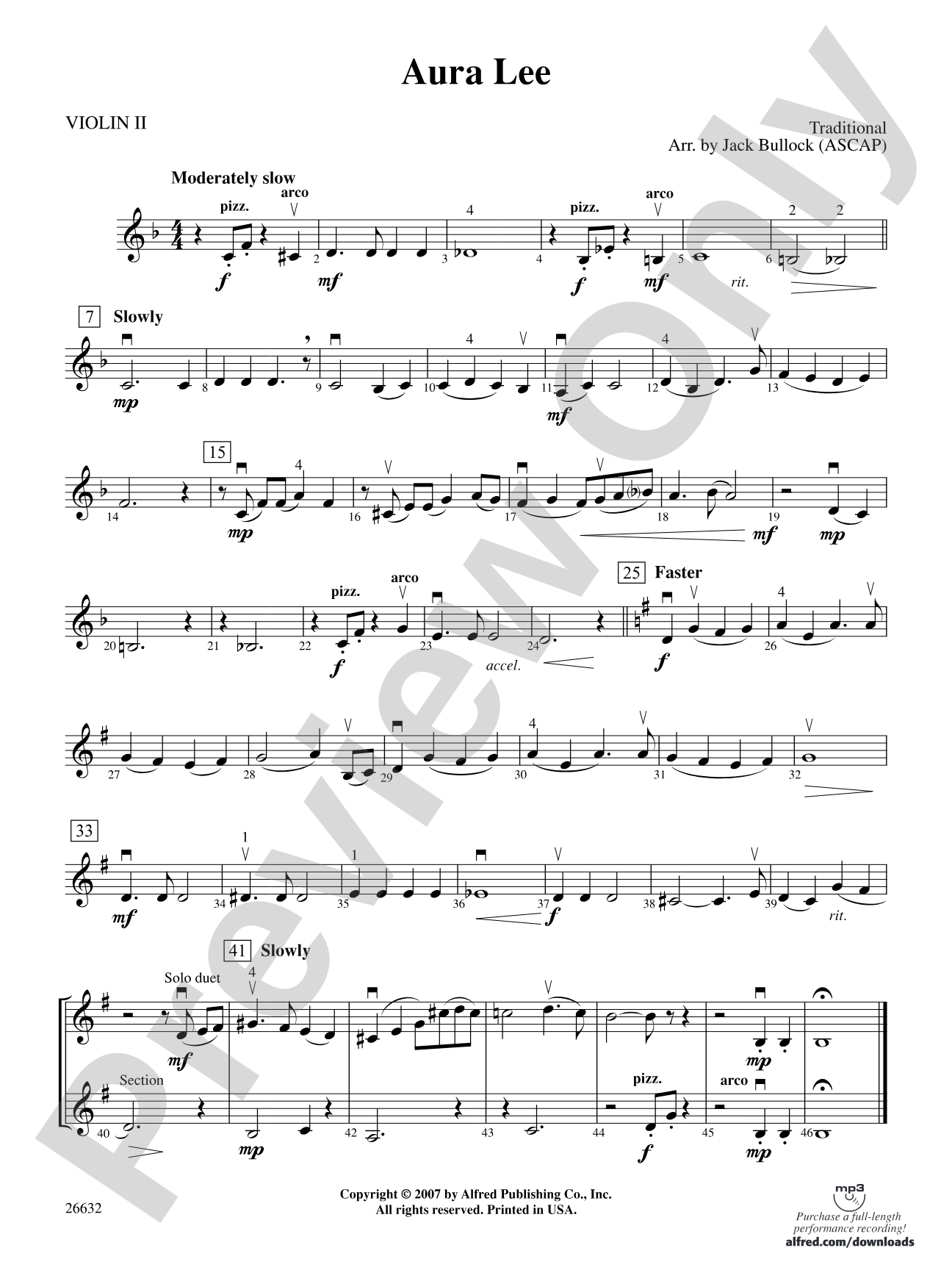

Aura Lee: 2nd Violin
Traditional / arr. Jack Bullock
Grade: 2.5
Item: 00-PC-0001135_VN2
$3.00
Pickup currently not available
Description
Long a favorite, this charming folk song dates back to the American Civil War era, providing a perfect vehicle for cross-curricular studies. Lush with strings alone, this arrangement can also be transformed into a full orchestra setting by adding any or all of the winds. This title is available in MakeMusic Cloud.


Don't just read it, hear it, play along with it, and watch your students grow with it. In MakeMusic Cloud, Aura Lee: 2nd Violin comes alive with professional accompaniment, adjustable tempo, and built-in practice tools that turn solo practice into real progress.
Open in the Player
Jump straight in and assign it today.
Start Your Free Trial
Open this title and explore the full library in minutes.
Sample Audio
1
Audio File
--:--
0:00
0:00
Sample Video
No sample videos found.
Additional Details
Series:
Belwin Intermediate String/Full Orchestra
Publisher:
Alfred Music
Page Count:
57
SKU:
00-PC-0001135_VN2
More about this title
About the Arranger: Jack Bullock

Jack Bullock brings three decades of professional experience across performance, composition, and education to his work as an arranger. A trumpet performer who worked with the Miami Philharmonic Orchestra and Miami Opera Company, as well as touring dance and show bands, he understands orchestral sonorities from the inside. His doctoral training in Music Education shaped his approach to writing for student ensembles.
With over 600 published works across concert band, orchestra, jazz ensemble, and marching band, Bullock has established himself as a prolific voice in educational music. He served on the faculty at Ithaca College's School of Music as an assistant band director and chaired the Music Education Department for four years. His contributions extend to curriculum development, including co-authorship of the Belwin 21st Century Band Method and work on Alfred Music's Music Expressions program. He has conducted clinics across North America and is an ASCAP member since 1980.
Why we love this
Bullock's orchestration gives you genuine flexibility without sacrificing musical coherence. The core string arrangement stands complete on its own, yet the optional wind parts feel integrated rather than tacked on, letting you build from a modest instrumentation to a full sound depending on what your program can field. That's the mark of an arranger who spent twenty years teaching in real classrooms with real constraints.
What to expect
Nostalgic and gentle, with the warmth of a melody that has traveled through American history. The string-only version carries an intimate, almost chamber quality that lets every note breathe. When winds enter, the sound expands without losing that reflective character, creating moments of genuine orchestral richness that feel earned rather than overdone.
Who it's for
Conductors of intermediate orchestras (grades 5-8 or early high school) looking for repertoire that bridges folk tradition with orchestral sophistication. The Grade 2.5 difficulty makes it accessible without sounding juvenile, and the flexible instrumentation means you can program it whether you have a full complement of winds or are still building your ensemble.
How to get the most out of it
- Bring out the lyrical quality of the string section in the opening; this folk melody thrives on warm, singing tone rather than precision of articulation
- If adding winds, introduce them gradually through the arrangement so the transition from strings alone feels natural rather than abrupt
- Balance the conductor score against the individual parts during rehearsal to catch intonation issues in divisi passages, particularly among younger string players
- Use tempo consistency as your anchor; the charm of this Civil War era tune rests on unhurried phrasing that lets the arrangement breathe
How to use it
Pair this with other Civil War era or folk-based repertoire to build a thematic concert around American roots music and history integration. Its moderate length and accessibility make it an excellent opener or a palate-cleansing piece between heavier works. The flexibility of instrumentation also positions it well as a piece that can grow with your orchestra throughout the year as your ensemble develops.
Skills your students will build
- Balancing ensemble sound within divisi string sections
- Sustaining lyrical phrasing over longer melodic lines
- Adjusting blend and tuning when winds combine with strings
- Reading from both conductor score and individual parts simultaneously during sectional work
- Understanding how orchestration choices affect musical character