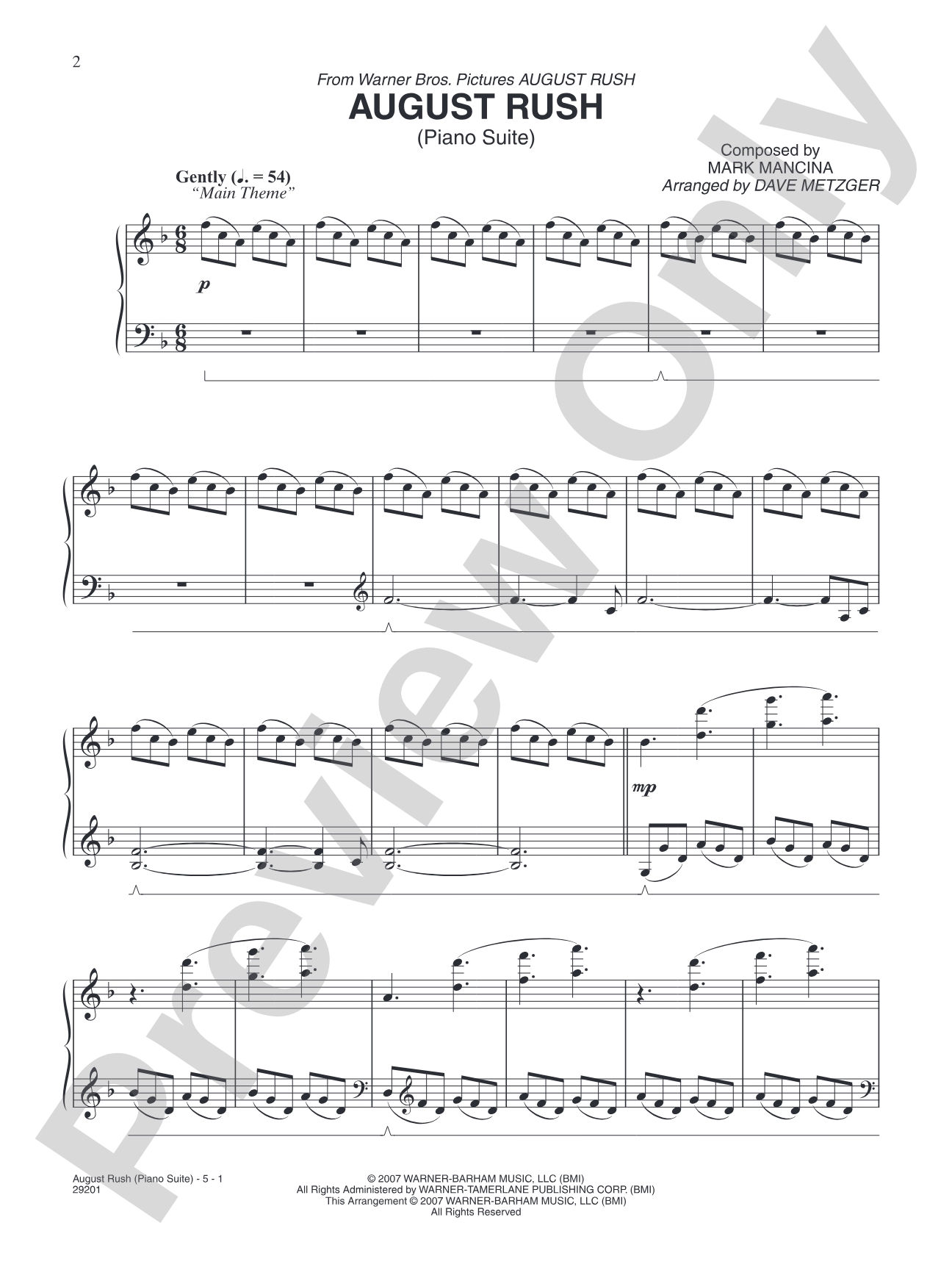
August Rush (Piano Suite) Sheet Music Preview

August Rush (Piano Suite): Piano

Composed by Mark Mancina / arr. Dave Metzger

Level: Advanced

Item: 00-PS-0000082

Digital Download
$3.99
Description
Learn music that inspires audiences nationwide. August Rush, now in theaters, tells the story of love, loss, and ultimately the bond of music that brings a family together. Winner of the Heartland Truly Moving Picture Award, the music from this sentimental film is sure to move musicians and fans everywhere!

Alfred introduces the original sheet music edition of August Rush (Piano Suite). Music was specially arranged by movie orchestrator David Metzger for Alfred Music.

August Rush (Piano Suite): Piano isn't in MakeMusic Cloud just yet...but it could be. Let us know you'd like to see it, and you'll help shape what comes next. In the meantime, start a free trial and dive into thousands of interactive titles your students can play along with today.

Sample Audio
No sample audio found.
Sample Video
Additional Details
Series: Original Sheet Music Edition
Publisher: Alfred Music
Page Count: 6
SKU: 00-PS-0000082

More about this title

About the Composer: Mark Mancina

Mark Mancina has composed music for more than one hundred films across multiple genres, from action blockbusters to intimate character studies. His work demonstrates a gift for melodic storytelling that works equally well in orchestral, electronic, and hybrid contexts. Mancina's film scores have earned numerous award nominations and have shaped how audiences experience emotional turning points on screen.

Why we love this

This suite captures the emotional arc of the film in a manageable six-page package, making it accessible for advanced pianists who want to perform music that resonates with general audiences. Mancina's melodies are singable and memorable without being simplistic, and Metzger's piano arrangement preserves the orchestral sweep of the original while maintaining genuine pianistic writing. Programming a film score of this caliber signals to your audience that you're taking them on a curated musical journey, not just filling concert time.

What to expect

The music evokes yearning and hope, with moments of quiet introspection balanced against fuller harmonic passages that build emotional intensity. Mancina's signature approach surfaces throughout: accessible without being shallow, emotionally direct without sentimentality, and built on strong melodic material that stays with listeners long after the final chord.

Who it's for

Advanced pianists and serious students who enjoy contemporary film music and want to perform repertoire with broad appeal. This suite works well for pianists preparing recital programs that mix classical and popular material, or for those seeking substantial contemporary work that doesn't require orchestral support.

How to get the most out of it

  • Honor the lyrical quality of Mancina's melodies by maintaining phrase shape even during technically demanding passages; the emotional core of the piece depends on listeners hearing the tune clearly.
  • Balance the arrangement's fuller textures in the middle register by ensuring your left hand doesn't overwhelm the harmonic foundation—let the melody in your right hand sing through.
  • Build momentum across the full suite rather than treating each section as isolated; the arc from beginning to end mirrors the film's emotional progression and rewards committed storytelling.

How to use it

Place this suite as a standalone work on a recital program to provide a tonal shift from classical repertoire, or program it alongside other contemporary film scores to create a thematic set. This piece also works as an effective finale for a concert in which you're exploring different musical languages or emotional territories; its warmth and accessibility provide satisfying closure.

Skills your students will build

  • Balancing melody and accompaniment in rich harmonic textures
  • Sustaining lyrical phrasing through technically demanding passages
  • Interpreting contemporary film music with artistic intent rather than literal movie-moment cues
  • Managing larger formal structures while maintaining emotional continuity

You May Also Like