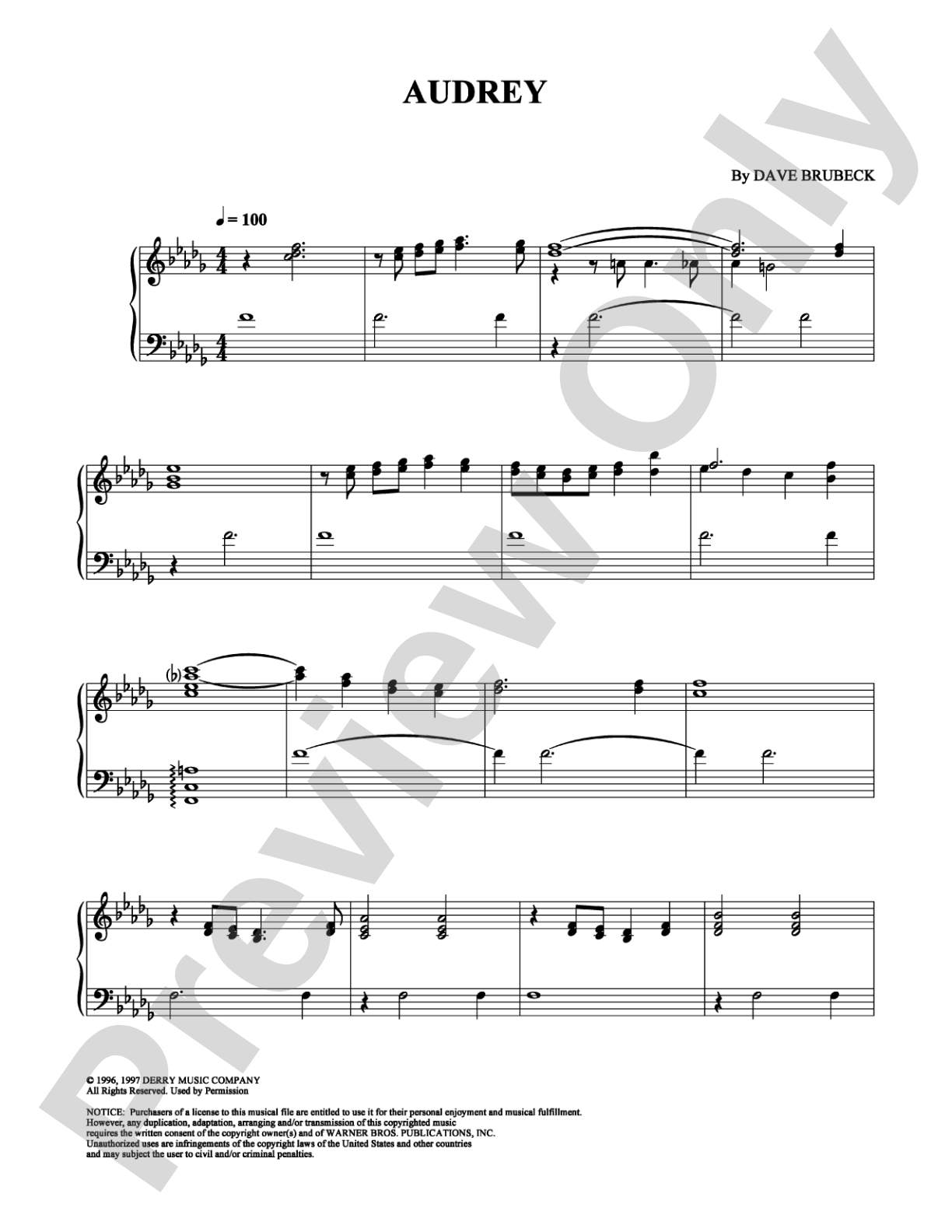
Audrey: Piano Digital Sheet Music

Audrey: Piano Digital Sheet Music

Dave Brubeck

Item: 00-PS-0001312

Digital Download
$3.99
Description

Audrey: Piano Digital Sheet Music isn't in MakeMusic Cloud just yet...but it could be. Let us know you'd like to see it, and you'll help shape what comes next. In the meantime, start a free trial and dive into thousands of interactive titles your students can play along with today.

Sample Audio
No sample audio found.
Sample Video
Additional Details
SKU: 00-PS-0001312

More about this title

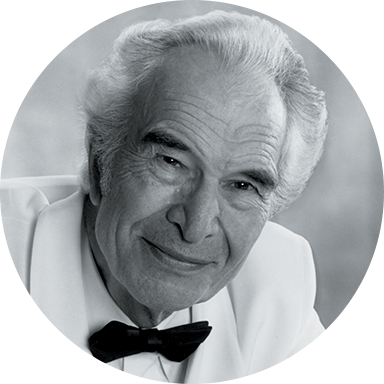
About the Artist: Dave Brubeck

Dave Brubeck

Dave Brubeck stands as one of jazz's most consequential figures, a pianist whose improvisational command shaped the language of modern jazz. Beyond his work as a performer, he composed prolifically across genres: classical orchestral works, choral pieces, chamber music, ballet suites, and solo works for piano, violin, and voice. His study with French composer Darius Milhaud at Mills College after World War II proved formative; Milhaud encouraged him to fuse jazz idiom with classical structure, a synthesis that defined Brubeck's artistic identity.

His album "Time Out" became the first jazz recording to sell over a million copies, and "Take Five" achieved iconic status in popular culture. Beyond music, Brubeck was a pioneering figure in breaking racial barriers during the mid-twentieth century. His sacred works, including the mass "To Hope!" and oratorios such as "The Voice of the Holy Spirit" and "Beloved Son," have been recorded by major orchestras and performed internationally. He received the Presidential Medal of the Arts, a Grammy Lifetime Achievement Award, and was honored by the London Symphony Orchestra with a lifetime achievement award in 2007.

Why we love this

Brubeck's solo piano writing captures the essence of his improvisational genius while remaining fully notated and reproducible. This piece gives pianists direct access to his sophisticated harmonic language and rhythmic sensibility without requiring the interpretive guesswork that often comes with jazz standards.

What to expect

Audrey moves with the thoughtful sophistication of a composer reflecting on melody and harmony. The piece unfolds with Brubeck's characteristic clarity, balancing cerebral harmonic movement with emotional warmth, inviting the pianist into a conversation between structure and spontaneity.

Who it's for

Advanced pianists seeking to deepen their understanding of jazz composition through the work of a master. This piece rewards players who can read and execute complex harmonies while bringing interpretive sensitivity and rhythmic flexibility to a fully notated score.

How to get the most out of it

  • Treat the notated melody and changes as a springboard, not a ceiling. Brubeck's notation reflects his composed intentions, but jazz phrasing demands rubato and expressive timing within the harmonic framework.
  • Listen closely to recordings of Brubeck's own performances to absorb his touch at the keyboard, particularly his approach to dynamics and sustain pedal. His comping style and solo vocabulary offer invaluable models for interpretation.
  • Pay attention to chord voicings and inversions. Brubeck's harmonic sophistication lies partly in how he voices changes, and maintaining those specific voicings preserves the color and intent of the composition.
  • Balance accuracy with freedom in rhythmic interpretation. Brubeck's written rhythms are precise, yet his recorded performances often subtle swing the eighth notes and phrase across bar lines in ways notation cannot fully capture.

How to use it

Include this in a recital or concert that highlights jazz composition and piano artistry. Pair it with other twentieth-century classical piano works or jazz standards to create a program that bridges concert tradition and jazz innovation, or feature it alongside other Brubeck pieces to celebrate a single composer's range.

Skills your students will build

  • Interpreting jazz notation and harmonic changes
  • Reading complex chord voicings and extensions
  • Balancing composed precision with improvisational expression
  • Developing touch and sustain pedal control for sophisticated harmonic movement

You May Also Like