
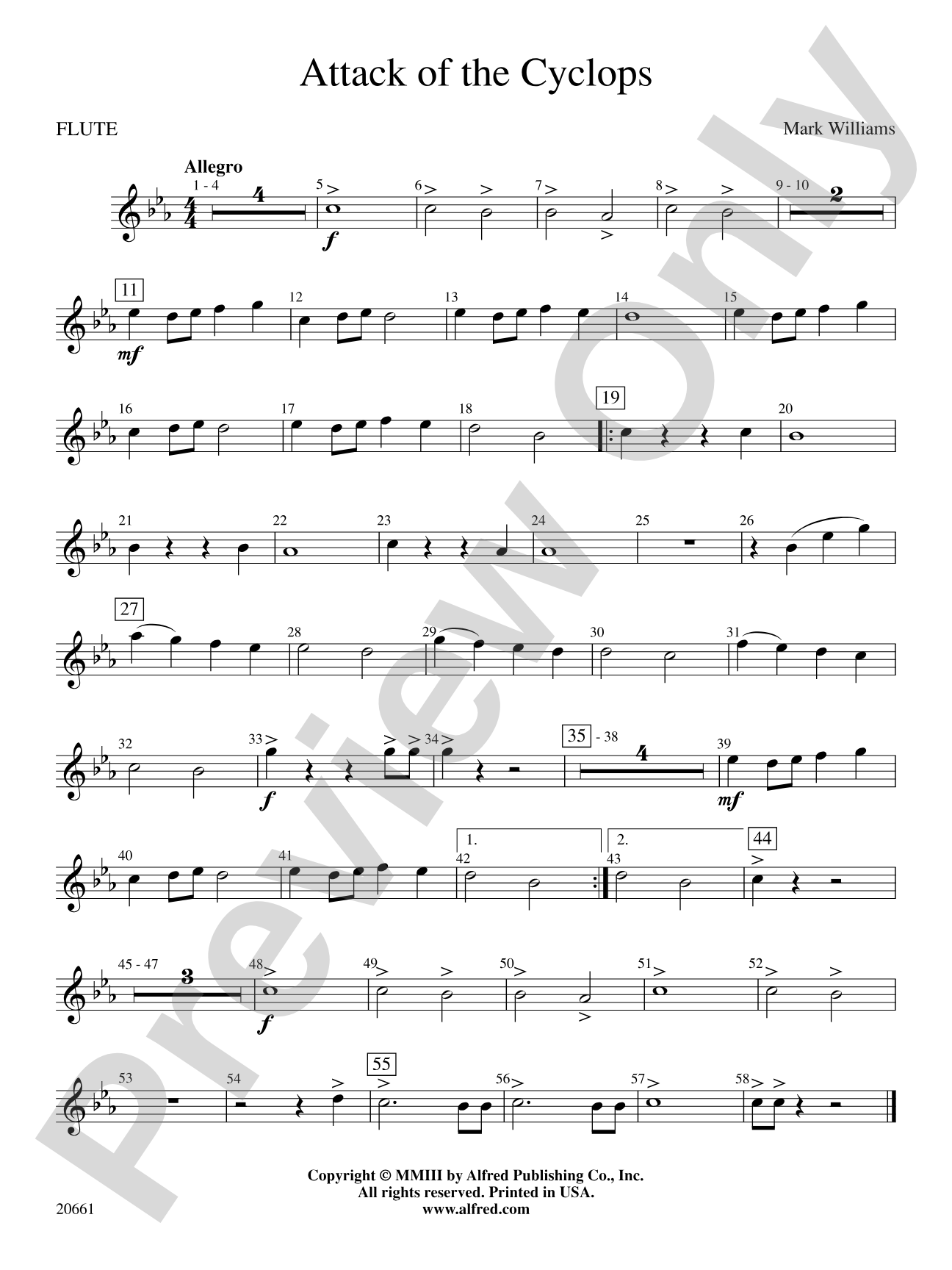

Attack of the Cyclops: Flute
By Mark Williams
Grade: 1 (Very Easy)
Item: 00-PC-0000422_F1
$3.00
Pickup currently not available
Description
The driving, accented rhythms of this exciting work are sure to energize and motivate your beginning band students. Depicting an ancient attack by the legendary one-eyed monster, this piece is a sonic powerhouse for the young band. Correlated with Accent on Achievement, Book 1, page 19. This title is available in MakeMusic Cloud.


Don't just read it, hear it, play along with it, and watch your students grow with it. In MakeMusic Cloud, Attack of the Cyclops: Flute comes alive with professional accompaniment, adjustable tempo, and built-in practice tools that turn solo practice into real progress.
Open in the Player
Jump straight in and assign it today.
Start Your Free Trial
Open this title and explore the full library in minutes.
Sample Audio
1
Audio File
--:--
0:00
0:00
Sample Video
Additional Details
Series:
Accent on Achievement
Publisher:
Alfred Music
Page Count:
124
SKU:
00-PC-0000422_F1
More about this title
About the Composer: Mark Williams

Mark Williams shaped instrumental music education through both his prolific compositional output and his foundational work as co-author of the Accent on Achievement Band Method. His catalog of over 200 published works reflects decades spent understanding what young musicians need to play, learn, and grow. Williams taught elementary band in Washington schools for many years while simultaneously establishing himself as a sought-after clinician and guest conductor across North America and Australia.
Beyond the classroom, Williams brought diverse musical perspectives to his work as a woodwind performer and arranger for the 560th Air Force Band and as conductor and artistic director for the Spokane British Brass Band. His contributions earned recognition including the Western International Band Clinic's Gralia Competition and multiple ASCAP Special Awards. A graduate of Eastern Washington University with degrees in music education, Williams understood the connection between accessible, engaging repertoire and student musicianship.
Why we love this
Attack of the Cyclops delivers immediate energy without requiring advanced technique or complex musicianship from your young players. The piece's narrative clarity and driving accented rhythms grab students' attention while the Grade 1 accessibility means your entire section can participate meaningfully from day one. For beginning bands seeking concert-ready material with genuine character, this novelty title proves you don't need sophistication to create something memorable.
What to expect
The piece evokes cinematic action with its relentless, pounding rhythms and accented figures that paint the image of an ancient monster on the attack. Driving energy pulses through every phrase, creating a sonic landscape that feels powerful and dramatic while remaining playful in its novelty treatment.
Who it's for
Beginning concert band students and their directors looking for engaging, Halloween-themed repertoire that builds rhythmic confidence and ensemble articulation. This piece works especially well for young musicians in their first or second year of band, when grade-appropriate material with genuine musical character remains limited.
How to get the most out of it
- Keep the accented figures crisp and uniform across the band; inconsistent attacks blur the rhythmic impact that makes this piece work.
- Let the tempo breathe naturally rather than rushing; young players often tighten up in excitement, and a steady pulse prevents the piece from becoming chaotic.
- Balance the parts so the primary melodic material stands out clearly; supporting voices should provide rhythmic foundation without overwhelming the main line.
How to use it
Program this as an October or November concert opener to establish immediate audience engagement and demonstrate your young ensemble's rhythmic precision. Pair it with contrasting material (a lyrical ballad or traditional march) to showcase your band's range within a single concert.
Skills your students will build
- Articulation clarity and dynamic accent control
- Rhythmic precision in unison passages
- Listening to the ensemble pulse while maintaining individual part integrity
- Sight-reading within a limited range and simple harmonic framework