
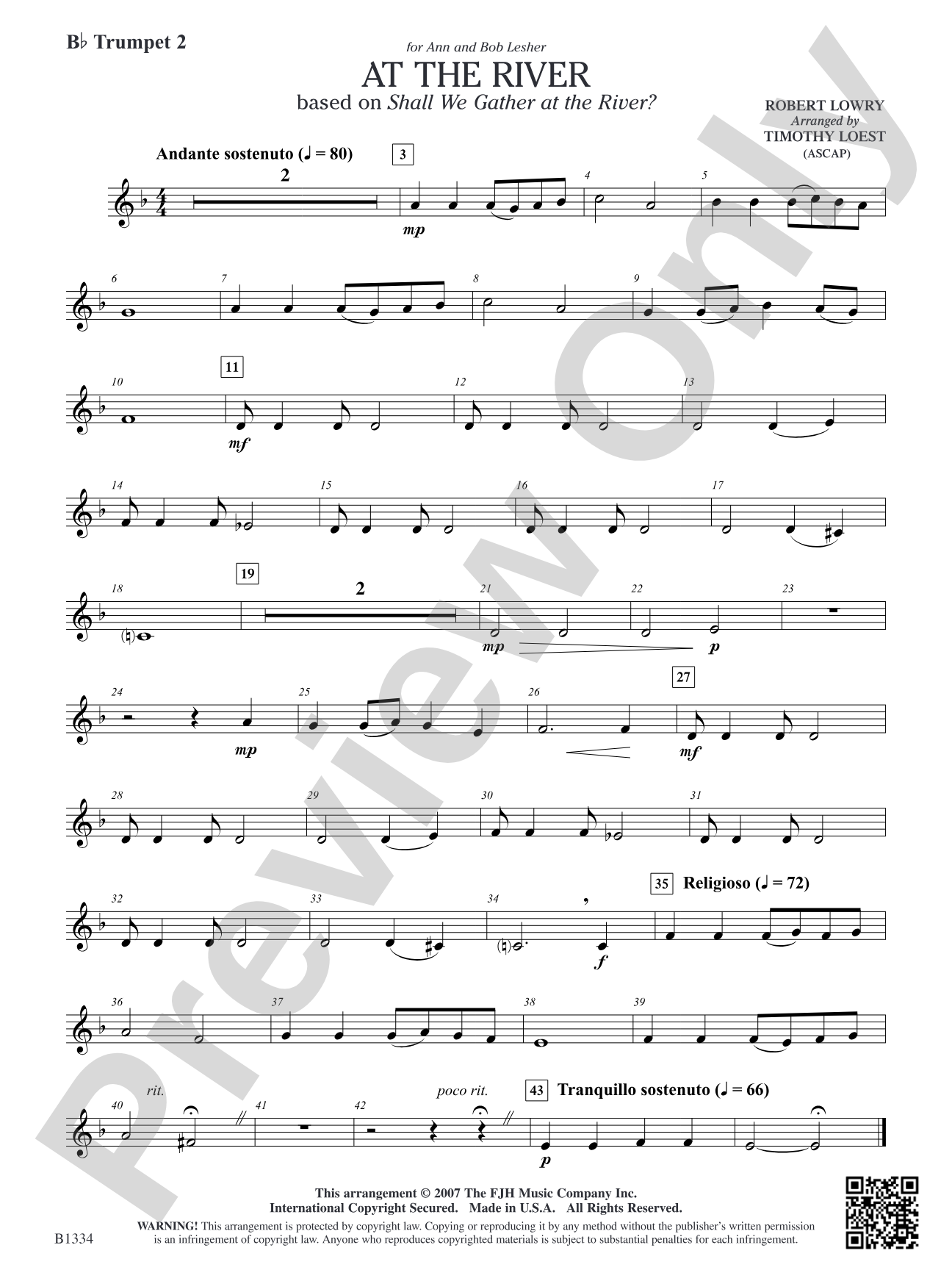

At the River: B-flat Trumpet 2
Arranged by Timothy Loest
Grade: 1.5
Item: 98-PC-DB1334_T2
$7.00
Pickup currently not available
Description
Based on the gospel hymn Shall We Gather at the River? by American hymn writer Robert Lowry, this arrangement includes lush harmonic writing with optional drum set. A great study in musicianship, the work includes many changes in texture and dynamic contrast, and is a wonderful change of pace for your next program.


At the River: B-flat Trumpet 2 isn't in MakeMusic Cloud just yet...but it could be. Let us know you'd like to see it, and you'll help shape what comes next. In the meantime, start a free trial and dive into thousands of interactive titles your students can play along with today.
Request This Title
Tell us you want it.
Start Your Free Trial
Explore everything that's ready to play right now.
Sample Audio
1
Audio File
--:--
0:00
0:00
Sample Video
No sample videos found.
Additional Details
Series:
FJH Developing Band
Publisher:
The FJH Music Company, Inc.
SKU:
98-PC-DB1334_T2
More about this title
About the Composer: Timothy Loest

Timothy Loest has shaped instrumental music education through three decades of classroom teaching combined with prolific composition and arrangement. His works for young band are performed internationally, and his pedagogical influence extends through widely adopted methods like Measures of Success and Warm-ups and Beyond. In 2017, one of his compositions reached over 5,000 listeners at Chicago's Millennium Park, and that same year he received the Illinois Grade School Music Association's Cloyd Myers Memorial Award for Excellence in Music Education.
Since his first publication in 1995, Loest has written for major publishers including Warner Bros. Publications, C.L. Barnhouse Company, FJH Music Company, and MakeMusic Publications. His music has appeared on network television programs including The Tonight Show Starring Jimmy Fallon and Good Morning America. In 2022, he founded Fanfare Music Press to publish band compositions and arrangements at the highest standard. Loest holds degrees from Illinois State University and Northwestern University, is an ASCAP member, and regularly accepts commissions for band.
Why we love this
Loest transforms a beloved hymn into a Grade 1.5 arrangement that sounds considerably more sophisticated than its technical demands suggest. The lush harmonic writing and deliberate texture changes give young musicians material worth performing seriously, while the optional drum set part allows you to adjust the instrumentation to match your ensemble's strengths.
What to expect
The familiar hymn tune emerges through warm, layered harmonies that feel both reverent and contemporary. Dynamic shifts create breathing room and invite genuine expression from young musicians, while the flexible instrumentation means the sound remains balanced whether you use full forces or adapt to your ensemble.
Who it's for
This arrangement serves developing concert bands ready to engage with harmonic sophistication and stylistic depth. It works equally well for mid-year programming when students have gained foundational skills or as a confidence-building encore that demonstrates how much musicianship matters at every level.
How to get the most out of it
- Attend carefully to the dynamic contrasts throughout. What might seem like subtle shifts in the score become the primary vehicle for musicality at this level; these moments shape the listener's journey through the arrangement.
- Bring out the harmonic movement in the inner voices during the softer passages. At Grade 1.5, students often focus on the melody line, so sectional rehearsals that isolate inner parts will deepen the ensemble's awareness of Loest's lush writing.
- Balance the optional drum set part so it enriches rather than overwhelms the band texture. If you include percussion, frame it as a choice that changes the character, not something that drowns out the wind instruments.
How to use it
Program this as a change-of-pace piece that honors the emotional weight of gospel hymn tradition while keeping technical demands accessible. The concert band format makes it suitable for community performances, holiday programs, or spring concerts where you want to showcase musicianship alongside technical achievement.
Skills your students will build
- Responding to dynamic shape and textural contrast
- Balancing harmonic voices across the ensemble
- Performing hymn-based music with appropriate stylistic awareness
- Reading and executing optional instrumentation choices