
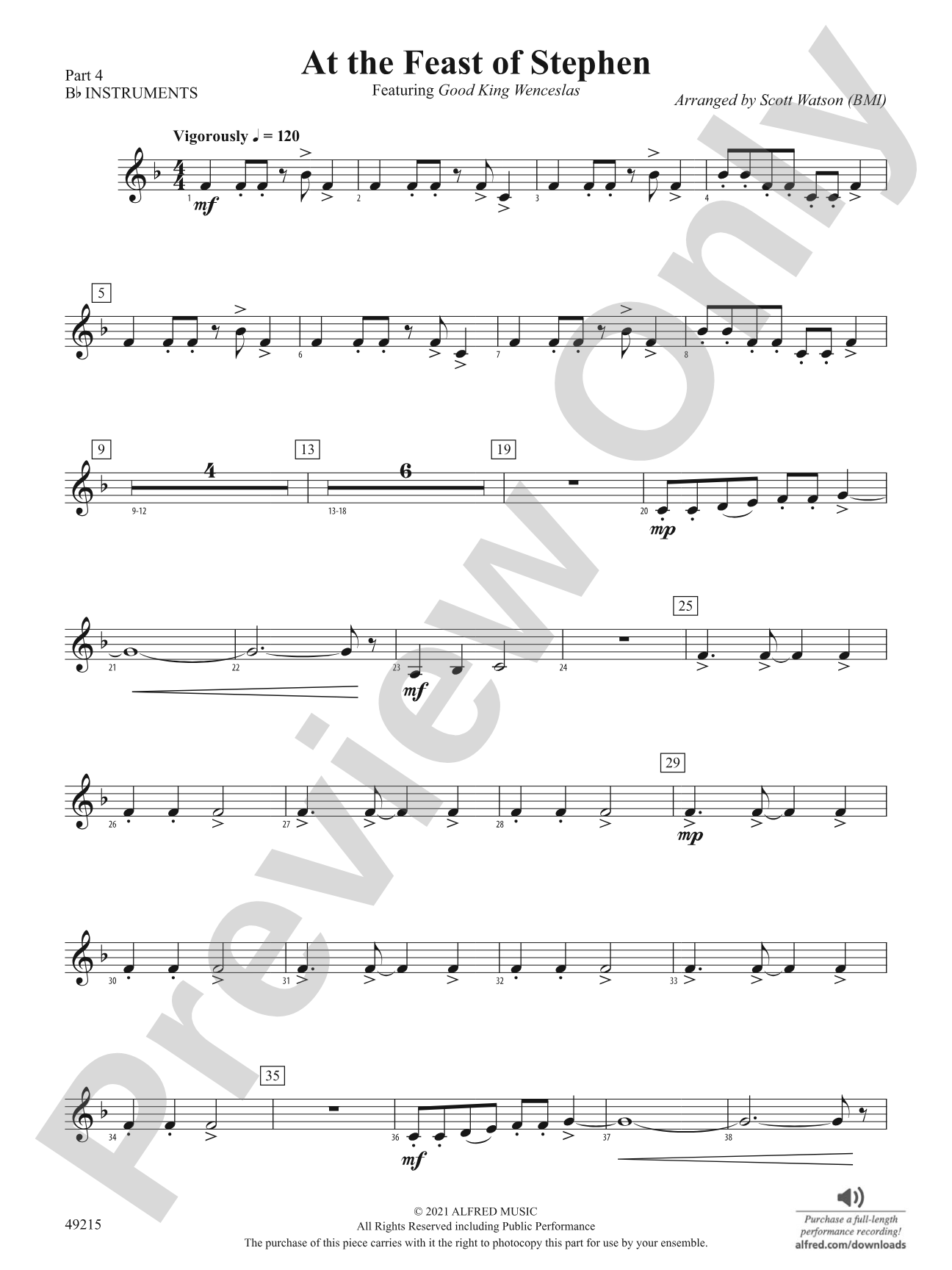

At the Feast of Stephen: Part 4 - B-flat Instruments
Featuring Good King Wenceslas
Arr. Scott Watson
Grade: 1 (Very Easy)
Item: 00-PC-0018756_PART4_BFLAT
$3.00
Pickup currently not available
Description
This version of At the Feast of Stephen by Scott Watson is part of our Alfred FLEX offerings and is designed with maximum flexibility for use by any mix of instruments---wind, strings, and percussion, including like- or mixed-ensembles with as few as 4 players. The suggested instrumentation and a customizable Teacher Map will help you plan out how to best assign parts to suit your ensemble's needs. The 4-part instrumentation will support balanced instrumentation of the lower voices. It also comes with supplemental parts for maximum flexibility. With the purchase of this piece, permission is granted to photocopy the parts as needed for your ensemble. A percussion accompaniment track is also available as a free download. String parts have been carefully edited with extra fingerings and appropriate bowings to support students in mixed ensembles playing in less familiar keys.
This novel setting of the traditional carol Good King Wenceslas will musically transport you and your students to the royal Christmas banquet hall of a medieval king! The old carol tells the story of a legendary 10th-century monarch, Duke Wenceslas of Bohemia, who went out in the severe cold to give charity to the poor on December 26, also known as St. Stephen's Day. The well-known 13th-century tune, as well as additional original material in period style, vividly conjures a lively celebration of Christmas in the high Middle Ages.
Come now ye lords and ladies to the Feast of Stephen and upon your instruments faire make most merry this Yuletide!
Percussion Accompaniment Track Downloads:
with click
without click. (2:30)


This novel setting of the traditional carol Good King Wenceslas will musically transport you and your students to the royal Christmas banquet hall of a medieval king! The old carol tells the story of a legendary 10th-century monarch, Duke Wenceslas of Bohemia, who went out in the severe cold to give charity to the poor on December 26, also known as St. Stephen's Day. The well-known 13th-century tune, as well as additional original material in period style, vividly conjures a lively celebration of Christmas in the high Middle Ages.
Come now ye lords and ladies to the Feast of Stephen and upon your instruments faire make most merry this Yuletide!
Percussion Accompaniment Track Downloads:
with click
without click. (2:30)
Don't just read it, hear it, play along with it, and watch your students grow with it. In MakeMusic Cloud, At the Feast of Stephen: Part 4 - B-flat Instruments comes alive with professional accompaniment, adjustable tempo, and built-in practice tools that turn solo practice into real progress.
Open in the Player
Jump straight in and assign it today.
Start Your Free Trial
Open this title and explore the full library in minutes.
Sample Audio
1
Audio File
--:--
0:00
0:00
Sample Video
No sample videos found.
Additional Details
Series:
Alfred Debut Series
Publisher:
Alfred Music
SKU:
00-PC-0018756_PART4_BFLAT
More about this title
About the Arranger: Scott Watson

Scott Watson has spent four decades shaping young musicians as both a classroom teacher and university instructor. His 35 years leading instrumental programs in the Parkland School District (Allentown, PA) gave him deep insight into what works in real ensembles, from elementary band beginnings through advanced high school groups. Now serving as Associate Professor of Music at Cairn University in Langhorne, Pennsylvania, he brings that classroom experience into his compositional voice.
With more than 120 published works across concert band, string orchestra, and chamber settings, Watson writes music that speaks equally to contemporary art music sensibilities and the practical needs of school musicians. His commissions and performances have reached stages including the Academy of Music in Philadelphia, the Midwest Clinic in Chicago, and the White House. He is an exclusive composer and clinician for Alfred Publications, contributes to their Sound Innovations series, and authored the influential text Using Technology to Unlock Musical Creativity (Oxford University Press, 2011). His work reflects a rare combination of compositional ambition and pedagogical clarity.
Why we love this
Watson's flexible instrumentation approach means you can actually assign parts based on who shows up that day, not the other way around. The Teacher Map removes the guesswork from mixed ensembles, and the extra string fingerings and bowings acknowledge that wind and string players inhabit different pedagogical worlds. Most importantly, this medieval feast setting transforms a familiar carol into something your students have never heard before, making it feel like a discovery rather than a repertoire obligation.
What to expect
You enter a medieval great hall where torches flicker and nobles gather for feast. The familiar carol arrives not as a bare melody but woven through period textures that evoke lutes and distant trumpets. Rhythmic vitality and harmonic warmth build toward celebration, creating music that feels both historically grounded and joyfully immediate.
Who it's for
Directors leading ensembles with mixed instrumentation and uncertain lineup stability will find this score invaluable. Beginning band and string students who are ready for something beyond unison pieces benefit from the carefully scaffolded harmonies and accessible ranges. This works equally well for homogeneous ensembles (all winds or all strings) that want a holiday showpiece with genuine musical substance.
How to get the most out of it
- Balance the lower voices carefully during tuttis; the 4-part structure creates room for 5th and 6th players to double lower lines, so use your accompaniment track to anchor ensemble blend.
- Bring out the period-style material that sits alongside the Good King Wenceslas tune; these original passages define the banquet atmosphere and deserve clarity in rehearsal.
- Assign string parts strategically to students comfortable with less familiar keys; Watson's additional fingering guidance is there for exactly this purpose, so point it out in early rehearsals.
- Lean into the narrative arc as it unfolds; the shift from charity and cold to the warmth of celebration should be audible in your ensemble's sound.
How to use it
Program this in the second half of a winter concert as a thematic bridge between traditional carols and contemporary holiday pops. It serves equally well as a standalone December performance piece for any mixed ensemble, or as the anchor of a themed concert exploring medieval music. The modest 10-minute duration and straightforward conducting make it ideal for younger ensembles and school assembly performances where you need musical credibility without technical overwhelm.
Skills your students will build
- Reading parts in less familiar keys with the aid of edited fingerings and bowings
- Ensemble balance and blend in mixed instrumentation contexts
- Flexible part assignment and adaptive rehearsal planning
- Performing period-style original material alongside recognizable melodic content
- Coordinating rhythm and phrasing across wind and string instruments