
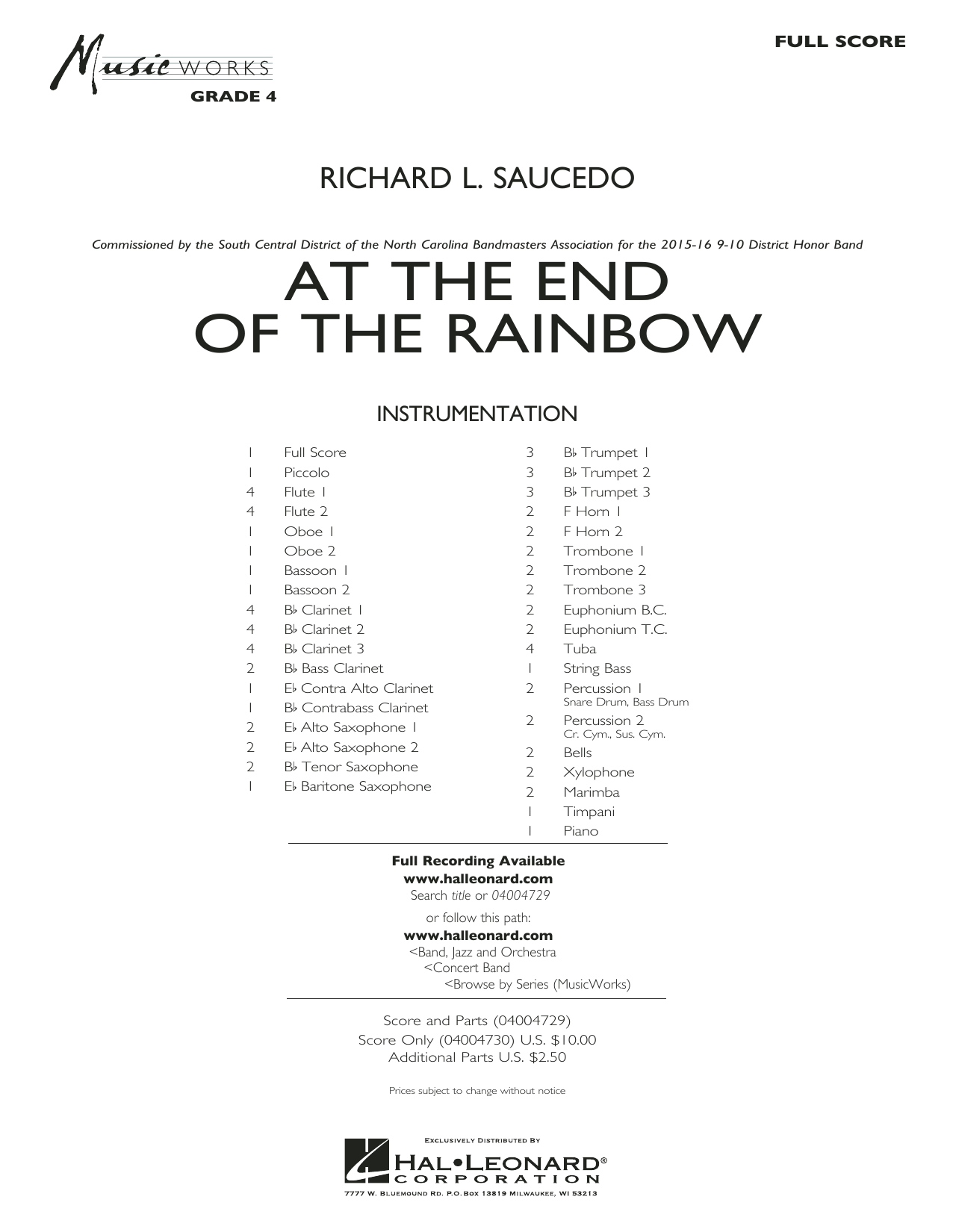

At the End of the Rainbow: Concert Band Conductor Score & Parts
By Richard L. Saucedo
Grade: 4
Item: 35-PK00334808
$85.00
Pickup currently not available
Buy Extra Parts (Digital PDF Download)
Parts Added to Cart!
Description
With a title that refers to the ongoing quest in which we all embark when trying to find our place in the world, Richard Saucedo's "At the End of the Rainbow" takes us on a journey of varied moods and styles. After the stark and dramatic opening unison statements, this imaginative works features a lighthearted and spirited 12/8 section with plenty of rhythmic vitality. This is beautifully paired with a lyric middle section that showcases a solo for horn and flowing melodic lines that build to an emotional climax. The fast 12/8 section returns with an exciting and energized finish. Dur: 4:10


At the End of the Rainbow: Concert Band Conductor Score & Parts isn't in MakeMusic Cloud just yet...but it could be. Let us know you'd like to see it, and you'll help shape what comes next. In the meantime, start a free trial and dive into thousands of interactive titles your students can play along with today.
Request This Title
Tell us you want it.
Start Your Free Trial
Explore everything that's ready to play right now.
Sample Audio
No sample audio found.
Sample Video
No sample videos found.
Additional Details
Publisher:
Hal Leonard
SKU:
35-PK00334808
More about this title
About the Composer: Richard L. Saucedo

Richard L. Saucedo spent 31 years as Director of Bands and Chairman of the Performing Arts Department at Carmel High School in Indiana, building one of the nation's most consistently successful band programs. His tenure produced multiple state champions, three appearances at the Music for All National Concert Band Festival, and a marching band that claimed top-ten finishes at the Bands of America Grand National Championship for 17 consecutive years, winning national titles in 2005 and 2012.
Beyond the high school podium, Saucedo has shaped the broader landscape of competitive music. He served as Brass Arranger and Composer for the Cavaliers Drum and Bugle Corps, contributing to five DCI world championships, and now coordinates music ensembles for the Blue Devils. His honors include Indiana Bandmaster of the Year (1998-99), induction into the Music for All Hall of Fame (2015) and Drum Corps International Hall of Fame (2022), and membership in the American Bandmasters Association. As a freelance composer and arranger, he continues creating works across genres: marching bands, concert bands, choral music, and orchestral settings.
Why we love this
Saucedo writes for ensemble energy without sacrificing musical substance. The piece moves through distinct emotional territories—unison drama, playful rhythmic drive in 12/8, a tender horn solo, and a climactic build—giving every section of your band something rewarding to execute and letting students experience how contrast and pacing create lasting impressions.
What to expect
A journey that mirrors the piece's own title. You begin in stark, contemplative terrain, then break into spirited, rhythmically alive movement before being drawn into a quieter, introspective moment with delicate beauty. The final return charges forward with confidence and resolution, leaving your ensemble and audience with a sense of arrival.
Who it's for
Grade 4 bands ready to balance technical demands with expressive storytelling. The varied moods and instrumentation requirements make this ideal for ensembles that want to showcase range and maturity without overreaching into Grade 5 complexity.
How to get the most out of it
- Establish the dramatic opening unison as a moment of absolute focus. Tightness and clarity here set the tone for everything that follows and grab the audience immediately.
- Keep the 12/8 section buoyant and forward-moving. The rhythmic vitality comes from precision in subdivision, not from pushing the tempo.
- Feature the horn solo with warmth and allow it breathing room. This moment is the emotional heart; let it land before the ensemble re-enters.
- Build the climactic passage with gradual intensity rather than a sudden jump. Shape the dynamics and texture so the return of the fast 12/8 feels earned and propulsive.
How to use it
This works beautifully as a concert opener that establishes mood and sophistication from the first notes, or as a centerpiece that showcases your band's versatility within a single work. At just over four minutes, it fits efficiently into festival schedules while giving adjudicators something substantive to evaluate.
Skills your students will build
- Contrast between unison textures and layered harmonic writing
- Control of 12/8 meter and rhythmic precision at tempo
- Dynamic shaping and phrasing across extended melodic lines
- Ensemble balance when supporting a solo line
- Gradual crescendo and climactic building techniques