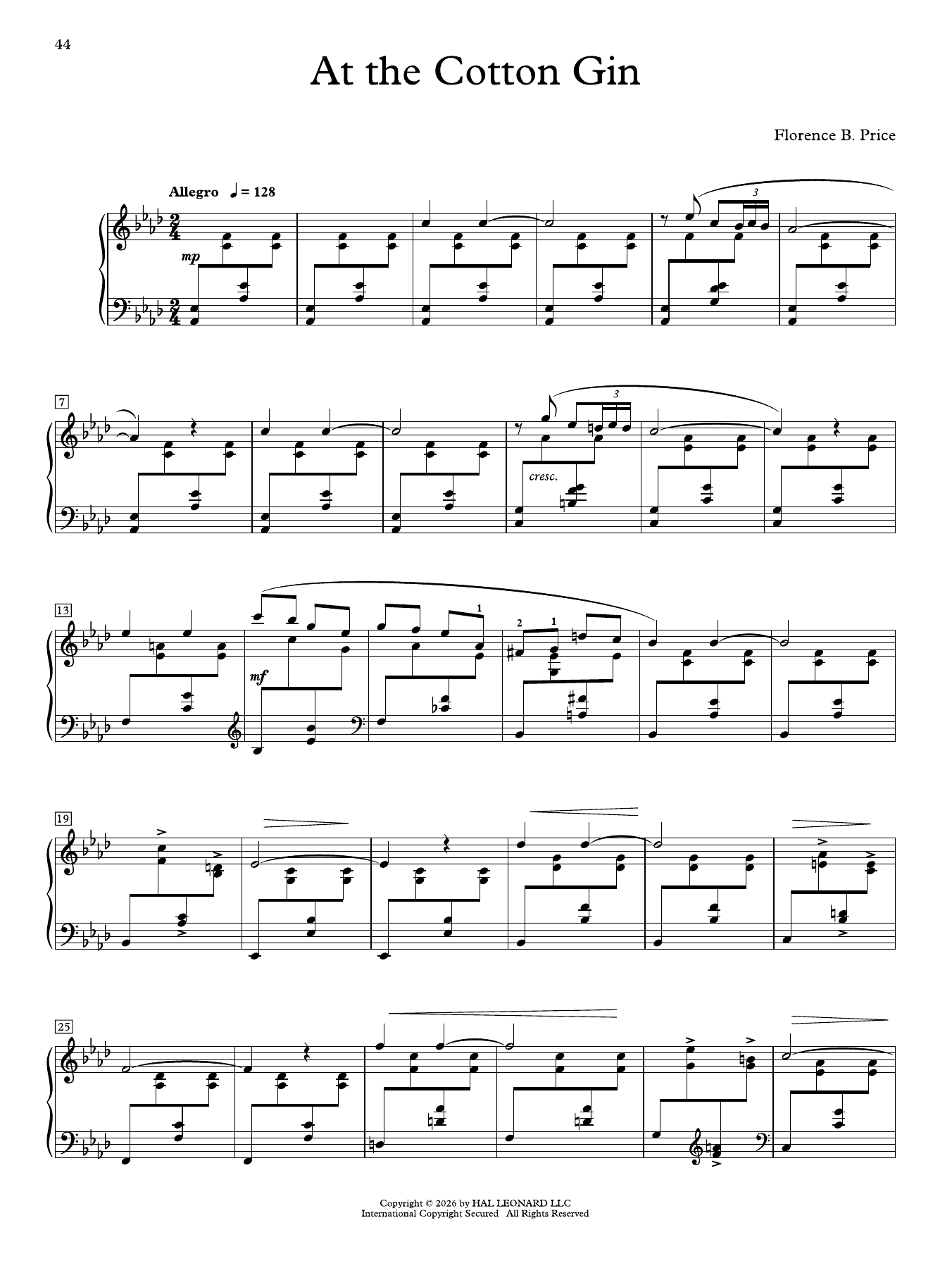
At The Cotton Gin Sheet Music Preview

At The Cotton Gin: Educational Piano

As performed by Florence Price

Item: 35-DS01838569

Digital Download
$4.99
Description

Discover MakeMusic Cloud: thousands of interactive titles your students can play along with today.

Sample Audio
No sample audio found.
Sample Video
Additional Details
Publisher: Hal Leonard
Page Count: 4
SKU: 35-DS01838569

More about this title

About the Artist: Florence Price

Florence Price (1887-1953) was the first African American woman to have a symphony performed by a major orchestra. A prolific composer working across orchestral, chamber, and solo piano genres, Price drew deeply from spirituals, folk melodies, and the musical traditions of the American South. Her piano works combine classical training with vernacular idioms, creating pieces that are both technically accessible and culturally resonant.

Why we love this

Price's piano works occupy a rare pedagogical space: they're genuinely rewarding to play while opening doors to American musical history and Black composers' contributions to classical music. This piece gives students substantive repertoire that matters culturally and artistically, not just technically.

What to expect

The piece evokes the rhythmic motion and human labor of the cotton gin while maintaining classical elegance. Price's harmonic language lifts folk material into something both intimate and formally coherent, creating music that is grounded in place and experience.

Who it's for

Intermediate to advanced pianists seeking repertoire that builds technical skills while offering meaningful cultural and historical context. Teachers looking to diversify concert programs and students interested in American composers and vernacular musical traditions.

How to get the most out of it

  • Honor the rhythmic character by feeling the implied pulse of the cotton gin's mechanical motion; this isn't floating or impressionistic but grounded and propulsive.
  • Balance clarity in the accompaniment pattern with a singing melodic line; the work's effectiveness depends on listeners hearing both layers distinctly.
  • Allow the folk elements to breathe without overselling them; Price's sophisticated harmonic language will do the work if you trust the composition.

How to use it

Program this as part of a concert exploring American regionalism or women composers. It works particularly well alongside other Price piano works or in a set that traces African American musical voices across genres and eras.

Skills your students will build

  • Independent hand coordination between rhythmic accompaniment patterns and melodic lines
  • Balancing tonal colors and dynamic layers within a single instrument
  • Interpreting folk idioms within formal classical structures
  • Clarity and consistency in repetitive figures without mechanical quality

You May Also Like