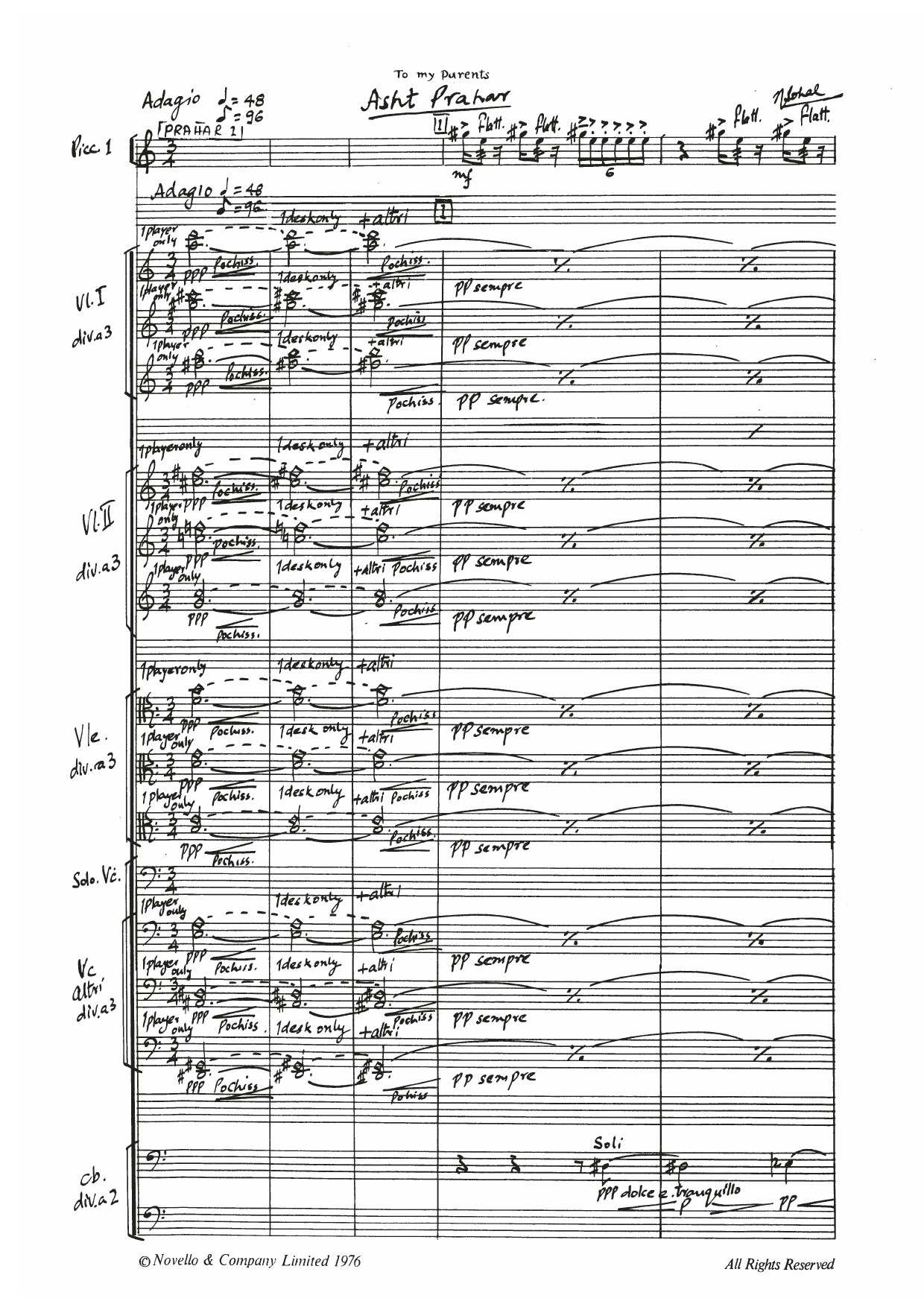
Asht Prahar (study score) Sheet Music Preview

Asht Prahar (study score): Full Orchestra Conductor Score & Parts

By Naresh Sohal

Item: 35-PK01779099

Digital Download
$19.95

Buy Extra Parts (Digital PDF Download)

Product Price Quantity
Asht Prahar (study score) - Study Score $19.95

Parts Added to Cart!

Description
Asht Prahar (study score)

Asht Prahar (study score): Full Orchestra Conductor Score & Parts isn't in MakeMusic Cloud just yet...but it could be. Let us know you'd like to see it, and you'll help shape what comes next. In the meantime, start a free trial and dive into thousands of interactive titles your students can play along with today.

Sample Audio
No sample audio found.
Sample Video
Additional Details
Publisher: Hal Leonard
SKU: 35-PK01779099

More about this title

About the Composer: Naresh Sohal

Naresh Sohal is a British composer of Indian heritage whose orchestral works bridge classical Western traditions with the rich harmonic and rhythmic vocabularies of Indian classical music. His compositions are known for their sophisticated orchestration, lyrical melodic lines, and thoughtful integration of non-Western musical elements into large ensemble contexts. His work appears regularly on concert programs and in educational settings where orchestras seek repertoire that expands cultural perspectives while maintaining technical rigor.

Sohal's approach to composition prizes clarity and accessibility without sacrificing complexity. His scores reward careful study and reveal new layers with each rehearsal, making them valuable teaching tools for conductors developing their interpretive skills.

Why we love this

Asht Prahar offers conductors a sophisticated entry point into culturally expanded orchestral repertoire that sounds rich without requiring the ensemble to master entirely unfamiliar performance techniques. The work balances structural clarity with harmonic color, giving every section meaningful material rather than padding around soloistic passages.

What to expect

Asht Prahar unfolds with meditative spaciousness, allowing individual instrumental timbres to resonate before layering additional colors. The musical landscape feels luminous rather than dense, with moments of introspection balanced by passages of fuller orchestral presence. There is a sense of philosophical reflection woven throughout, reflecting the piece's conceptual grounding.

Who it's for

Conductors leading orchestras at the advanced high school, university, or community ensemble level who want to program beyond the standard Romantic repertoire. This score works for musicians with solid fundamentals and the capacity to engage with less familiar compositional language.

How to get the most out of it

  • Study the interaction between melodic lines and harmonic support; Sohal's orchestration often distributes thematic content across multiple instrumental families rather than concentrating it in obvious places.
  • Attend to the rhythmic independence of different sections. Even in moments that sound unified, individual parts frequently move at slightly different implied meters, requiring precise rehearsal of relative timing.
  • Shape phrases through subtle dynamic gradation rather than dramatic contrast. This piece rewards conductors who think in terms of long arcs and gentle swells rather than obvious architectural contrasts.

How to use it

Consider this work as a centerpiece for a concert exploring global perspectives on orchestral composition, paired with Western and non-Western repertoire from adjacent traditions. Its moderate length and sophisticated but accessible character make it suitable for a major work on a concert that also features shorter pieces or a concerto.

Skills your students will build

  • Balancing transparent orchestration while maintaining ensemble cohesion across complex harmonic writing
  • Responding to non-traditional phrase structures and rhythmic organizations
  • Blending instrumental timbres to create unified sonority across culturally diverse instrumental roles
  • Sustaining attention and forward momentum through lyrical, slower-moving musical architecture

You May Also Like