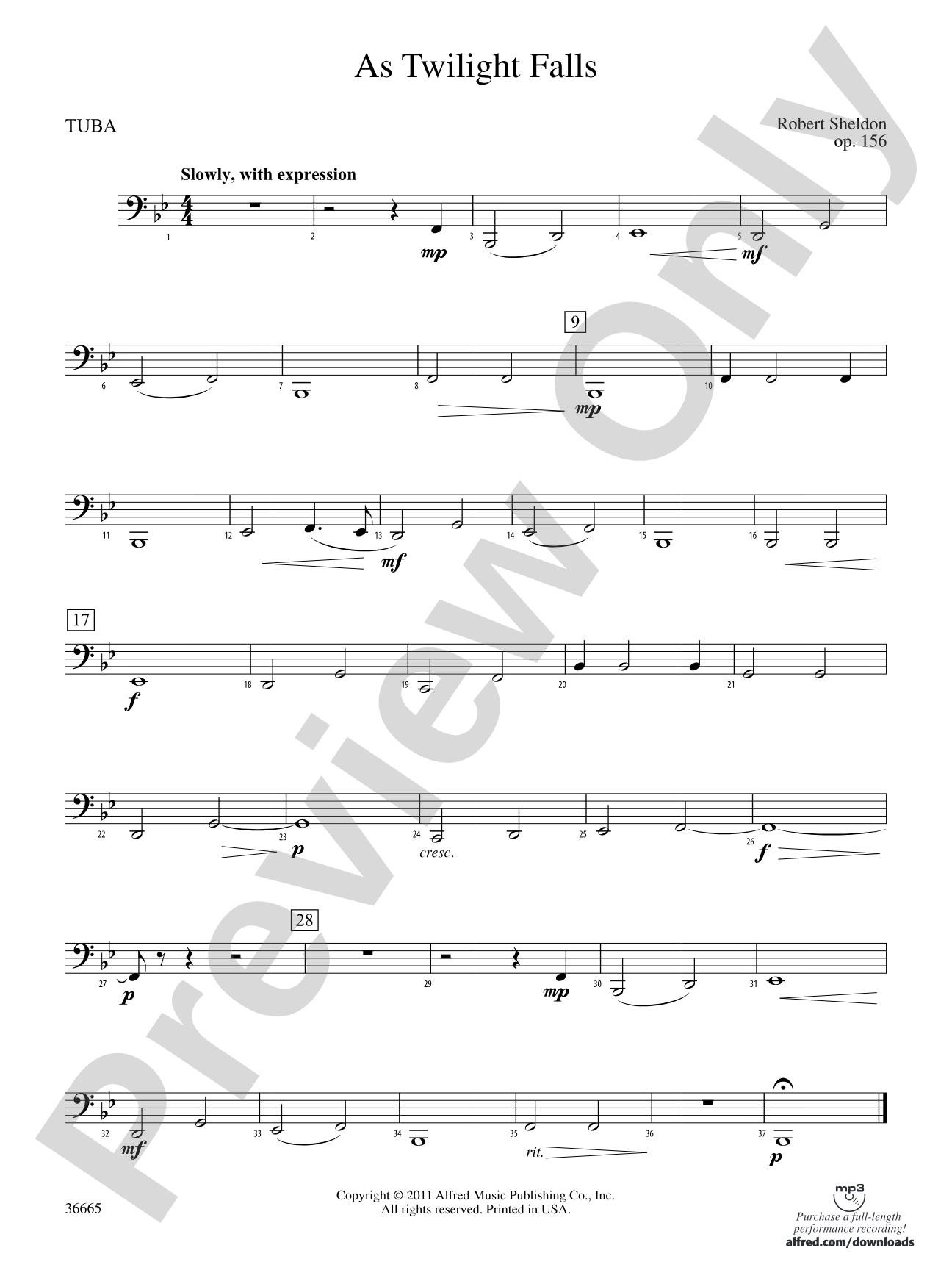
As Twilight Falls: Tuba Sheet Music Preview

As Twilight Falls: Tuba

By Robert Sheldon

Grade: 1 (Very Easy)

Item: 00-PC-0015093_TB1

Digital Download
$3.00
Description
The sense of peace and tranquility of twilight on a summer's evening inspires this lovely, lyrical offering. An excellent teaching opportunity for phrasing and expression, "As Twilight Falls" provides a moment of contrast on any young band's concert performance. (2:08) This title is available in MakeMusic Cloud.

Correlates to Book 1, Level 5 of Sound Innovations for Concert Band. (2:10)

Don't just read it, hear it, play along with it, and watch your students grow with it. In MakeMusic Cloud, As Twilight Falls: Tuba comes alive with professional accompaniment, adjustable tempo, and built-in practice tools that turn solo practice into real progress.

Sample Audio
0:00
0:00
Sample Video
Additional Details
Series: Sound Innovations for Concert Band
Publisher: Alfred Music
Page Count: 140
SKU: 00-PC-0015093_TB1

More about this title

About the Composer: Robert Sheldon

Robert Sheldon

Robert Sheldon's compositions dominate the wind band repertoire internationally. His works are performed constantly across concert halls, festivals, and school stages worldwide, and he holds commissions from ensembles at every level. He authored Sound Innovations for Concert Band, the foundational pedagogical series that structures this piece.

Sheldon's contributions to music education have earned recognition from the American School Band Director's Association, Phi Beta Mu, and ASCAP. His schedule balances guest conducting appearances at All-State and Regional Honor Bands with clinician work at universities and state conferences. He has led performances of his compositions at Carnegie Hall, Orchestra Hall, Boston's Symphony Hall, the Sydney Opera House, and the Kennedy Center, and has guest conducted throughout the United States, Japan, Canada, Italy, Germany, Australia, and China. VanderCook College of Music awarded him an honorary doctorate in 2020.

Why we love this

Sheldon designs this piece with careful attention to what young ensembles actually need to develop musicianship. The lyrical phrasing work embedded here translates directly into stronger playing across your entire repertoire, and the accessible Grade 1 voicing means every section can contribute meaningfully to the musical statement. Programming a piece this brief but sophisticated creates real contrast on concert programs while filling a genuine teaching need.

What to expect

The music captures that specific moment when daylight softens into dusk, with warm harmonic colors and unhurried phrasing that invites the ensemble to play with genuine lyricism. There's nothing flashy here, only the satisfaction of creating something beautiful together through careful attention to tone and line.

Who it's for

Young concert bands at Grade 1 level who are ready to move beyond technical exercises and explore genuine musical expression. This piece works for ensembles that have developed basic ensemble blend and intonation but still need guided instruction in phrasing and dynamic shaping.

How to get the most out of it

  • Shape the opening phrases with a gentle breath between musical ideas; the tranquility depends on players understanding where the melody breathes, not where the measures end.
  • Conduct with purposeful stillness through the sustained passages; excessive gesture can undermine the piece's sense of calm.
  • Balance the upper voices slightly higher than lower voices to let the lyrical content emerge, then pull back during harmonic support passages.
  • Take the full 2:08 duration seriously; rushing destroys the evocative quality of the twilight imagery.

How to use it

Place this as a concert contrast piece after more energetic selections to reset the audience and demonstrate your ensemble's expressive range. Its two-minute duration makes it ideal for a concert closer that leaves a calm, memorable impression, or as the anchor of a thematic program exploring musical imagery and tone painting.

Skills your students will build

  • Shaping lyrical phrases and identifying natural breath points
  • Balancing texture between melodic and harmonic voices
  • Controlling dynamics to create emotional arc within a quiet range
  • Sustaining pitch and tone quality across longer harmonic passages
  • Responding to conductor gestures for nuance rather than just rhythm

You May Also Like