
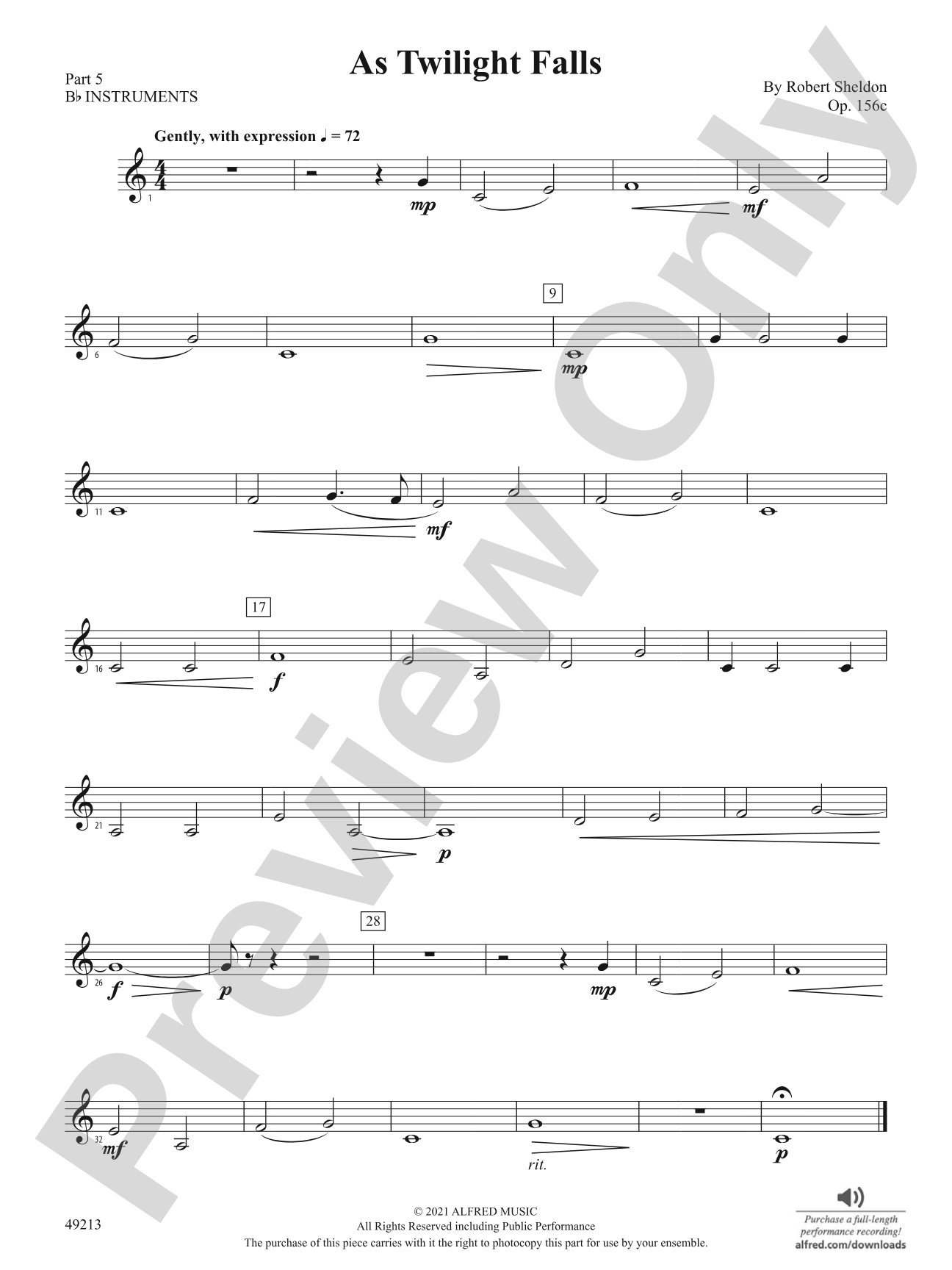

As Twilight Falls: Part 5 - B-flat Instruments
By Robert Sheldon
Grade: 1.5 (Easy)
Item: 00-PC-0018754_PART5_BFLAT
$3.00
Pickup currently not available
Description
This version of As Twilight Falls by Robert Sheldon is part of our Alfred FLEX offerings and is designed with maximum flexibility for use by any mix of instruments---wind, strings, and percussion, including like- or mixed-ensembles with as few as 5 players. The suggested instrumentation and a customizable Teacher Map will help you plan out how to best assign parts to suit your ensemble's needs. It also comes with supplemental parts for maximum flexibility. With the purchase of this piece, permission is granted to photocopy the parts as needed for your ensemble. A percussion accompaniment track is also available as a free download. String parts have been carefully edited with extra fingerings and appropriate bowings to support students in mixed ensembles playing in less familiar keys.
The sense of peace and tranquility of twilight on a summer's evening inspires this lovely, lyrical offering. An excellent teaching opportunity for phrasing and expression, As Twilight Falls provides a moment of contrast at any young band's concert performance and is now available in Alfred's 5-part FLEX format. Correlates to Book 1, Level 5 of Sound Innovations for Concert Band.
Percussion Accompaniment Track Download. (2:10)


The sense of peace and tranquility of twilight on a summer's evening inspires this lovely, lyrical offering. An excellent teaching opportunity for phrasing and expression, As Twilight Falls provides a moment of contrast at any young band's concert performance and is now available in Alfred's 5-part FLEX format. Correlates to Book 1, Level 5 of Sound Innovations for Concert Band.
Percussion Accompaniment Track Download. (2:10)
Don't just read it, hear it, play along with it, and watch your students grow with it. In MakeMusic Cloud, As Twilight Falls: Part 5 - B-flat Instruments comes alive with professional accompaniment, adjustable tempo, and built-in practice tools that turn solo practice into real progress.
Open in the Player
Jump straight in and assign it today.
Start Your Free Trial
Open this title and explore the full library in minutes.
Sample Audio
1
Audio File
--:--
0:00
0:00
Sample Video
Additional Details
Series:
Sound Innovations for Concert Band
Publisher:
Alfred Music
SKU:
00-PC-0018754_PART5_BFLAT
More about this title
About the Composer: Robert Sheldon

Robert Sheldon's compositions occupy a central place in the concert band repertoire, performed by ensembles worldwide and regularly appearing on festival and contest programs. He is the lead author of Sound Innovations for Concert Band and has received recognition from the American School Band Director's Association, Phi Beta Mu, and the American Society of Composers, Authors and Publishers. His work balances musical depth with accessibility, making his pieces valuable teaching tools across all levels.
Sheldon maintains an active schedule as guest conductor for All-State and Regional Honor Bands, clinician at colleges and universities, and presenter at state music education conferences. His commissions and annual publications reflect a prolific output shaped by decades of direct engagement with student and professional ensembles. He has conducted his works at major concert halls including Carnegie Hall, Boston's Symphony Hall, and the Kennedy Center, and received a honorary doctorate from VanderCook College of Music in 2020.
Why we love this
This flexible instrumentation version removes the guesswork from mixed-instrument programming. The Teacher Map and supplemental parts mean you can assign music thoughtfully to your exact roster without doubling or cutting on the fly, and the careful string editing with fingerings and bowings makes this accessible even when strings are new to a piece written for winds.
What to expect
A quiet, introspective moment that captures the stillness of summer dusk. The writing is lyrical and unhurried, with transparent textures that invite listeners to settle into the gentle harmonic movement and soft-focus melodies typical of Sheldon's more reflective works.
Who it's for
Young concert bands and mixed ensembles with flexible instrumentation needs, particularly groups working from Sound Innovations for Concert Band. This piece works equally well for small ensembles with five players or larger groups, making it practical for schools with variable attendance, multi-level rehearsals, or programs blending winds and strings.
How to get the most out of it
- Lean into the sustained, open texture by giving the ensemble time to breathe at phrase endings; this piece rewards patience and silence as much as sound.
- Balance the top melodic line across your instrumentation since it may shift between instruments depending on your assignment choices; mark cues clearly so no one loses the primary voice.
- Use the free percussion accompaniment track in rehearsal to anchor the ensemble's sense of space and pacing, then pull it for performances to let your students own the harmonic foundation.
- Pay close attention to the bowings and fingerings provided, especially in keys less familiar to your string players; these markings support consistency and tone quality across the mixed ensemble.
How to use it
Program this as a moment of contrast on a concert heavy with faster or louder pieces, or use it to open a second half and reset the room's energy. Its gentle character and modest forces also make it suitable for small ensemble showcases or festivals where you need a piece that sounds polished with young players.
Skills your students will build
- Phrasing and expression in lyrical writing
- Blend and balance across mixed instrumentation
- Reading fingerings and bowings for less familiar keys
- Sustaining tone quality over long, open harmonies
- Listening to and supporting an ensemble's collective sound rather than a solo line