As the Robin to the Meadow: 2nd E-flat Alto Saxophone Sheet Music Preview

As the Robin to the Meadow: 2nd E-flat Alto Saxophone

By Todd Stalter

Grade: 2 (Medium Easy)

Item: 00-PC-0000651_AX2

Digital Download
$3.00
Description
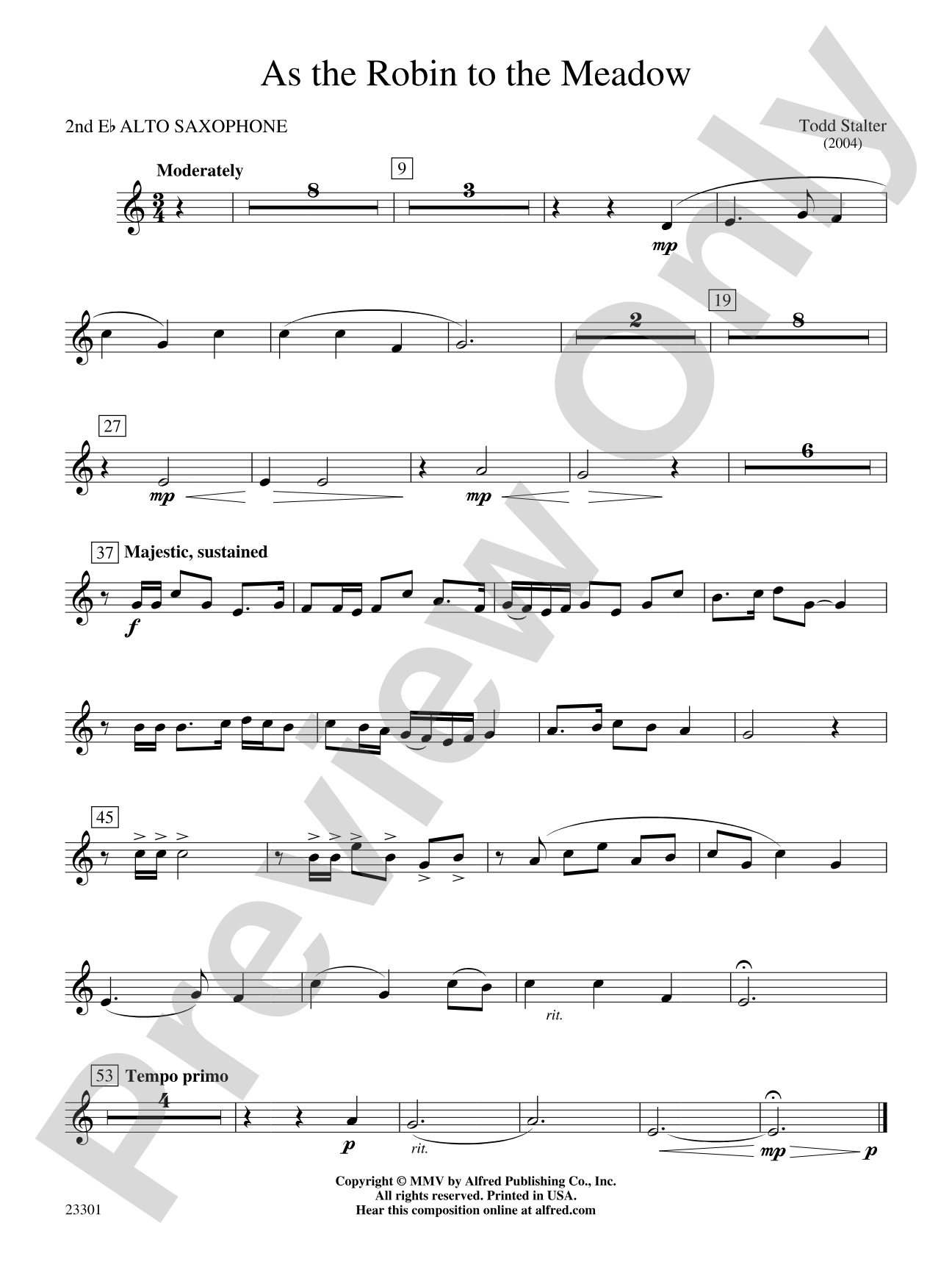
As the Robin to the Meadow was inspired by the composer's love of British folk song settings. The flowing melody and modal harmonic elements set a pastoral mood, calling to mind the enjoyment of a beautiful spring day in the country. Breathtaking! This title is available in MakeMusic Cloud.

Don't just read it, hear it, play along with it, and watch your students grow with it. In MakeMusic Cloud, As the Robin to the Meadow: 2nd E-flat Alto Saxophone comes alive with professional accompaniment, adjustable tempo, and built-in practice tools that turn solo practice into real progress.

Sample Audio
0:00
0:00
Sample Video
Additional Details
Series: Young Symphonic
Publisher: Alfred Music
Page Count: 126
SKU: 00-PC-0000651_AX2

More about this title

About the Composer: Todd Stalter

Todd Stalter

Todd Stalter built a legendary 34-year tenure as Director of Bands at Eureka High School in Illinois, where his ensembles earned 16 state marching championships, consistent superior ratings at IHSA contests, and invitations to perform at Orchestra Hall in Chicago and Walt Disney World. His work as a conductor extends beyond the classroom: he has led All-State Bands in Georgia and Delaware, guest conducted regional honor bands, and maintains an active schedule as an adjudicator and clinician across multiple states.

Staiker holds degrees from Illinois State University, including a Bachelor of Music Education (cum laude) and a Master of Music in Trumpet Performance. His compositions for band and string orchestra are performed nationally and appear on state festival and contest lists throughout the United States. Several of his band works are featured in the "Teaching Music Through Performance in Band" series published by GIA, a standard reference for music educators.

Why we love this

This piece captures the essential appeal of Grade 2 writing: it is musically satisfying without overwhelming younger ensembles. The pastoral British folk idiom gives conductors something genuinely expressive to shape, and the modal harmony and flowing melody reward careful attention to phrasing and tone quality. A spring festival or concert programming choice that sounds far more sophisticated than its technical demands.

What to expect

The music unfolds like a spring morning in the English countryside: unhurried, gentle, and colored by the modal harmonies of traditional folk song. There is genuine beauty in its simplicity, with a flowing quality that lets the ensemble breathe and connects the players to something pastoral and timeless.

Who it's for

Grade 2 concert bands with solid fundamentals in intonation and ensemble balance. This work suits developing ensembles ready to explore expressive conducting and the character-building that comes from understanding folk music idioms without complex technical passages.

How to get the most out of it

  • Shape the melody with a singing tone throughout; the folk song character depends on long, connected phrases rather than mechanical clarity.
  • Balance the harmonic texture carefully in the lower voices, where the modal colors emerge most distinctly.
  • Allow the accompaniment voices room to breathe; resist the urge to lock everything into metronomic precision.
  • Experiment with subtle dynamic shaping within phrases to suggest the gentle landscape the piece evokes.

How to use it

Program this as the opening of a spring concert to establish a lyrical mood, or pair it with contrasting contemporary works to highlight the ensemble's stylistic range. It is equally effective as a festival selection where adjudicators will recognize both the sophisticated harmonic language and the pedagogical wisdom of writing at this level.

Skills your students will build

  • Sustaining long melodic lines with consistent tone quality and phrasing
  • Balancing modal harmonic textures where tertian harmony is absent or secondary
  • Reading and interpreting folk-inspired music idioms and their expressive demands
  • Ensemble intonation in non-traditional harmonic contexts
  • Responding to subtle dynamic and tempo shaping in the conductor's beat

You May Also Like