As Tears Go By Sheet Music Preview

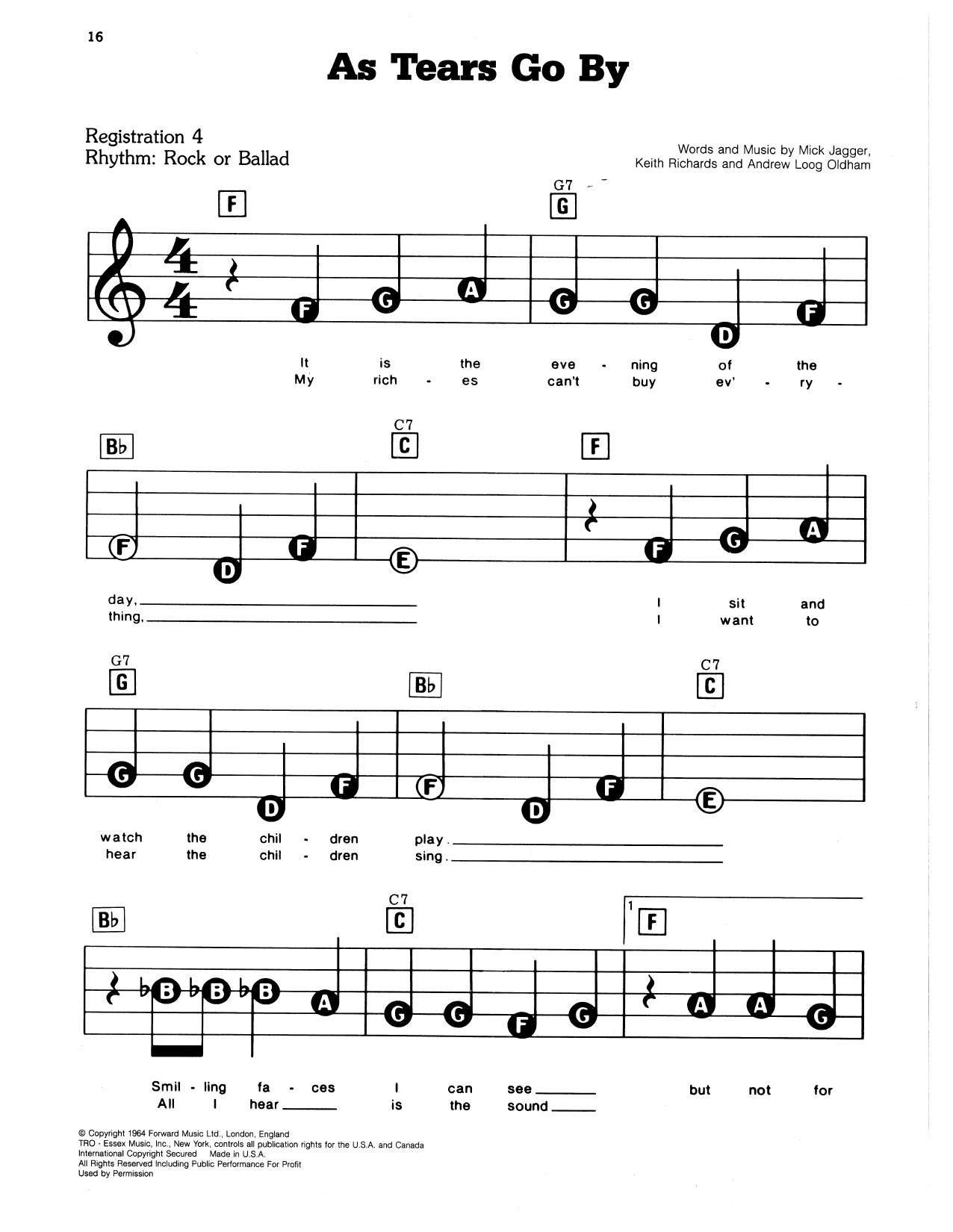
As Tears Go By: E-Z Play Today

As performed by The Rolling Stones / As performed by Marianne Faithfull

Item: 35-DS01866937

Digital Download
$4.99
Description

As Tears Go By: E-Z Play Today isn't in MakeMusic Cloud just yet...but it could be. Let us know you'd like to see it, and you'll help shape what comes next. In the meantime, start a free trial and dive into thousands of interactive titles your students can play along with today.

Sample Audio
No sample audio found.
Sample Video
Additional Details
Publisher: Hal Leonard
Page Count: 2
SKU: 35-DS01866937

More about this title

About the Artist: The Rolling Stones

The Rolling Stones emerged from London in 1962 as one of rock music's defining forces, building their sound on blues foundations while reshaping popular music for five decades. Their songwriting partnership, particularly between Mick Jagger and Keith Richards, produced some of the era's most enduring compositions, many of which have become standards in popular music education and performance.

Why we love this

This ballad sits comfortably in a pianist's wheelhouse without sacrificing emotional depth. The accessible two-page arrangement lets students experience how restraint and simplicity can carry profound lyrical weight, making it ideal for recitals, coffee house concerts, or as a bridge between classical and contemporary repertoire.

What to expect

Wistful and contemplative, this arrangement captures the ache of the original without relying on production flourishes. The piano voice becomes intimate and direct, drawing listeners into a moment of quiet reflection.

Who it's for

Intermediate pianists looking to expand beyond classical or jazz frameworks will find this piece immediately accessible and musically satisfying. It works equally well for students building pop and rock literacy or for teachers seeking authentic material that connects to their students' musical lives.

How to get the most out of it

  • Allow the melody to breathe by resisting the urge to rush through the quieter passages. The song's power lives in its stillness.
  • Shape phrases by listening to how the vocal line moves, then mirror that phrasing in your accompaniment patterns.
  • Experiment with dynamic contrast between verses and the chorus to highlight the emotional arc without overdoing the arrangement.
  • Pay attention to where the harmonic movement slows or accelerates; these shifts create natural momentum even in an understated arrangement.

How to use it

Slot this into a mixed recital to offer tonal and stylistic variety or use it as a warm-up piece that helps students transition from classical mindsets into popular idioms. It also pairs naturally with other 1960s singer-songwriter material in a thematic concert.

Skills your students will build

  • Playing with dynamic restraint and emotional intention
  • Translating vocal phrasing into instrumental interpretation
  • Reading straightforward folk and pop harmonic progressions
  • Building confidence with non-classical repertoire at the intermediate level

You May Also Like