
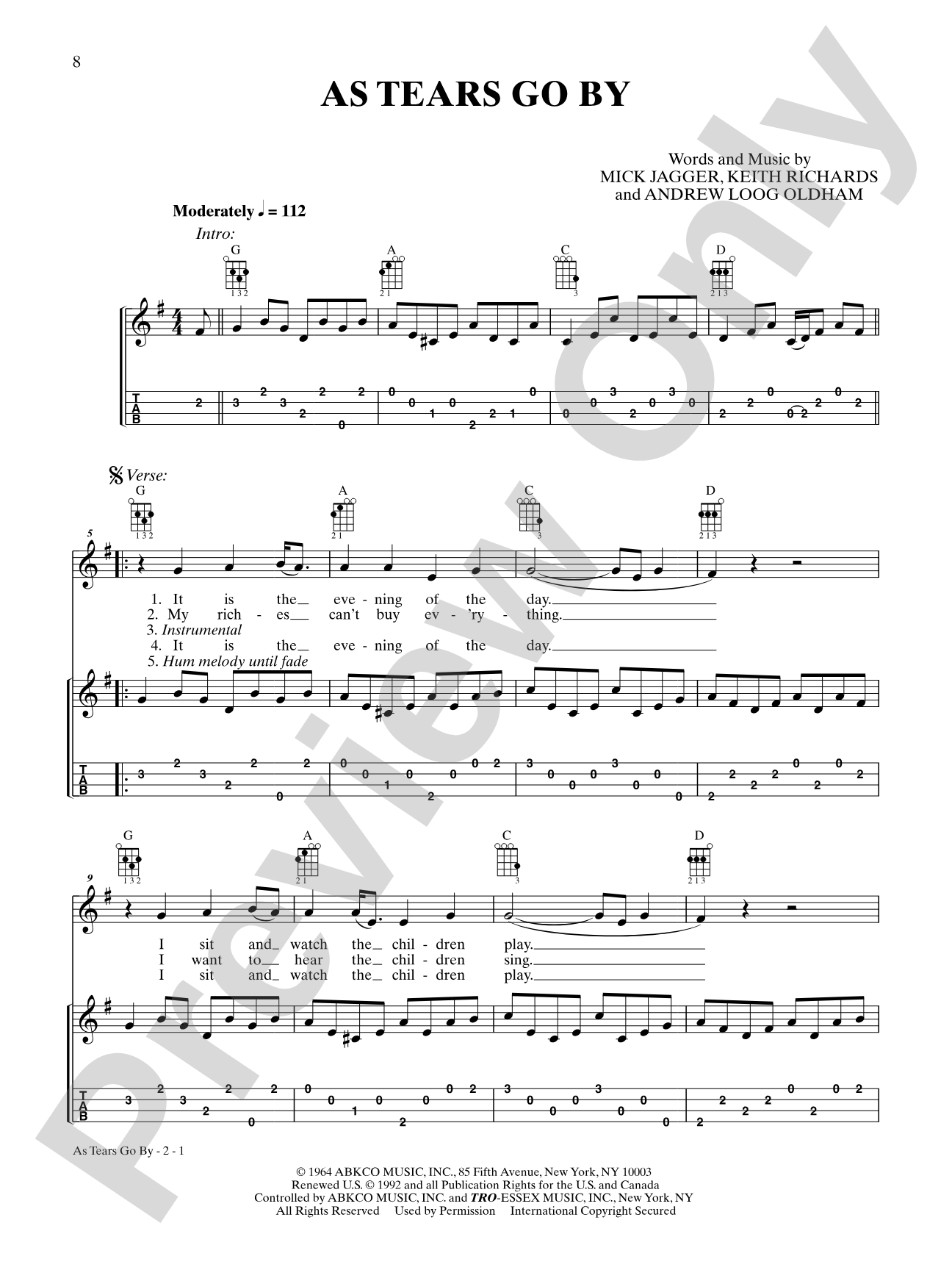

As Tears Go By: Ukulele TAB
19 Stones Classics Arranged for Ukulele, Complete with Authentic Riffs and Solos!
The Rolling Stones
Item: 00-PS-0011810
$4.99
Pickup currently not available
Related Items
Paint It, Black: Ukulele TAB |
$4.99
|
View | |
Dandelion: Ukulele TAB |
$4.99
|
View | |
Satisfaction, (I Can't Get No): Ukulele TAB |
$4.99
|
View | |
Last Time, The: Ukulele TAB |
$4.99
|
View | |
19th Nervous Breakdown: Ukulele TAB |
$4.99
|
View | |
Play With Fire: Ukulele TAB |
$4.99
|
View | |
Mother's Little Helper: Ukulele TAB |
$4.99
|
View | |
Honky Tonk Women: Ukulele TAB |
$4.99
|
View | |
Ruby Tuesday: Ukulele TAB |
$4.99
|
View | |
It's All Over Now: Ukulele TAB |
$4.99
|
View | |
She's a Rainbow: Ukulele TAB |
$4.99
|
View | |
Brown Sugar: Ukulele TAB |
$4.99
|
View | |
Get Off of My Cloud: Ukulele TAB |
$4.99
|
View | |
Let's Spend the Night Together: Ukulele TAB |
$5.99
|
View | |
Under My Thumb: Ukulele TAB |
$4.99
|
View | |
Gimme Shelter: Ukulele TAB |
$5.99
|
View | |
You Can't Always Get What You Want: Ukulele TAB |
$4.99
|
View | |
Jumpin' Jack Flash: Ukulele TAB |
$4.99
|
View | |
Uke 'An Play The Rolling Stones: Ukulele TAB Book |
$19.99
|
View |
Description
Nineteen Stones classics arranged for ukulele. Includes all the classic guitar riffs in TAB. Titles: 19th Nervous Breakdown * As Tears Go By * Brown Sugar * Dandelion * Get Off of My Cloud * Gimme Shelter * Honky Tonk Women * It's All Over Now * Jumpin' Jack Flash * The Last Time * Let's Spend the Night Together * Mother's Little Helper * Paint It, Black * Play with Fire * Ruby Tuesday * Satisfaction * She's a Rainbow * Under My Thumb * You Can't Always Get What You Want.


As Tears Go By: Ukulele TAB isn't in MakeMusic Cloud just yet...but it could be. Let us know you'd like to see it, and you'll help shape what comes next. In the meantime, start a free trial and dive into thousands of interactive titles your students can play along with today.
Request This Title
Tell us you want it.
Start Your Free Trial
Explore everything that's ready to play right now.
Sample Audio
No sample audio found.
Sample Video
No sample videos found.
Additional Details
Series:
Uke 'An Play
Publisher:
Alfred Music
Page Count:
76
SKU:
00-PS-0011810
More about this title
About the Composer: Mick Jagger
Mick Jagger stands as one of rock music's most distinctive frontmen and songwriters. Working primarily with Keith Richards, Jagger shaped the sonic identity of The Rolling Stones across five decades, writing songs that balanced blues authenticity with pop accessibility and irreverent attitude.
For ukulele players, Jagger's compositions offer something rare: songs built on strong melodic hooks and clever lyrical hooks that translate beautifully to smaller instruments. His gift for crafting memorable, singable lines makes these arrangements ideal for players wanting to explore serious rock repertoire without leaving the ukulele behind.
Why we love this
This collection transforms some of rock's most iconic riffs and melodies into material that ukulele players actually want to perform. The TAB arrangements preserve the character of the originals while acknowledging what works on a four-string instrument, giving students a genuine entry point into classic rock without simplification that strips away the music's attitude.
What to expect
Swagger and attitude translated to four strings. These songs arrive with a sense of cool that the ukulele doesn't often get to explore, mixing driving rhythms with moments of restraint and space. You'll feel the pull of blues-inflected melodies alongside pop hooks sharp enough to stick with you for days.
Who it's for
Ukulele students who have moved beyond beginner chord-strumming and want to tackle songs with real musical sophistication and cultural weight. Players comfortable reading TAB and tackling songs with varied rhythmic structures will find plenty of challenge and reward here.
How to get the most out of it
- Study the original recordings before diving into TAB. Hearing Jagger's phrasing and the original guitar textures will inform your tempo choices and help you understand where the rhythmic pocket sits.
- Pay close attention to the rhythm notation alongside the TAB. These songs often sit in the pocket in subtle ways that TAB alone won't reveal; the combination of both systems is your complete picture.
- Experiment with percussive techniques on the body of the ukulele during quieter passages or intros. Many of these songs benefit from added texture that a straight strumming approach won't provide.
- Consider which songs to extend with loops or layering if you're performing solo. Several tracks work beautifully as practice material for building arrangements that don't rely on backing tracks.
How to use it
Program a handful of these alongside original ukulele repertoire in a mixed recital setting to show the range and credibility of the instrument in rock contexts. They also work beautifully as supplemental solo material for intermediate students building confidence, or as starting points for students interested in arranging and adapting songs for ukulele.
Skills your students will build
- Reading TAB in conjunction with standard notation
- Navigating varied rhythmic patterns and syncopation
- Translating guitar-based arrangements to ukulele voicings
- Developing dynamic control across multiple song styles
- Connecting melody, rhythm, and lyrical phrasing