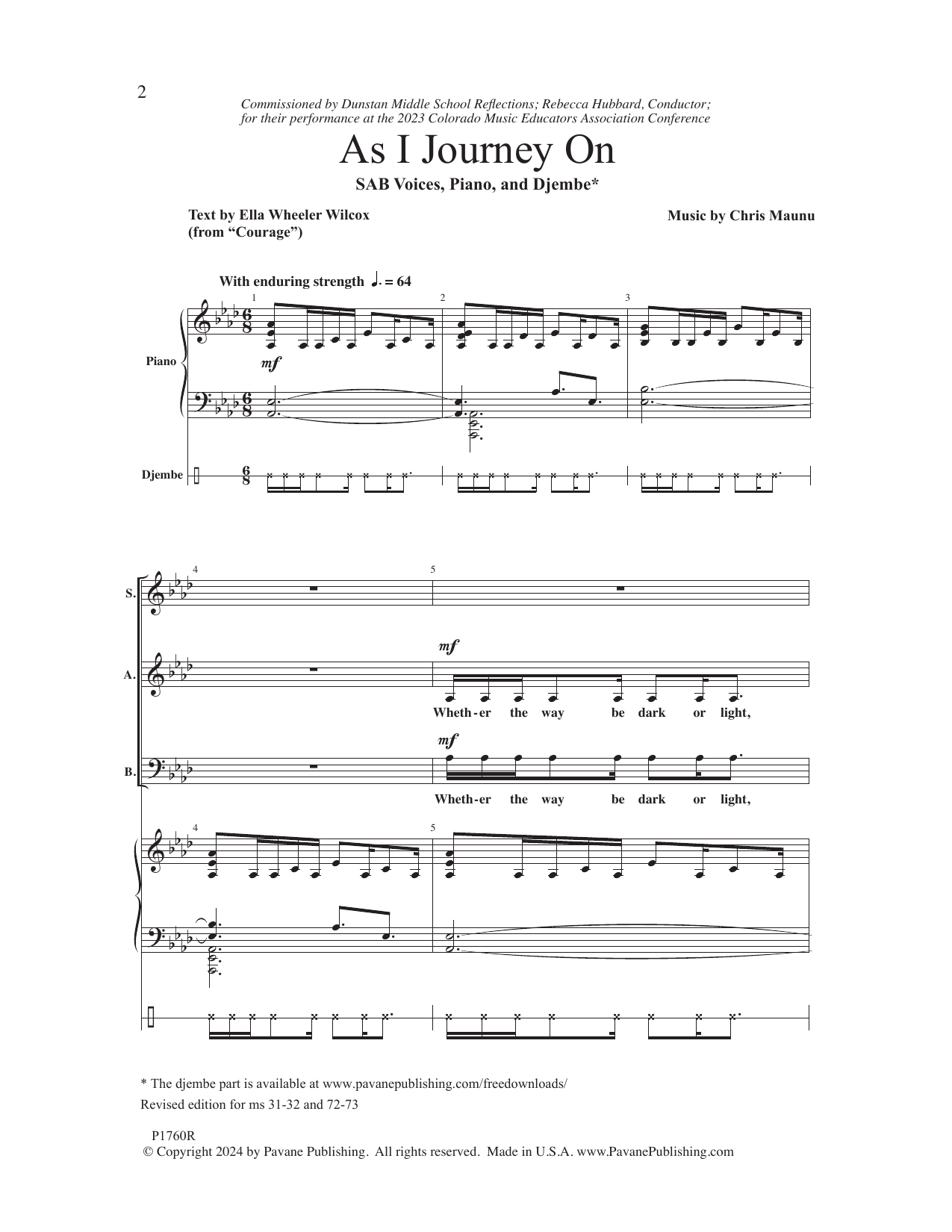
Chris Maunu has established himself as a composer whose choral writing balances accessibility with genuine musical substance. His works appear regularly in the libraries of high school and community choirs, reflecting his understanding of what voices can achieve at different levels of development.
Why we love this
Maunu's setting respects Wilcox's reflective text without overcomplicating it. The three-part writing sits comfortably for developing voices while maintaining harmonic interest, and the piece unfolds at a pace that allows singers to inhabit the emotional arc rather than fight the music.
What to expect
The piece has a contemplative quality that invites introspection; it moves forward with gentle momentum rather than dramatic sweep. There's warmth in the harmony and sincerity in the character that makes it feel earned rather than sentimental.
Who it's for
SAB choirs working toward concert performance, particularly groups comfortable with three-part textures but still building harmonic sophistication. The piece suits intermediate-level singers who can handle sustained lyricism and who are ready to sing with interpretive maturity rather than relying on accompaniment to carry them.
How to get the most out of it
Balance the part writing so that no single voice dominates; this works best when all three lines carry equal weight in shaping the phrase.
Shape the text with natural speech rhythms rather than metronomic precision; let the message breathe.
Use dynamic contrast to trace the emotional journey of the text rather than treating it as static throughout.
Encourage singers to connect each phrase to the journey metaphor in the title, which clarifies intent and musicality together.
How to use it
This works naturally in a concert centered on reflection or personal growth, or as an anchor piece in a program exploring lyric poetry. It also pairs well with other Maunu settings or with contemporary concert literature that values clarity and emotional directness.
Skills your students will build
Sustaining legit tone across longer phrases without trembling or pushing
Finding independence in three-part SAB writing without leaning on the harmony
Phrasing text with musical intention rather than mechanically
Blend and balance among parts in non-homophonic textures
You May Also Like
Scan to Complete Your Purchase
Use your phone's camera to scan the code below
You'll log in on your phone and the order will be added to your account