
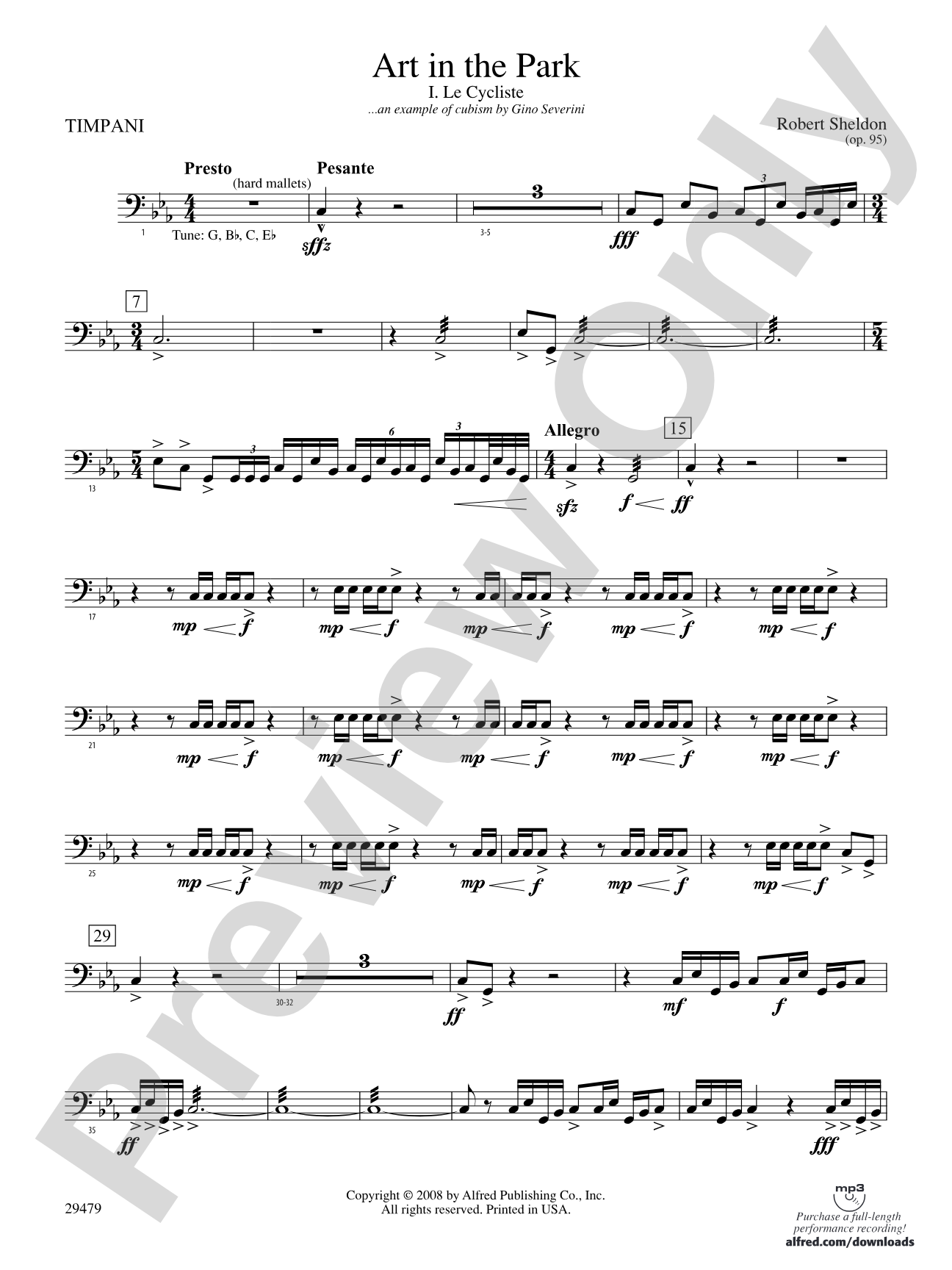

Art in the Park: Timpani
By Robert Sheldon
Grade: 5 (Difficult)
Item: 00-PC-0001435_TMP
$3.00
Pickup currently not available
Description
Art in the Park is a four-movement work that musically portrays various styles and techniques used in the visual arts. Musical representations of high energy cubism, dreamy impressionistic aquarelle, the nobility and subtle shadings of chiaroscuro, and a percussion ensemble's rendition of a sgraffito are included, with the orchestration designed to depict the style of the brushstrokes in each painting. This is a very unusual piece with highly diverse content! (8:30)


Don't just read it, hear it, play along with it, and watch your students grow with it. In MakeMusic Cloud, Art in the Park: Timpani comes alive with professional accompaniment, adjustable tempo, and built-in practice tools that turn solo practice into real progress.
Open in the Player
Jump straight in and assign it today.
Start Your Free Trial
Open this title and explore the full library in minutes.
Sample Audio
1
Audio File
--:--
0:00
0:00
Sample Video
No sample videos found.
Additional Details
Series:
Alfred Concert Band
Publisher:
Alfred Music
Page Count:
300
SKU:
00-PC-0001435_TMP
More about this title
About the Composer: Robert Sheldon

Robert Sheldon stands among the most widely performed composers in wind band repertoire. His works appear regularly on state and national contest lists, and his commissions span concert halls and honor bands across North America, Europe, Asia, and Australia. He has conducted his own compositions at prestigious venues including Carnegie Hall, the Kennedy Center, and the Sydney Opera House.
Beyond composition, Sheldon shaped music education as lead author of Sound Innovations for Concert Band and serves frequently as a guest conductor for All-State and Regional Honor Bands. The American School Band Director's Association, Phi Beta Mu, and ASCAP have all recognized his contributions to the field. In 2020, VanderCook College of Music awarded him an honorary doctorate in acknowledgment of his impact on wind band literature and music education.
Why we love this
Sheldon's gift for orchestration shines throughout this four-movement suite, where each section's instrumentation genuinely mirrors the visual art it portrays. The work holds significant appeal as both a concert centerpiece and contest selection because it balances sophisticated compositional language with accessible Grade 5 execution, allowing bands to sound far more ambitious than their technical level might suggest.
What to expect
Art in the Park swings between visceral energy and lyrical introspection. The opening movement crackles with angular rhythms and bright orchestration that evoke cubist fragmentation, while the second movement settles into shimmering impressionistic washes of color. The third movement commands dignity and restraint through careful dynamic gradation, and the finale erupts into a tactile percussion display where the ensemble becomes an instrument exploring texture and sound itself.
Who it's for
This work suits advanced Grade 5 concert bands with the rhythmic maturity to navigate its diverse styles and the tonal control to execute subtle dynamic shadings. Directors programming contest or concert seasons will find it compelling for groups ready to tackle ambitious contemporary wind band literature with strong musicianship.
How to get the most out of it
- Study the program notes carefully before rehearsals begin so you can communicate the artistic intent of each movement to your ensemble. Understanding that movement two evokes impressionistic painting and movement four uses percussion to mimic textured scratching transforms how players approach tone color and phrasing.
- Balance the orchestration throughout rehearsal so that individual color shifts register clearly without any section overpowering others. Movement one's high-energy cubism relies on rhythmic clarity across all voices, while the impressionistic second movement needs restraint in the lower parts to allow the upper colors to float.
- Mark conductor subdivisions in passages where rhythmic precision matters most (particularly in the sgraffito movement) to maintain ensemble lock during rapid textural changes. The unusual scoring in this movement demands absolute clarity from the podium.
- Shape the arc of the entire work as a narrative progression through artistic styles rather than four separate pieces. This approach sustains listener engagement across the full 8:30 duration and elevates the conceptual unity of the suite.
How to use it
Schedule this as your concert or festival centerpiece, where its distinctive character and structural arc anchor an entire performance. The four-movement design allows it to stand alone as a complete artistic statement, making it ideal for programs built around thematic concepts or for showcasing your band's range of stylistic control.
Skills your students will build
- Orchestration awareness and color differentiation across wind band voicings
- Dynamic control and subtle shading within single movements
- Rhythmic independence and precision in complex polyrhythmic sections
- Stylistic flexibility across contrasting musical idioms
- Ensemble balance in unconventional scoring combinations
- Sustained musical phrasing across longer formal structures