
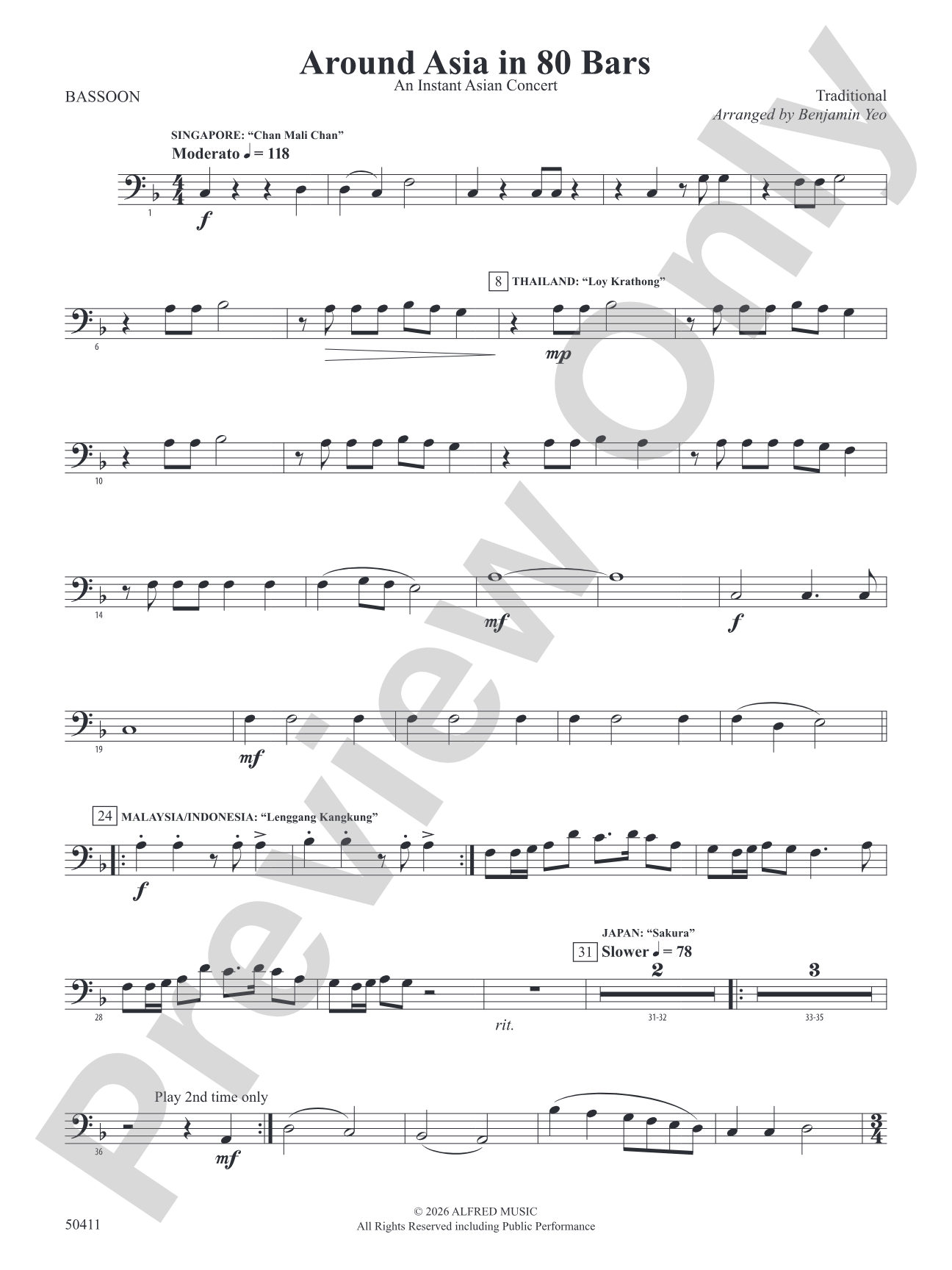

Around Asia in 80 Bars: Bassoon
An Instant Asian Concert
Traditional / arr. Benjamin Yeo
Grade: 3
Item: 00-PC-0019763_B1
$3.00
Pickup currently not available
Description
Take your band and audience on a thrilling musical adventure with Around Asia in 80 Bars (An Instant Asian Concert), an exciting medley by Singaporean composer Benjamin Yeo! Inspired by Harold Walters' "Instant Concert" and Jules Verne's novel title, "Around the World in 80 Days," this piece delivers a whirlwind tour through the rich musical landscapes of Singapore, Thailand, Malaysia, Indonesia, Japan, Korea, the Philippines, China, and back to Singapore--all within 80 bars!
Featuring iconic folk tunes such as "Chan Mali Chan" (Singapore), "Loy Krathong" (Thailand), "Lenggang Kangkung" (Malaysia/Indonesia), "Sakura" (Japan), "Arirang" (Korea), "Planting Rice" (the Philippines), and "Lift Your Veil" (China), this medley showcases the cultural diversity of Asia in a fresh and exhilarating way. Brimming with energy and creativity, the piece keeps musicians engaged with seamless transitions, colorful orchestration, and familiar melodies that audiences will love.
Its well-balanced scoring ensures accessibility for younger bands while maintaining musical depth and excitement for more advanced ensembles. Whether as a concert opener, a multicultural showcase, or a crowd-pleasing encore, Around Asia in 80 Bars is guaranteed to be a standout addition to any program!


Featuring iconic folk tunes such as "Chan Mali Chan" (Singapore), "Loy Krathong" (Thailand), "Lenggang Kangkung" (Malaysia/Indonesia), "Sakura" (Japan), "Arirang" (Korea), "Planting Rice" (the Philippines), and "Lift Your Veil" (China), this medley showcases the cultural diversity of Asia in a fresh and exhilarating way. Brimming with energy and creativity, the piece keeps musicians engaged with seamless transitions, colorful orchestration, and familiar melodies that audiences will love.
Its well-balanced scoring ensures accessibility for younger bands while maintaining musical depth and excitement for more advanced ensembles. Whether as a concert opener, a multicultural showcase, or a crowd-pleasing encore, Around Asia in 80 Bars is guaranteed to be a standout addition to any program!
Don't just read it, hear it, play along with it, and watch your students grow with it. In MakeMusic Cloud, Around Asia in 80 Bars: Bassoon comes alive with professional accompaniment, adjustable tempo, and built-in practice tools that turn solo practice into real progress.
Open in the Player
Jump straight in and assign it today.
Start Your Free Trial
Open this title and explore the full library in minutes.
Sample Audio
1
Audio File
--:--
0:00
0:00
Sample Video
Additional Details
Series:
Young Symphonic Series
Publisher:
Alfred Music
SKU:
00-PC-0019763_B1
More about this title
About the Arranger: Benjamin Yeo

Benjamin Yeo (b. 1985) is a Singaporean composer and conductor whose wind band works have earned recognition across Asia, North America, and Europe. His compositions appear regularly on the American Band College and Band World Top 100 lists, and ensembles ranging from the Washington Winds to the Royal Netherlands Army Band have recorded his music. His fanfare "Winds of Niagara" captured the 2017 Dallas Wind Symphony Fanfare Competition, and his catalog is published by C. L. Barnhouse, Carl Fischer, Beriato Music, and Tierolff Muziekcentrale.
Yeo began composing for wind bands at fifteen and later studied composition under Dr. Kelly Tang and Dr. Zechariah Goh. As a clinician and adjudicator, he has worked with ensembles and festivals throughout Singapore, Taiwan, and China, and presented at the 2024 WASBE Conference in South Korea. He maintains an active teaching practice with students across primary, secondary, and university levels while serving as a sought-after composer for international commissions.
Why we love this
Yeo's medley captures genuine musical character from each region without resorting to stereotype or oversimplification. The orchestration balances accessibility with sophistication, allowing Grade 3 ensembles to sound polished while the harmonic and textural choices reward more advanced bands with rewarding complexity. For programming, it solves the real challenge of representing Asian musical traditions authentically while keeping energy high and performance time short.
What to expect
Eighty bars of purposeful momentum. Each folk melody arrives with its own personality, lifted by crisp orchestration and unexpected harmonic choices that keep the ear engaged. The piece radiates genuine cultural curiosity rather than exotica, and its efficiency means the band and audience experience a satisfying journey without fatigue.
Who it's for
Concert bands at Grade 3 level will find this medley both playable and genuinely rewarding. Directors seeking an accessible opener with broad appeal, or programming a cultural celebration or world music focus, will benefit from the built-in audience recognition and the seamless, energetic pacing that keeps musicians engaged from beginning to end.
How to get the most out of it
- Keep transitions crisp and deliberate; each new folk tune should feel like a fresh destination rather than a rushed pivot. Brief sectional rehearsals on the transition passages will tighten the overall pacing.
- Balance melodic clarity with rhythmic drive throughout. The familiar tunes will carry themselves if the accompaniment remains lighter and more precise than in traditional harmonies.
- Pay attention to the orchestration's regional flavor; Yeo scores each tune differently to reflect its cultural context. Highlighting those orchestral choices (instrumentation, articulation, dynamic contours) deepens the audience's experience of the medley's structure.
- Ensure woodwind passages sit forward without dominating when brass or mallets support the melody. The piece thrives on textural variety, not overpowering unison.
How to use it
Open a concert with this medley to signal to your audience that the evening will travel somewhere. It works equally well as a bridge between classical and contemporary programming, or as the anchor for a dedicated world music or multicultural concert. Its compact length and high energy make it an effective closer if you want to send the audience home energized rather than reflective.
Skills your students will build
- Reading and executing rapid section changes and contrasting rhythmic figures across nine different folk idioms
- Maintaining ensemble balance and blend when familiar melodies shift between instrumental groups
- Understanding orchestration as a tool for cultural representation and musical storytelling
- Coordinating articulation and phrasing with different regional musical styles within a single continuous movement