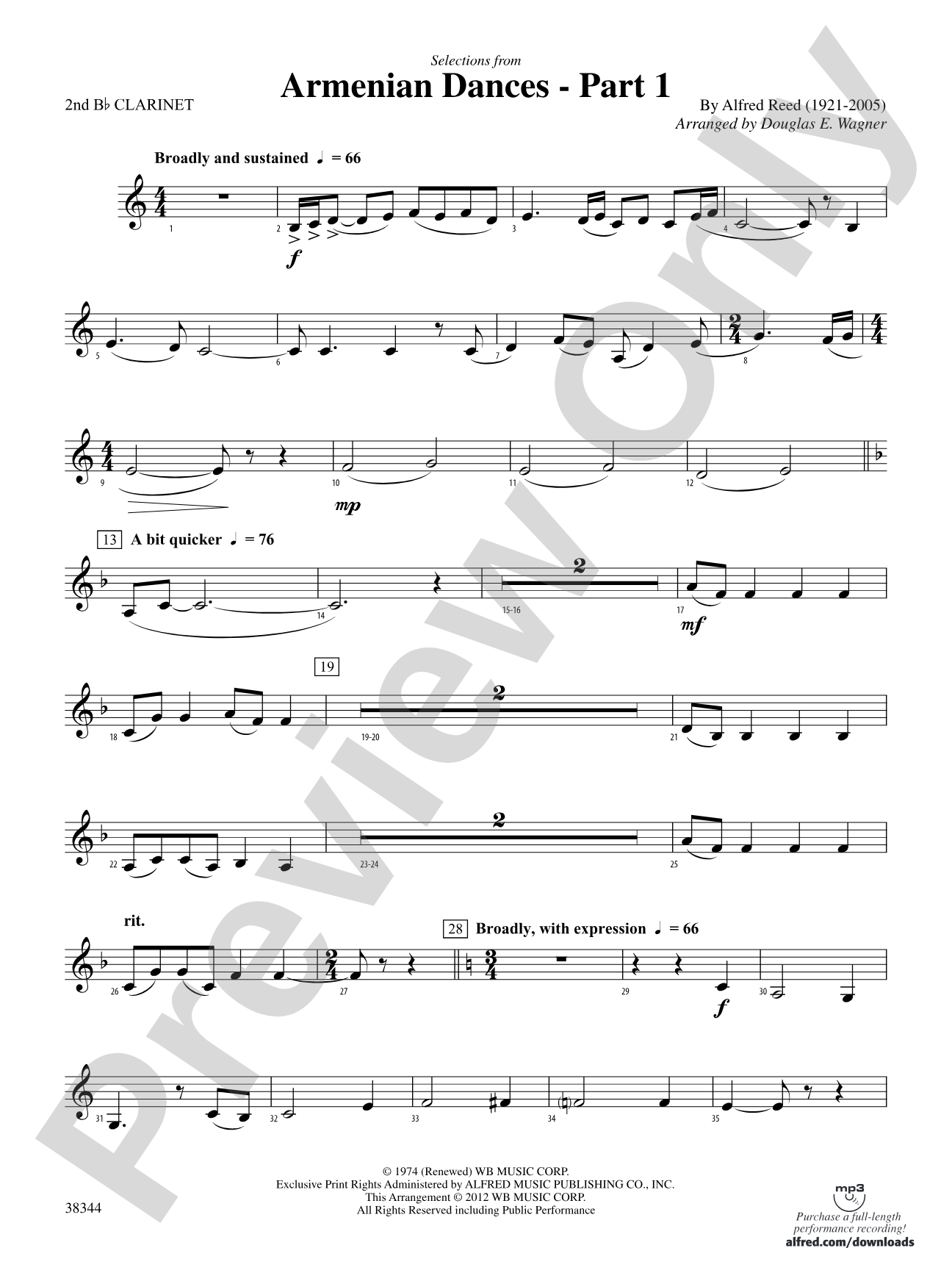
Armenian Dances, Part 1, Selections from: 2nd B-flat Clarinet Sheet Music Preview

Armenian Dances, Part 1, Selections from: 2nd B-flat Clarinet

By Alfred Reed / arr. Douglas E. Wagner

Grade: 2 (Easy)

Item: 00-PC-0015799_C2

Digital Download
$3.00
Description
Part I of Armenian Dances is the first of a four-movement suite drawn from the folk song arrangements and original musical works of Armenian composer Komitas Vardapet collected during the early 20th century. Each of Reed's four movements is represented in this lush through-played medley. Douglas Wagner has crafted a rewarding musical addition to the young band repertoire. (3:00) This title is available in MakeMusic Cloud.

Don't just read it, hear it, play along with it, and watch your students grow with it. In MakeMusic Cloud, Armenian Dances, Part 1, Selections from: 2nd B-flat Clarinet comes alive with professional accompaniment, adjustable tempo, and built-in practice tools that turn solo practice into real progress.

Sample Audio
0:00
0:00
Sample Video
Additional Details
Series: Pop Young Band
Publisher: Alfred Music
Page Count: 236
SKU: 00-PC-0015799_C2

More about this title

About the Composer: Alfred Reed

Alfred Reed (1921-2005) was an American composer and conductor whose catalog spans over 100 published works for concert band, orchestra, and chamber ensembles. Throughout his career, Reed demonstrated a gift for accessible orchestration that never sacrificed musical substance, making him a foundational figure in the young band repertoire.

Why we love this

Wagner's arrangement captures the modal warmth and rhythmic vitality of Armenian folk music while maintaining transparency of line ideal for young ensembles. The piece respects both the source material and the developing abilities of Grade 2 musicians, avoiding the pitfall of oversimplification by preserving genuine harmonic and melodic interest throughout.

What to expect

Warm, contemplative passages alternate with moments of spirited energy, all grounded in the ancient modal colors of Armenian melody. The orchestration invites ensemble players to listen across the band, hearing how folk themes weave through different instrumental families.

Who it's for

Young concert bands with solid fundamentals and developing musicianship (grades 2-3). Directors seeking literature that sounds more mature than its technical demands, offering authentic cultural content without condescension.

How to get the most out of it

  • Balance the melodic material across sections by identifying which instruments carry the tune in each movement, then shade accompanying voices slightly lighter without sacrificing blend.
  • Respect the folk origins by allowing rubato in phrase endings where the melody suggests a natural breath, rather than conducting metronomically through every bar.
  • Give sustained harmonic voices (especially inner woodwinds and lower brass) room to resonate; these create the lush sonority Wagner's arrangement depends on.
  • Mark tempo relationships between movements in rehearsal so transitions feel intentional rather than awkward, especially if you're programming Part 1 as a complete statement.

How to use it

Program this as a complete concert piece showcasing your band's lyrical control and cultural awareness. It works equally well as a contest selection or as part of a world music or cultural heritage concert theme.

Skills your students will build

  • Balancing melody and accompaniment across multiple instrumental choirs
  • Sustaining tone in supporting voice parts to create harmonic resonance
  • Playing with interpretive flexibility within a steady meter
  • Recognizing and respecting non-Western melodic and harmonic patterns
  • Responding to conductor cues for musical phrasing and section balance

You May Also Like