
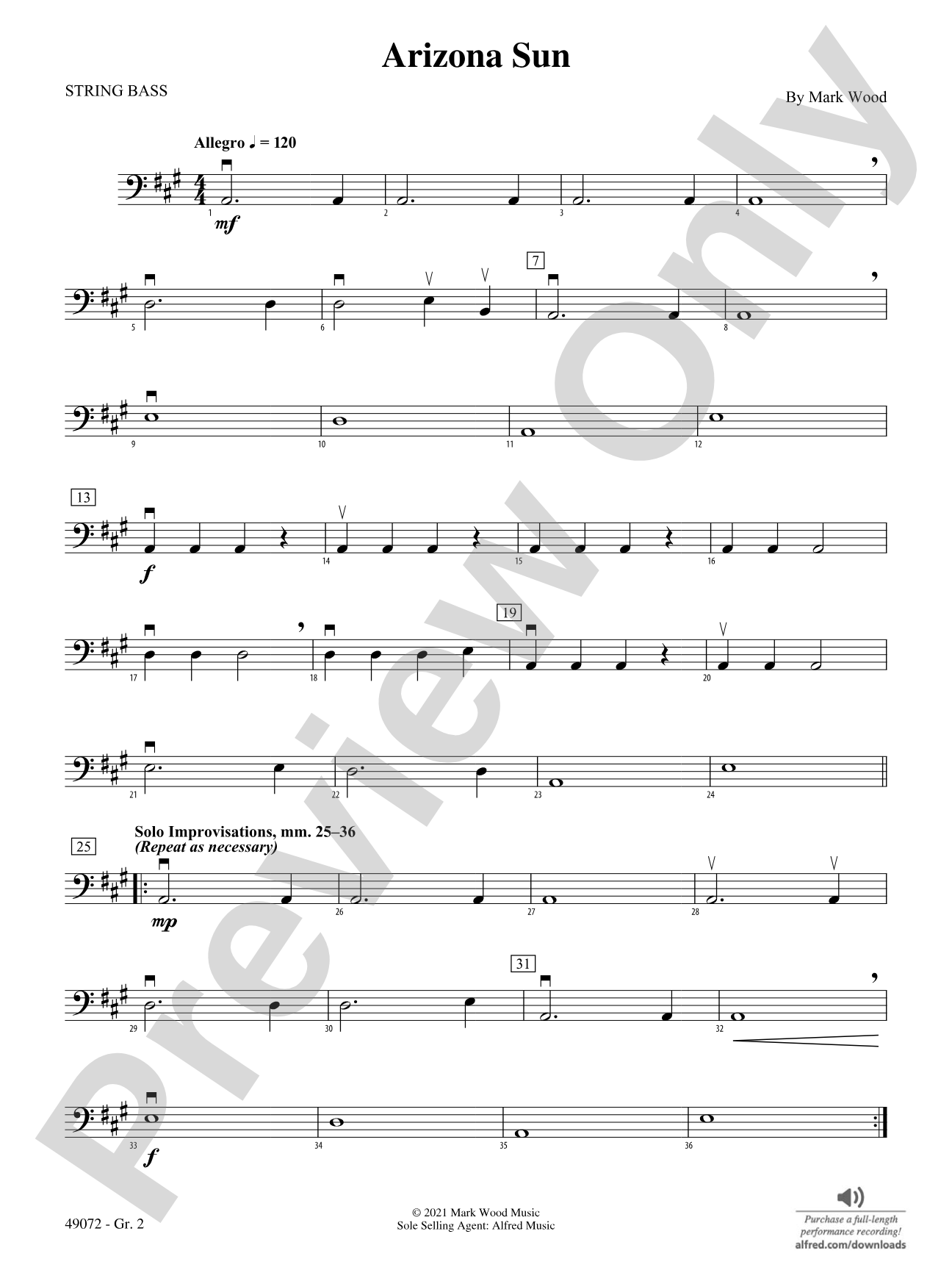

Arizona Sun: String Bass - Grade 2
By Mark Wood
Grade: 1 & 2
Item: 00-PC-0019155_GRADE2_SB
$3.00
Pickup currently not available
Description
This multi-level piece includes a full set of parts for grade 1 as well as a full set for grade 2 ensembles. Mix and match the parts as you need---perfect for mixed-ability ensembles!
Representing one of Mark Wood's favorite places to visit, Arizona Sun was inspired by the sheer beauty and power of the American southwest, specifically that of the Grand Canyon State. The work is in the key of A major, and based on a traditional blues progression that can be found in early rock and roll. Arizona Sun features two sections that allow the players to improvise. For string orchestra with optional rock rhythm section parts. (3:00)
Download Play-Along Track


Representing one of Mark Wood's favorite places to visit, Arizona Sun was inspired by the sheer beauty and power of the American southwest, specifically that of the Grand Canyon State. The work is in the key of A major, and based on a traditional blues progression that can be found in early rock and roll. Arizona Sun features two sections that allow the players to improvise. For string orchestra with optional rock rhythm section parts. (3:00)
Download Play-Along Track
Arizona Sun: String Bass - Grade 2 isn't in MakeMusic Cloud just yet...but it could be. Let us know you'd like to see it, and you'll help shape what comes next. In the meantime, start a free trial and dive into thousands of interactive titles your students can play along with today.
Request This Title
Tell us you want it.
Start Your Free Trial
Explore everything that's ready to play right now.
Sample Audio
1
Arizona Sun
--:--
Arizona Sun
0:00
0:00
Sample Video
Additional Details
Series:
Mark Wood Series
Publisher:
Alfred Music
SKU:
00-PC-0019155_GRADE2_SB
More about this title
About the Composer: Mark Wood

Mark Wood stands apart as a performer and composer who has spent four decades reshaping what string instruments can do in contemporary music. His path from founding member of Trans Siberian Orchestra (with over 10 million records sold) to Emmy-winning composer and electric violin innovator has given him a singular voice in both the concert hall and the recording studio. His work spans film and television scores, seven solo albums with his band The Mark Wood Experience, and collaborations with artists ranging from Paul McCartney to Celine Dion.
Beyond his extensive performing and recording career, Wood is deeply committed to music education and breaking down the barriers between classical and popular music. His compositions for young ensembles reveal the same creative restlessness that defined his pioneering work in electric strings, offering students a direct line to contemporary musical thinking and the kind of energy that draws newcomers into music.
Why we love this
Mark Wood brings the sensibility of a working rock musician to string writing, and Arizona Sun proves he understands how to energize young players without oversimplifying the music. The two-level flexibility (grade 1 and grade 2 parts) means you can actually build an ensemble that includes every player in the room, rather than leaving some behind or pulling others up beyond their readiness. Best of all, the improvisation sections give students permission to own the music and experiment, which transforms them from note-readers into musicians.
What to expect
Arizona Sun radiates warmth and wide-open space, capturing the visual power of the American southwest in sound. The blues progression at its heart pulses with a rock-and-roll swagger that feels both accessible and genuine, never condescending; the improvisation sections shimmer with possibility, inviting players to discover their own voice within the ensemble texture.
Who it's for
String orchestras serving mixed-ability ensembles where grade 1 and grade 2 players rehearse together. This score gives you a legitimate way to include everyone without compromise, since you're not simplifying a single part but rather choosing which layer of the arrangement each player tackles based on current ability.
How to get the most out of it
- Balance the rhythm section carefully if you include the optional rock drum and bass parts; they should lock in with the strings as one unit, not dominate the texture.
- Encourage violinists in the improvisation sections to start small and listen to what others are playing before expanding their range and rhythmic complexity.
- Use the play-along track as both a rehearsal tool and a gateway to the recorded accompaniment; hearing how professional players approach the blues sections builds confidence before live performance.
- Shape the A major tonality with brightness and clarity, but let the blues progression ground the music in its rock roots rather than playing it with classical restraint.
How to use it
This works beautifully as an opener or closer on a concert featuring young string orchestras, especially if you're programming toward a theme of American music or contemporary composition. Its three-minute length and high energy make it ideal for an audience seeking vitality and modern sound, particularly if you want to signal that strings matter in popular and rock contexts too.
Skills your students will build
- Playing and improvising within a blues harmonic progression
- Mixing multiple grade levels (grade 1 and 2 parts) in single ensemble arrangement
- Understanding how electric and acoustic strings interact in rock and pop contexts
- Responding rhythmically and tonally to optional rock rhythm section accompaniment
- Developing ensemble texture and balance across multiple instrumental layers