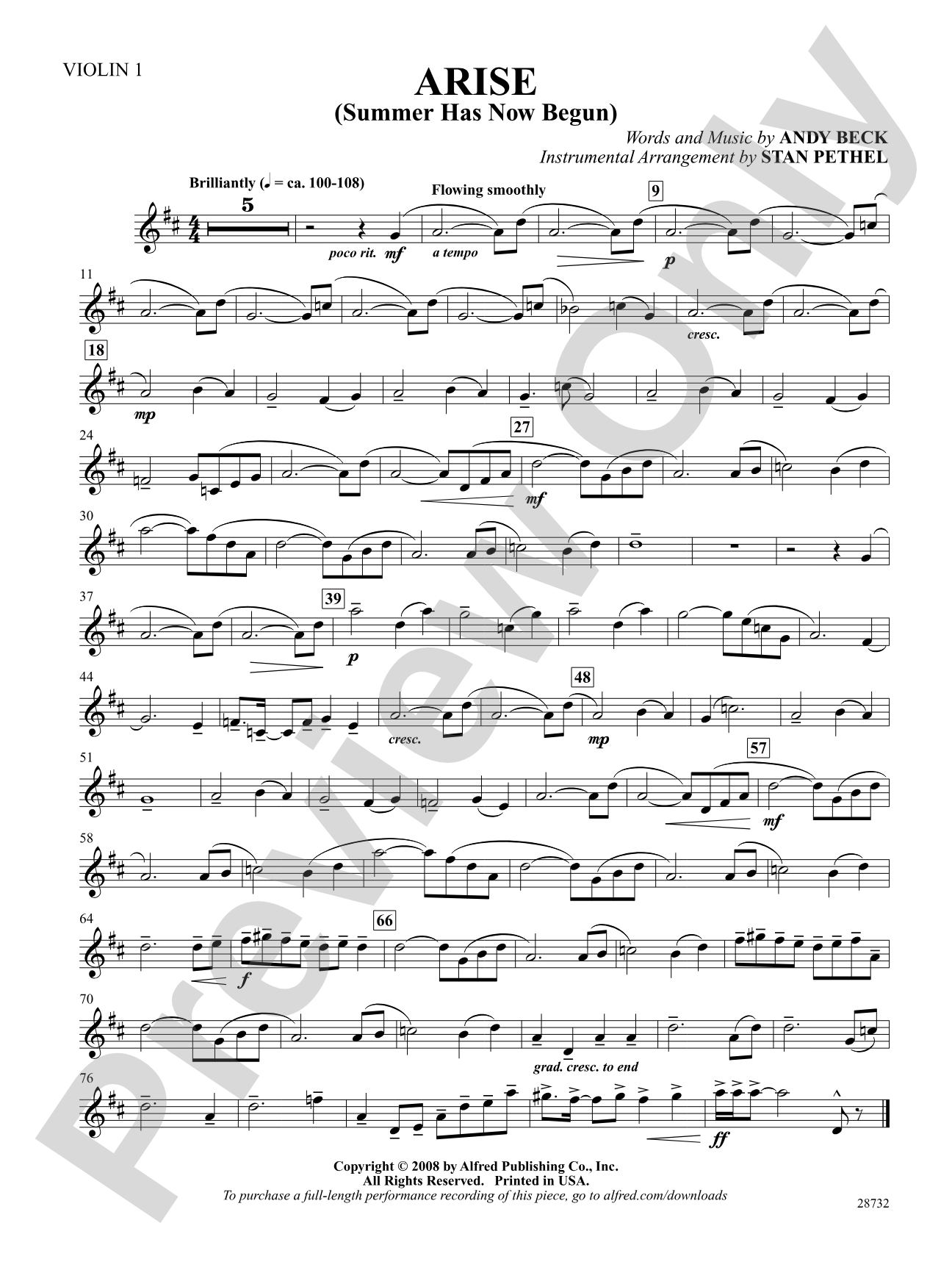
Arise (Summer Has Now Begun): 1st Violin Sheet Music Preview

Arise (Summer Has Now Begun): 1st Violin: Choral SoundPax

Words and music by Andy Beck

Item: 00-PC-0001354_VN1

Digital Download
$3.00
Description
From the first shimmering chords of the introduction to the final flourish of an uplifting descant, this artistic song paints an acoustic picture. Poetic words, progressive harmonies, and a piano part that your accompanist will love to play provide a vivid backdrop for a solid choral experience. Includes part for string quartet.

Don't just read it, hear it, play along with it, and watch your students grow with it. In MakeMusic Cloud, Arise (Summer Has Now Begun): 1st Violin: Choral SoundPax comes alive with professional accompaniment, adjustable tempo, and built-in practice tools that turn solo practice into real progress.

Sample Audio
No sample audio found.
Sample Video
Additional Details
Series: Alfred Choral Designs
Publisher: Alfred Music
Page Count: 12
SKU: 00-PC-0001354_VN1
Instrumentation: SoundPax

More about this title

About the Composer: Andy Beck

Andy Beck

Andy Beck serves as Director of Choral Publications at Alfred Music, overseeing a catalog that reflects his deep commitment to choral artistry and music literacy. His output spans over 450 published works across choral music, vocal resources, and children's musicals, along with widely adopted sight-singing and vocal technique resources including Sing at First Sight and Vocalize! 45 Vocal Warm-Ups That Teach Technique. A trained tenor and music educator, he holds degrees from Ithaca College and Northwest Missouri State University, and remains active as a guest conductor, clinician, and adjudicator for honor choirs and all-state groups across the country.

Beyond his publishing work, Beck continues to compose on commission and conduct featured performances at regional and all-state choral events. His involvement with the North Carolina Master Chorale Chamber Choir and decades as an Alfred Music studio singer ground his compositions in practical, performance-tested artistry. His dual focus on accessible pedagogy and artistic depth shows up clearly in every piece he publishes.

Why we love this

Beck's gift for pairing singable, memorable melodies with harmonies that feel fresh and sophisticated comes through immediately in this piece. The inclusion of a string quartet part and a carefully crafted piano accompaniment gives you real programming flexibility, whether you're building an all-vocal program or layering in instrumental color for a larger concert.

What to expect

The piece unfolds like a painting coming into focus, opening with shimmering harmonic washes and building toward a moment of genuine uplift. Poetic text and flowing melodic lines combine with sophisticated chord progressions to create something that feels both contemporary and timeless, inviting the singer into an acoustic landscape.

Who it's for

This work suits intermediate to advanced choral ensembles ready to engage with progressive harmonies and multiple layers of texture. It works equally well for concert choirs seeking a standalone piece or programs that benefit from flexible instrumentation.

How to get the most out of it

  • Bring the piano part into the open rehearsal early. Beck's writing for accompaniment doubles and supports the choral lines intelligently, so when your pianist learns their part thoroughly, the choir's intonation and rhythmic confidence improve significantly.
  • Balance the descant in your final section carefully; it's written to shimmer rather than soar. Too much volume and it overshadows the main line; too little and you lose the uplifting effect the composer intended.
  • If you're using the optional string quartet, have the ensemble listen to how those parts interact with the piano texture during a sectional. The instrumental writing creates an acoustic picture, so choir members who understand that context will blend more intentionally.

How to use it

This is an excellent choice for a spring or early summer concert, where its thematic warmth and lyrical quality feel most natural. Pair it with contrasting repertoire to let its artistic sensibility stand out, or use it as an opener that establishes a more refined tone for the entire program.

Skills your students will build

  • Reading and sustaining progressive harmonic movement
  • Blending multiple melodic lines and upper voice independence
  • Matching tone and intonation across complex chord changes
  • Interpreting text through phrased, connected singing

You May Also Like