
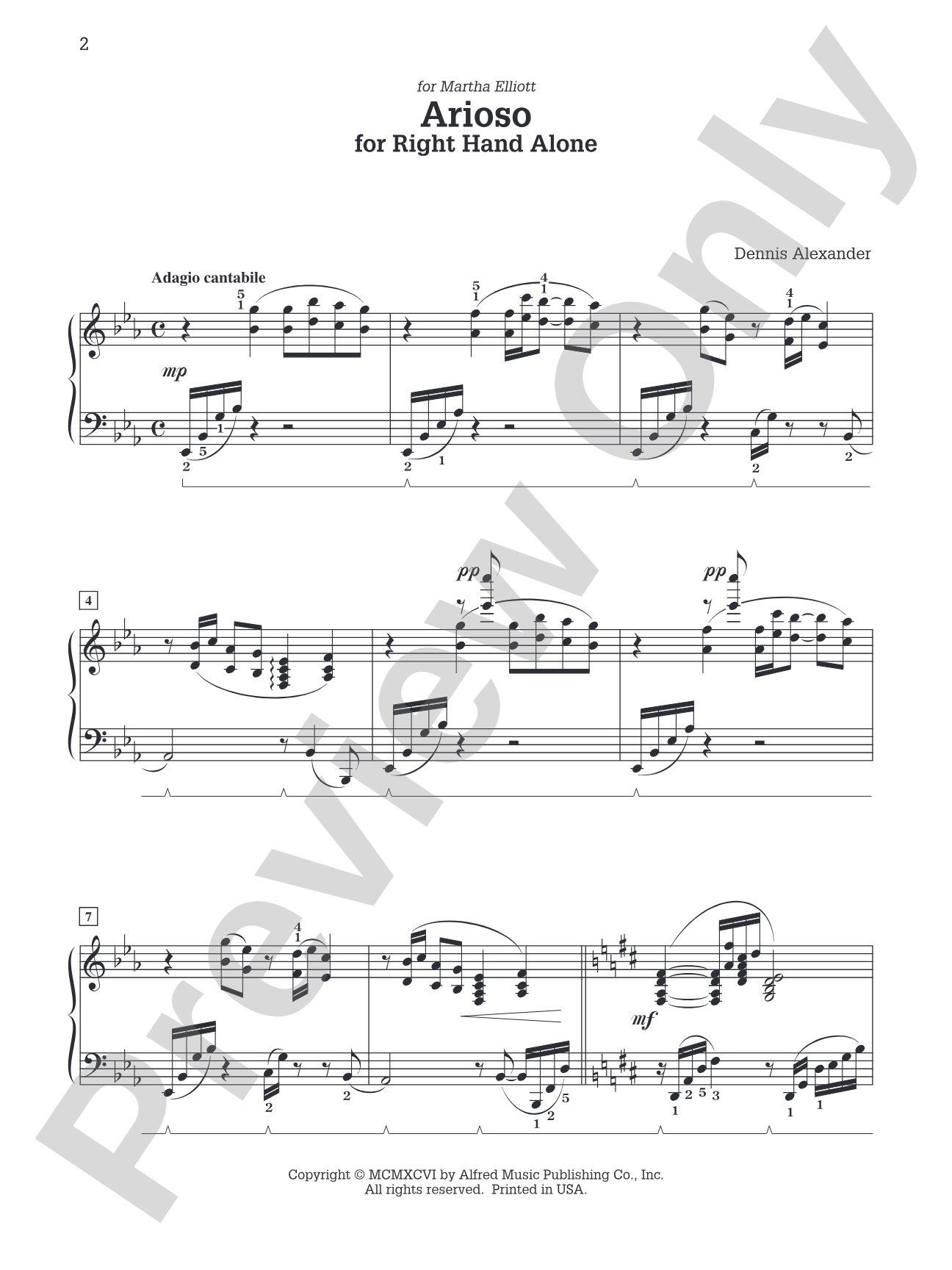

Arioso (for right hand alone) - Piano Solo: Piano
By Dennis Alexander
Level: Early Advanced
Item: 00-PB-0000770
$3.50
Pickup currently not available
Related Items
Arioso (for right hand alone): Piano Sheet |
$3.50
|
View |
Description
This early advanced piano solo by Dennis Alexander is an adagio for right hand alone. The music spans both bass and treble clefs and modulates from E-flat major to D major and back. This lyrical piece is challenging and rewarding for the right hand alone player. A Federation Festivals 2024-2028 selection.


Arioso (for right hand alone) - Piano Solo: Piano isn't in MakeMusic Cloud just yet...but it could be. Let us know you'd like to see it, and you'll help shape what comes next. In the meantime, start a free trial and dive into thousands of interactive titles your students can play along with today.
Request This Title
Tell us you want it.
Start Your Free Trial
Explore everything that's ready to play right now.
Sample Audio
1
Arioso Eb RH
--:--
Arioso Eb RH
0:00
0:00
Sample Video
No sample videos found.
Additional Details
Publisher:
Alfred Music
Page Count:
4
SKU:
00-PB-0000770
More about this title
About the Composer: Dennis Alexander

Dennis Alexander has shaped educational piano pedagogy for decades through his work with Alfred Music Publishing, which began in 1986. His catalog of over 400 compositions and recordings established him as a leading voice in piano education across all levels. He spent 24 years on the faculty at the University of Montana teaching piano pedagogy and serving as piano department chair before relocating to California, where he taught at Cal State Fullerton and Cal State Northridge. A Kansas native and University of Kansas alumnus, Alexander earned his New York recital debut at Carnegie Recital Hall in 1987 and has maintained an active performance career as soloist, accompanist, and chamber musician alongside his composing work.
Beyond the classroom, Alexander's influence extends through his clinic work at state and national music teachers conventions and his international reach. He has judged national competitions, toured across Southeast Asia and East Asia conducting workshops and recitals, and served as a collaborative artist for recognized soloists and chamber ensembles. His works have been commissioned by numerous organizations and state associations. He currently resides in Albuquerque, New Mexico, where he continues to compose and tour for Alfred Music Publishing.
Why we love this
Alexander writes with genuine understanding of the early advanced pianist's hand independence and musical maturity. The constraint of right hand alone forces the composer to create real melodic sophistication and harmonic interest within a single staff line, and he executes this beautifully here. The modulation from E-flat major to D major and back shows a composer unafraid to challenge students with harmonic vocabulary they haven't seen in simpler repertoire.
What to expect
An unfolding meditation in adagio time, moving with the patience and breath of a singer. The piece has a contemplative intimacy that grows as the harmony shifts, inviting the pianist to shape nuance and sustain musical architecture across unexpected tonal ground.
Who it's for
Early advanced pianists who are ready for single-hand études that demand real musicality, not just technical display. This piece suits students preparing for solo competition or recital contexts, particularly those drawn to lyrical repertoire and players ready to explore harmonic color.
How to get the most out of it
- Shape the phrases as you would in a vocal line; the right hand carries the full emotional weight, so legato voicing and deliberate pedal management will reveal the piece's lyricism.
- Map the modulation clearly in your practice. Identify exactly where E-flat major yields to D major and plan the transition so listeners hear it as a purposeful harmonic shift, not a surprise.
- Work the register changes carefully. The span across both clefs demands smooth voice leading; practice moving between upper and lower registers on a single staff without losing connection to the musical phrase.
How to use it
Program this as a recital opener to establish a reflective mood, or pair it with a more energetic piece later in the set to show range. Its inclusion in the Federation Festivals 2024-2028 list makes it a natural choice for students preparing for festival competitions at the early advanced level.
Skills your students will build
- Harmonic modulation recognition and execution (E-flat major to D major transitions)
- Single-hand voicing and independence across register changes
- Adagio interpretation and sustained phrasing without accompaniment
- Reading fluency between treble and bass clefs on one staff
- Pedal control for harmonic color and legato shaping