
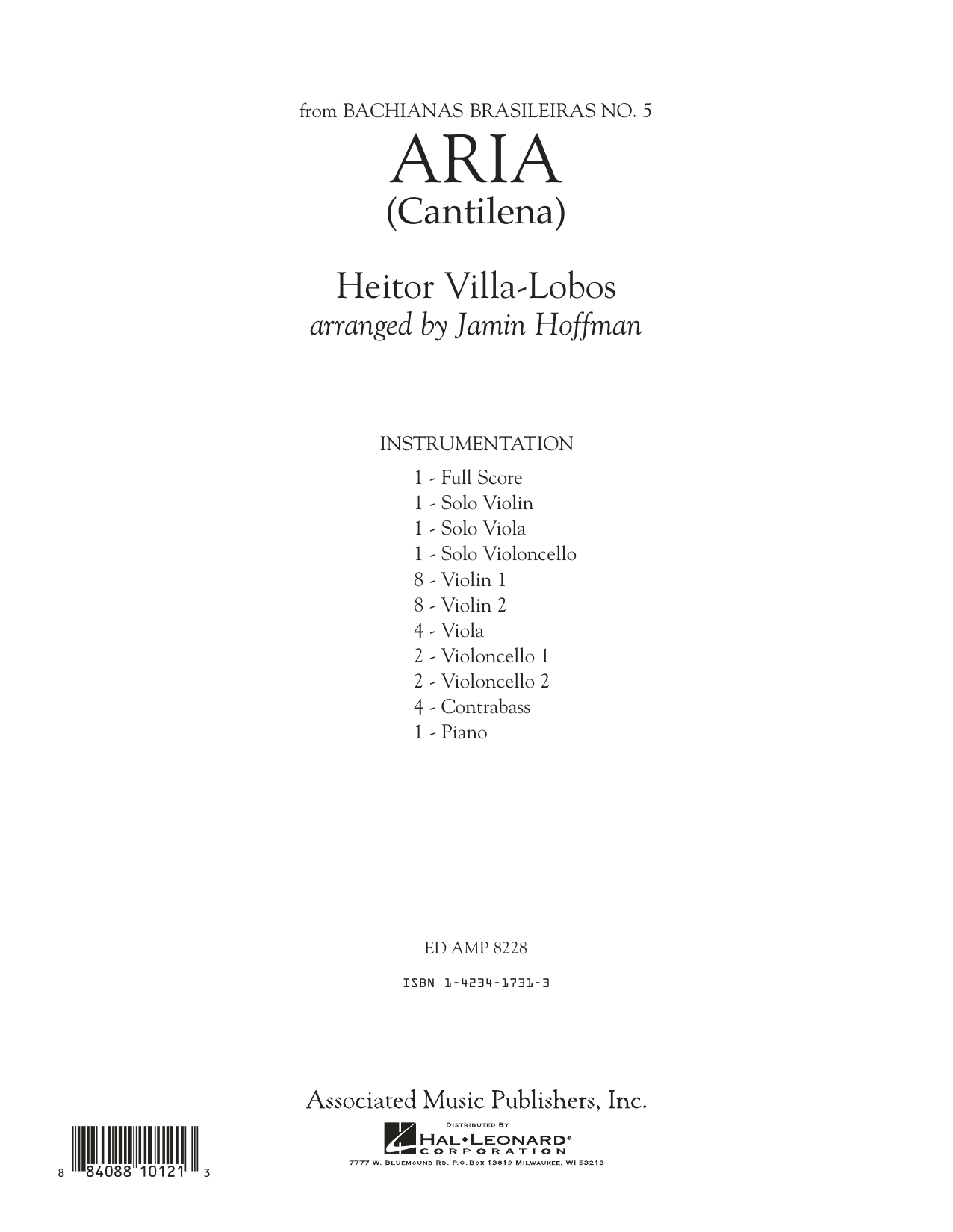

Aria (Cantilena) (arr. Jamin Hoffman): String Orchestra Conductor Score & Parts
By Heitor Villa-Lobos / Arranged by Jamin Hoffman
Grade: 3-4
Item: 35-PK01212844
$55.00
Pickup currently not available
Buy Extra Parts (Digital PDF Download)
Parts Added to Cart!
Description
This famous aria pays homage to Johann Sebastian Bach and remains one of the most popular of Villa-Lobos' works, originally written for solo soprano and eight celli. Jamin Hoffman's setting for string orchestra spotlights a violin soloist with the beautiful melodic line, which soars and captivates, in the manner of Bach's long non-repeating slow movements. Extraordinary programming for today's string orchestras!


Aria (Cantilena) (arr. Jamin Hoffman): String Orchestra Conductor Score & Parts isn't in MakeMusic Cloud just yet...but it could be. Let us know you'd like to see it, and you'll help shape what comes next. In the meantime, start a free trial and dive into thousands of interactive titles your students can play along with today.
Request This Title
Tell us you want it.
Start Your Free Trial
Explore everything that's ready to play right now.
Sample Audio
No sample audio found.
Sample Video
No sample videos found.
Additional Details
Publisher:
Hal Leonard
SKU:
35-PK01212844
More about this title
About the Composer: Heitor Villa-Lobos
Heitor Villa-Lobos (1887–1959) stands as Brazil's most influential classical composer, a figure who synthesized European modernism with the rhythmic vitality and melodic richness of Brazilian folk music. His prolific output spans nine symphonies, concertos, chamber works, and the celebrated Bachianas Brasileiras series, which explicitly honors Bach while rooting itself in Brazilian soil. Villa-Lobos shaped music education across Latin America and remains central to 20th-century repertoire in conservatories worldwide.
For string players and directors, Villa-Lobos offers something vital: music that sounds both sophisticated and immediately alive. His works reward careful attention to phrasing and color while remaining genuinely playable by developing musicians. The Aria exemplifies his gift for writing long, singing lines that feel inevitable and natural, never precious.
Why we love this
Hoffman's orchestration preserves the intimate lyricism of the original while giving a violin soloist room to breathe and soar. String orchestras at this level rarely encounter material this direct and emotionally coherent; the piece avoids both oversimplification and gratuitous difficulty, asking instead for nuance, tonal control, and genuine musicality from every stand.
What to expect
The music unfolds like a long sigh, spacious and unhurried. Bach's influence shows itself in the architecture of the melodic line and the clarity of the harmonic framework, yet the expressive warmth and the subtle rhythmic ease are distinctly Villa-Lobos. It is deeply reflective without being mournful.
Who it's for
String orchestras with a capable first-chair violinist and solid ensemble control. The piece works equally well for intermediate high school orchestras and college non-major ensembles seeking repertoire that feels grown-up without requiring advanced technique.
How to get the most out of it
- Shape the solo violin line with long, unbroken phrasing even in passages with rests; think of the melody as one continuous singing voice rather than a series of separate statements.
- Balance the accompaniment so the supporting strings remain clearly audible without overwhelming the soloist; this transparency reveals the harmonic sophistication underneath.
- Resist the urge to rush through the slow music. Villa-Lobos builds tension through duration and subtle harmonic movement, not through surface activity.
- Use the recorded accompaniment to hear how the parts interlock and to establish a steady, unhurried tempo that lets the melody breathe.
How to use it
Pair this with other works that prize lyricism and tonal beauty; it serves as a natural complement to Baroque repertoire or contemporary pieces that embrace accessible modernism. Consider programming it as an opener or a centerpiece that sets a contemplative tone for the rest of the concert.
Skills your students will build
- Sustaining long melodic lines with consistent tone and expressive control
- Balancing solo and accompaniment textures
- Playing slowly with rhythmic precision and harmonic awareness
- Responding to rubato and subtle tempo inflection in a non-metered musical line
- Reading string-specific articulations and bowing indications