
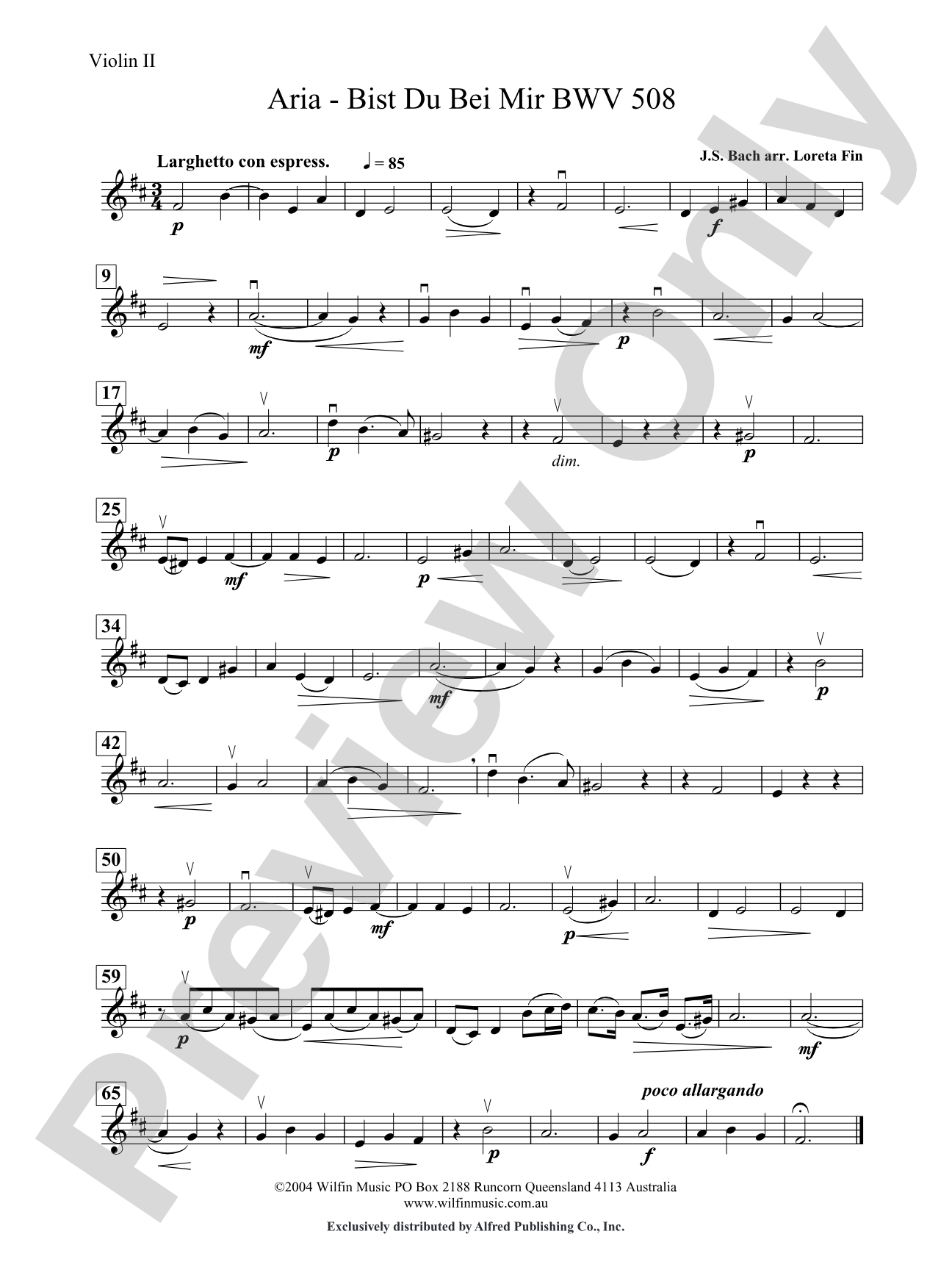

Aria -- Bist Du Bei Mir: 2nd Violin
By Johann Sebastian Bach / arr. Loreta Fin
Grade: 3-3.5
Item: 76-PC-0000028_VN2
$5.99
Pickup currently not available
Description
The influence of Johann Sebastian Bach on music is incalculable. In particular, his choral music lends itself beautifully to strings. In this aria, balance and blend in all sections, and throughout the ensemble, are essential. Dynamics need to be sensitively observed and adjusted.


Aria -- Bist Du Bei Mir: 2nd Violin isn't in MakeMusic Cloud just yet...but it could be. Let us know you'd like to see it, and you'll help shape what comes next. In the meantime, start a free trial and dive into thousands of interactive titles your students can play along with today.
Request This Title
Tell us you want it.
Start Your Free Trial
Explore everything that's ready to play right now.
Sample Audio
No sample audio found.
Sample Video
No sample videos found.
Additional Details
Series:
Wilfin String Orchestra: Young String Ensemble Series
Publisher:
Wilfin Music
Page Count:
66
SKU:
76-PC-0000028_VN2
More about this title
About the Arranger: Loreta Fin

Loreta Fin AM is an Australian string educator and composer whose career spans performance, teaching, and advocacy for string music. Trained at the Sydney Conservatorium of Music, she served as Principal Viola with the Queensland Pops Orchestra for over 25 years while maintaining an active chamber and orchestral performance schedule. Since 1993, she has directed strings at Somerville House School in Brisbane, establishing herself as a respected pedagogue and adjudicator at major Australian competitions and national conferences.
Fin has composed over 100 works for string orchestra published internationally by Alfred Music, including a comprehensive Beginner String Ensemble Series. Her contributions to string education in Australia have earned recognition including a Queensland State Award for services to the Australian Strings Association (where she served as both State and National President), the National Award for Services to Music and String Teaching, and a nomination for the inaugural ARIA "Best Teacher" award. She currently serves as State Advisor for Strings with the Australian Music Examinations Board and has conducted Honours Ensembles Programs since 2015.
Why we love this
This arrangement captures what makes Bach's vocal writing sing on strings without sacrificing the intimacy of the original aria. Loreta Fin's decades of experience managing string blend and balance shows in every phrase: the part-writing is transparent, the ranges are considerate, and the dynamic landscape invites sensitive, musical response from young players rather than demanding technical virtuosity.
What to expect
A moment of quiet spiritual reflection rendered in string color. The aria unfolds with the warmth and directness of Bach's vocal originals, allowing the ensemble to explore the relationship between individual voices and the unified whole without overwhelming technical hurdles.
Who it's for
String orchestras at the early intermediate level who are ready to move beyond simple arrangements and engage with genuine musical architecture. Players need solid intonation and basic independence in their parts, but the writing stays within comfortable ranges and avoids extended technical demands.
How to get the most out of it
- Shape each entrance carefully so inner voices don't disappear; Bach's counterpoint relies on hearing all strands of the texture.
- Let dynamics guide your tempo choices rather than locking in a metronomic speed; the music breathes naturally when players listen to the dynamic contours around them.
- Balance violas and cellos with particular attention; they carry essential harmonic content that anchors the soaring upper lines.
- Rehearse sections in pairs (violin 1 with cello, violin 2 with viola) before combining; this clarifies the underlying voice leading and prevents the ensemble from losing direction.
How to use it
This works beautifully as a concert centerpiece for a program exploring Baroque music, or as a contrasting moment within a larger concert that might otherwise emphasize lighter repertoire. Its contemplative character makes it an effective choice for mid-program placement, giving audiences and musicians a chance to settle into more deliberate musical thinking.
Skills your students will build
- Balancing sustained harmonic textures across all four string sections
- Reading and responding to expressive dynamic markings that shape phrasing
- Understanding voice leading and preventing inner parts from disappearing
- Maintaining consistent vibrato and tone quality across longer sustained passages
- Ensemble intonation in slow, exposed music where tuning issues are audible