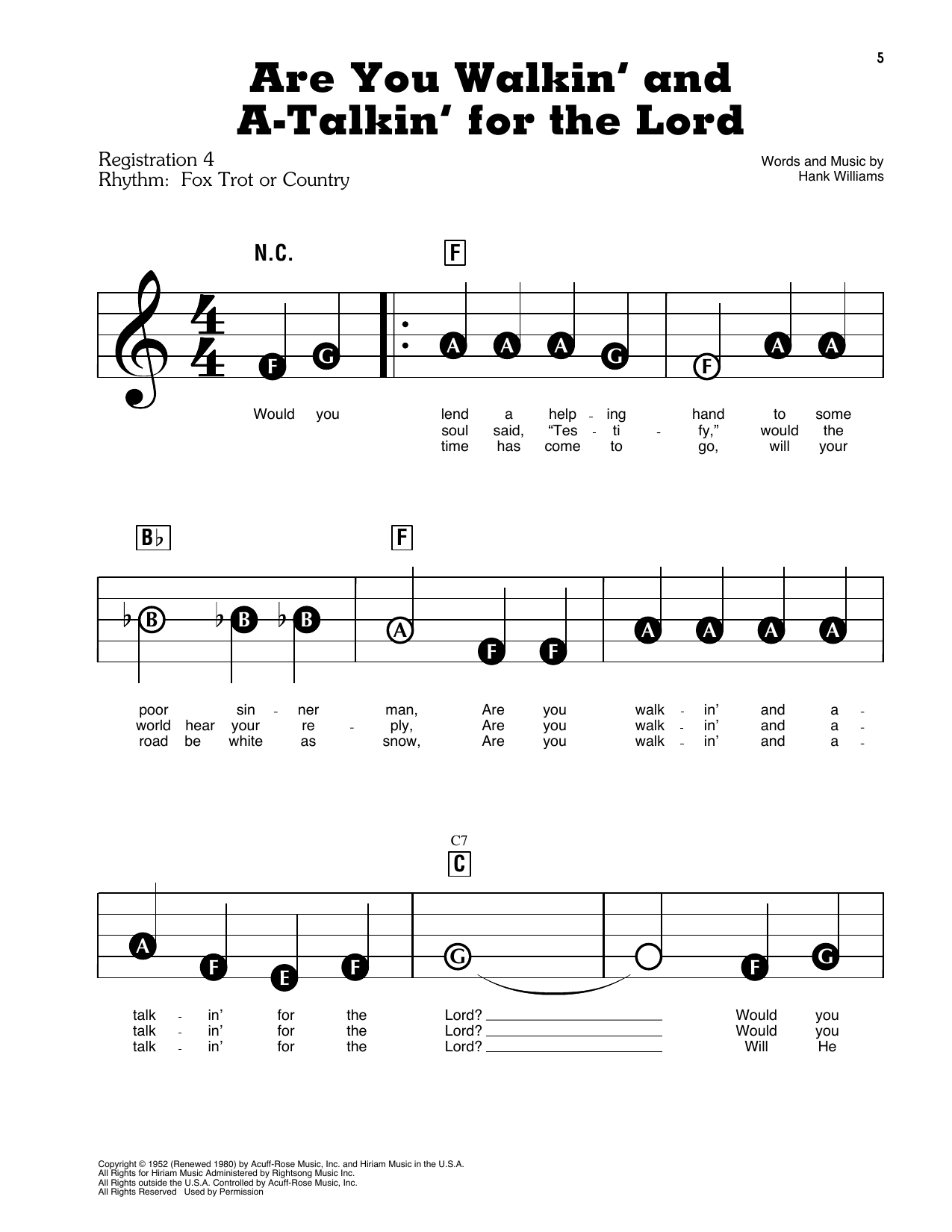
Hank Williams (1923-1953) remains one of the most influential songwriters in American music history. His ability to blend country authenticity with profound emotional depth transformed popular music and established templates that country and gospel artists still follow today. Williams drew from his deep connection to faith and hardship, creating songs that resonated across denominational and regional boundaries, making his sacred compositions particularly valuable for musicians exploring the intersection of country and spiritual traditions.
Why we love this
This arrangement captures the conversational warmth that made Williams such a natural storyteller. The E-Z Play reduction strips away nothing essential; instead, it preserves the melodic character and harmonic movement that makes this spiritual work memorable enough to stay with singers long after the performance ends.
What to expect
Sincere and conversational, like sharing testimony in an intimate setting rather than performing from a concert stage. The melody carries the directness of someone asking an important question, supported by harmonies that feel grounded and lived in rather than ornate.
Who it's for
Pianists seeking accessible sacred repertoire with genuine country and gospel roots, as well as singers wanting authentic accompaniment for faith based performance contexts. Teachers introducing students to hymn writing and spiritual music from the American songwriting canon will find this piece both pedagogically useful and emotionally honest.
How to get the most out of it
Let the lyrical phrasing guide your touch at the keyboard. The melody benefits from slight rubato that mirrors natural speech rather than metronomic regularity.
Lean into the gospel harmonic language without overstyling it. Simple voicings often communicate more authenticity than elaborate reharmonizations.
Support a vocalist if accompanying one by anchoring the rhythmic foundation while leaving space for their interpretive choices in the melody.
How to use it
Include this in a concert exploring American sacred music traditions or pair it with other Williams compositions to demonstrate his range beyond secular country hits. It works equally well as a standalone performance piece or as part of a broader program examining faith based songwriting across genres.
Skills your students will build
Reading simple lead sheet notation and chord symbols
Accompanying melodic lines with supportive piano voicings
Interpreting gospel harmonic progressions at the keyboard
Balancing rhythmic precision with interpretive flexibility in accompaniment
You May Also Like
Scan to Complete Your Purchase
Use your phone's camera to scan the code below
You'll log in on your phone and the order will be added to your account