
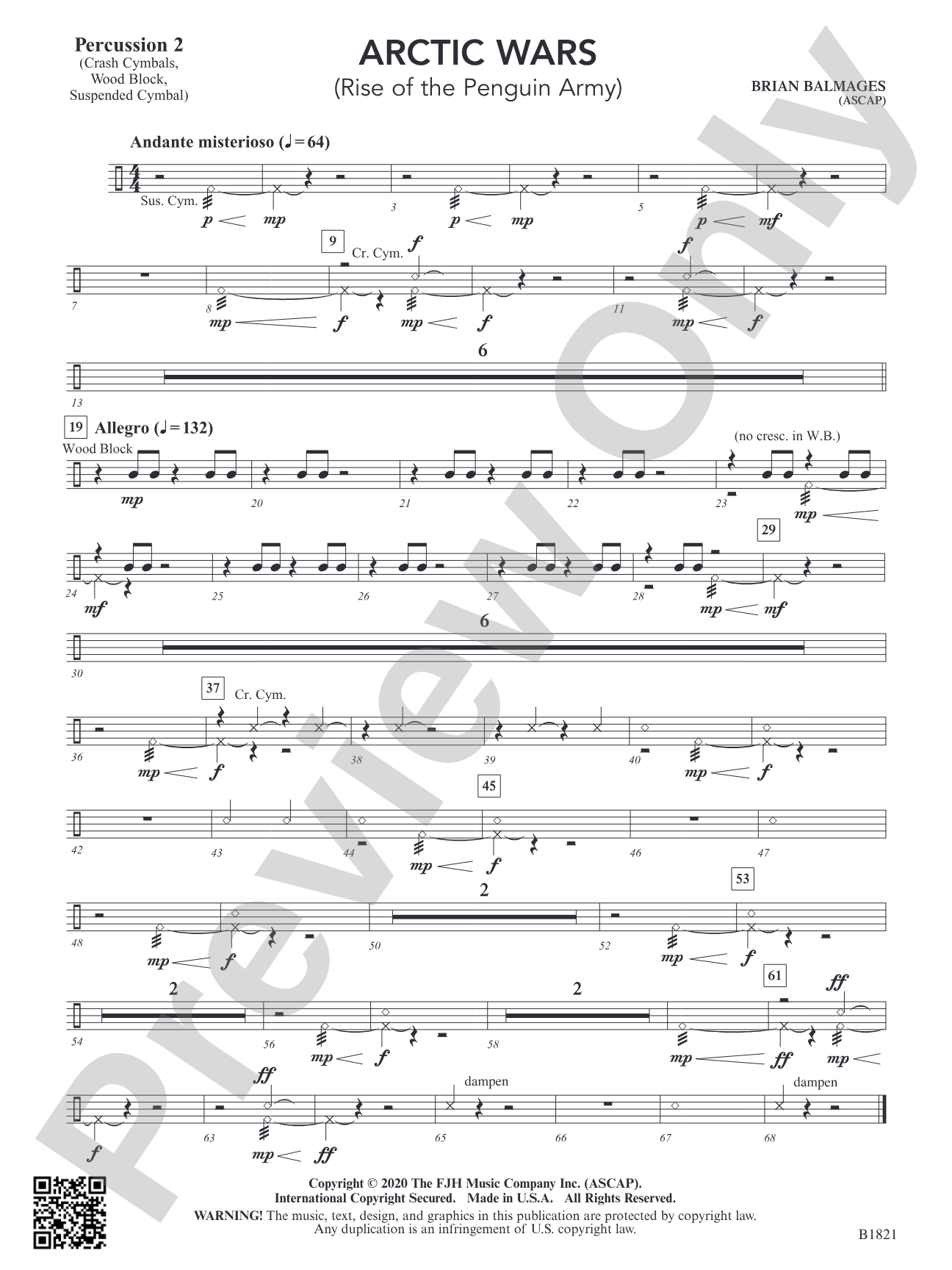

Arctic Wars (Rise of the Penguin Army): Percussion 2
Rise of the Penguin Army
By Brian Balmages
Grade: 1
Item: 98-PC-DB1821_PC2
$7.00
Pickup currently not available
Description
Dark harmonies create a menacing atmosphere in the opening of this engaging work. As the pace quickens, powerful themes combine with aggressive rhythmic lines, layered with ominous motives throughout. An amazing combination of heroism, uncertainty, and uplifting peaks, this highly imaginative work has it all!


Don't just read it, hear it, play along with it, and watch your students grow with it. In MakeMusic Cloud, Arctic Wars (Rise of the Penguin Army): Percussion 2 comes alive with professional accompaniment, adjustable tempo, and built-in practice tools that turn solo practice into real progress.
Open in the Player
Jump straight in and assign it today.
Start Your Free Trial
Open this title and explore the full library in minutes.
Sample Audio
1
Audio File
--:--
0:00
0:00
Sample Video
Additional Details
Series:
FJH Beginning Band
Publisher:
The FJH Music Company, Inc.
SKU:
98-PC-DB1821_PC2
More about this title
About the Composer: Brian Balmages

Brian Balmages has established himself as a composer and conductor with reach across orchestral, band, and chamber music spheres. His works have been performed worldwide by everyone from professional symphony orchestras to elementary school ensembles in major venues including Carnegie Hall, the Kennedy Center, and Sydney Opera House. He holds membership in the American Bandmasters Association and received the A. Austin Harding Award from the American School Band Directors Association, along with winning the 2020 NBA William D. Revelli Composition Contest for Love and Light.
Beyond composing, Balmages maintains an active conducting schedule with all-state and regional ensembles, university groups, and professional orchestras across the globe. His music has appeared in high-profile contexts, including a performance at the 2013 Presidential Inaugural Prayer Service. He received the inaugural James Madison University Distinguished Alumni Award and a commission from the University of Miami for presidential inauguration music. Currently, he serves as Director of MakeMusic Publications and Digital Education for Alfred and MakeMusic.
Why we love this
Balmages builds narrative momentum expertly in a Grade 1 arrangement, moving from atmospheric opening through rhythmic intensity without losing accessibility. Directors appreciate how the piece combines storytelling flair with straightforward technical demands, making it equally valuable for concert programming and contest appearances. The orchestration gives every section a moment to shine while keeping parts playable for developing musicians.
What to expect
The piece opens with a brooding tension that gradually intensifies through rhythmic propulsion and layered motives. As the work unfolds, heroic themes emerge alongside moments of doubt, before arriving at an uplifting peak that rewards the ensemble's effort.
Who it's for
Beginning band students ready to tackle imaginative programming beyond traditional folk tune arrangements. Directors seeking Grade 1 concert repertoire that engages players with narrative interest and sophisticated harmonies without excessive technical demands.
How to get the most out of it
- Shape the opening dark harmonies with controlled dynamics; resist the urge to play loud too early so the acceleration feels earned when it arrives
- Balance the aggressive rhythmic lines so that melody remains audible even when layered with ominous motifs; this clarity prevents the texture from becoming muddy
- Mark the transitions between sections clearly in rehearsal so students understand the emotional arc from menace to heroism to uncertainty and back to uplift
How to use it
Program this as an opener or centerpiece on a concert where you want to set a dramatic tone and showcase your band's dynamic range. It works equally well at contest festivals, where the combination of atmospheric writing and driving rhythms demonstrates both control and energy.
Skills your students will build
- Sustaining dynamic control through extended phrases
- Balancing rhythmic independence with ensemble cohesion in layered textures
- Responding to sudden shifts in tempo and intensity
- Shaping thematic material with musical intention rather than mechanical repetition