
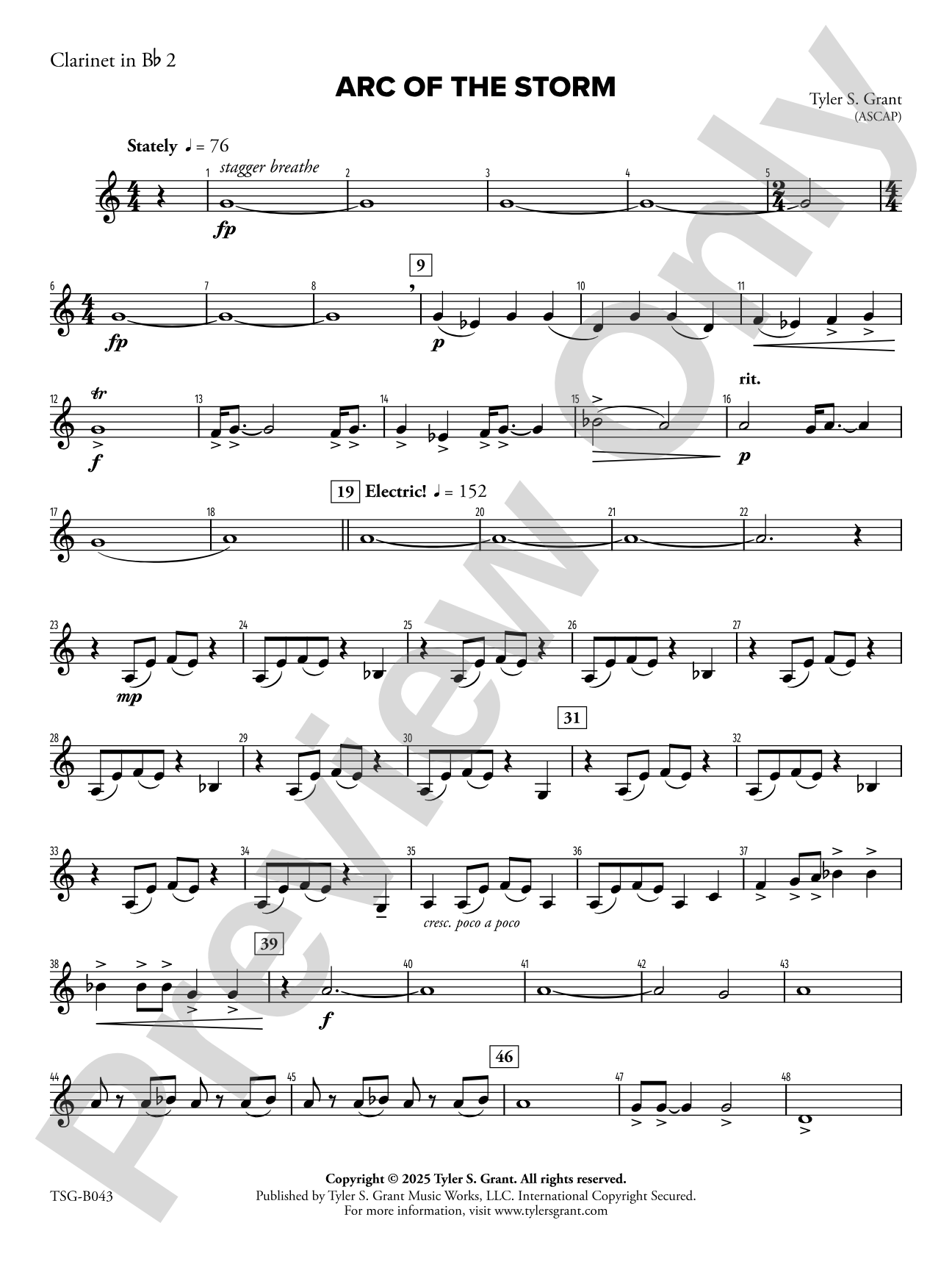

Arc of the Storm: 2nd B-flat Clarinet
By Tyler S. Grant
Item: 98-PC-0000068_C2
$3.00
Pickup currently not available
Description
A bold and atmospheric work depicting the power and majesty of a lightning storm. Swirling textures, driving rhythms, and dramatic fanfares give this work a unique soundscape that captures the energy and unpredictability of nature. Stunning from beginning to end!


Arc of the Storm: 2nd B-flat Clarinet isn't in MakeMusic Cloud just yet...but it could be. Let us know you'd like to see it, and you'll help shape what comes next. In the meantime, start a free trial and dive into thousands of interactive titles your students can play along with today.
Request This Title
Tell us you want it.
Start Your Free Trial
Explore everything that's ready to play right now.
Sample Audio
1
Audio File
--:--
0:00
0:00
Sample Video
Additional Details
Series:
Tyler S. Grant Music Works
Publisher:
Tyler S. Grant Music Works
SKU:
98-PC-0000068_C2
More about this title
About the Composer: Tyler S. Grant

Tyler S. Grant has built a reputation as a composer whose works appear consistently on state and all-state honor ensemble programs across North America. His composition Panoramic Fanfare won the Dallas Wind Symphony's 2014 Call for Fanfares Competition and has since been performed by collegiate and professional ensembles throughout the continent. Since 2010, he has maintained an active commissioning practice, producing new concert band and orchestral works annually while serving as a clinician with over 100 school programs across 15 states.
Grant's conducting and educational work spans major venues including The Midwest Clinic, Carnegie Hall, and the Meyerson Symphony Center. A graduate of the University of Alabama with a degree in instrumental music education, he studied conducting with Professor Randall Coleman and credits composer Brian Balmages as essential to his development. Beyond composition, Grant has contributed to Alfred Music's Sound Innovations series and regularly engages with instrumental programs through clinics and conducting appearances at regional and national conferences.
Why we love this
Arc of the Storm delivers the dramatic payoff that middle school bands crave without requiring virtuosic technique. The atmospheric writing feels sophisticated and substantial, yet the Grade 2½ level means your students can actually execute the musical ideas rather than struggle through transcription-level notation. It's the kind of piece that makes your ensemble sound prepared and confident at festival.
What to expect
Arc of the Storm immerses you in the swirling power of weather in motion. The piece moves between moments of turbulent energy and darker, gathering calm, creating the feeling of watching a storm roll in, peak overhead, and finally pass through. It's visceral without being bombastic.
Who it's for
Concert bands at the Grade 2½ level who want substantial, programmatic music with genuine theatrical appeal. This works equally well for high school bands seeking accessible festival material or middle school programs ready to tackle something with real dramatic ambition.
How to get the most out of it
- Establish the swirling textures through careful balancing of the woodwind layers. These should feel like wind currents rather than individual lines competing for attention.
- Let the rhythmic drive build gradually across the ensemble. Precision in the foundation voices (low reeds and brass) anchors the energy without needing to push tempo.
- Shape the fanfare sections with deliberate articulation and dynamic contrast. Grant's dramatic writing works best when you give each moment clear intention rather than treating them as climactic outbursts.
- Use dynamics to create the sense of a storm moving across the landscape. Smaller dynamic shifts in the development sections will make the final payoffs feel earned.
How to use it
This belongs on a festival program as a centerpiece that demonstrates musicianship and ensemble control. It also works effectively as a concert opener that establishes mood and captures attention, or as the dramatic heart of a program exploring nature-inspired repertoire. The atmospheric quality makes it a natural pairing with quieter, more introspective works that follow.
Skills your students will build
- Balancing multiple independent woodwind lines while maintaining forward harmonic motion
- Sustaining ensemble rhythmic precision during driving, layered passages
- Shaping dramatic dynamic arcs across extended musical phrases
- Executing rapid tonal shifts between atmospheric and energetic textures
- Responding to gestural conducting through varied articulation and attack