
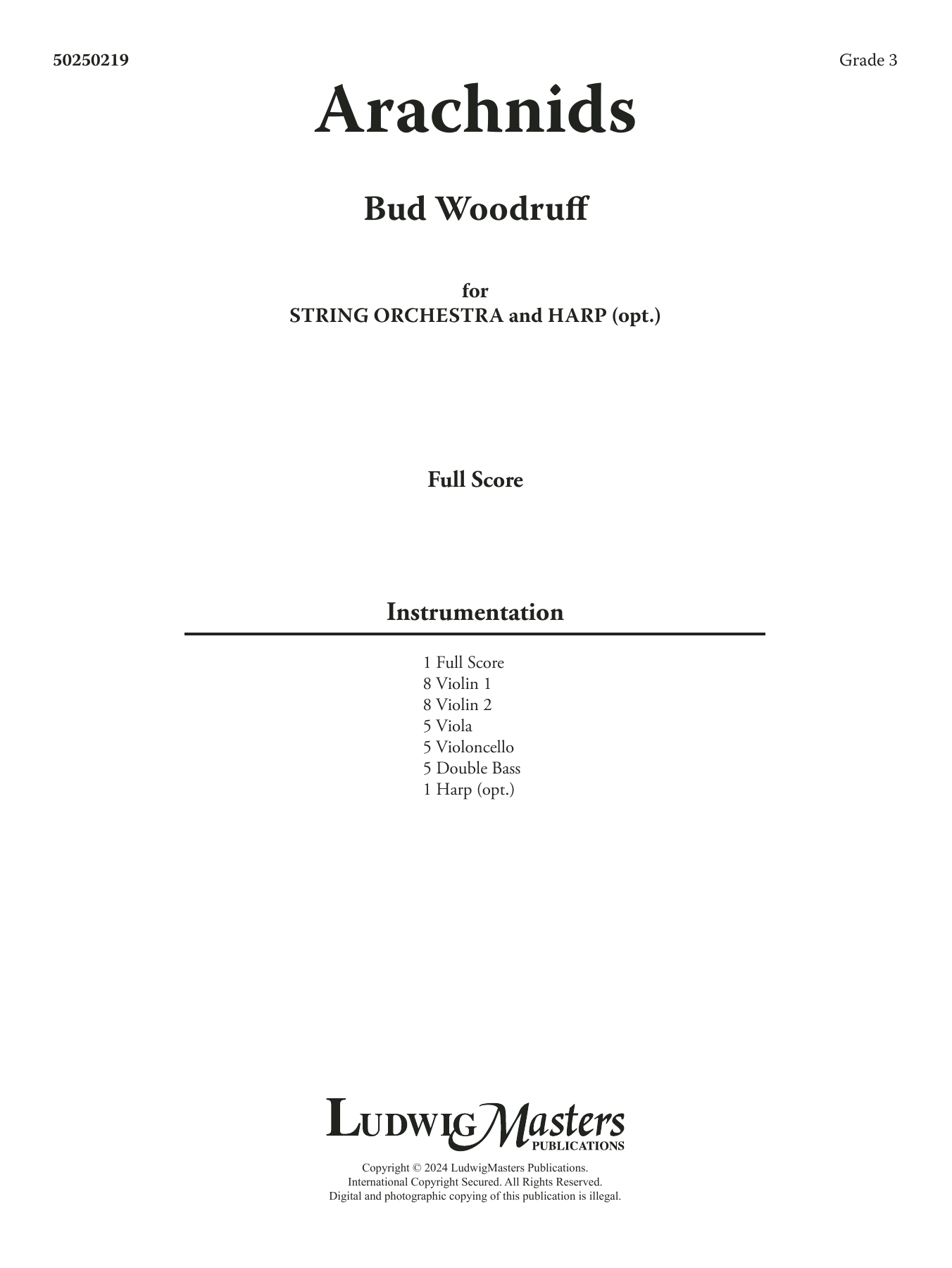

Arachnids: String Orchestra Conductor Score & Parts
By Bud Woodruff
Grade: 3
Item: 35-PK01498739
$55.00
Pickup currently not available
Buy Extra Parts (Digital PDF Download)
| Product | Price | Quantity |
|---|---|---|
| Arachnids - Full Score | $7.00 | |
| Arachnids - Violin 1 | $2.50 | |
| Arachnids - Violin 2 | $2.50 | |
| Arachnids - Viola | $2.50 | |
| Arachnids - Violoncello | $2.50 | |
| Arachnids - Double Bass | $2.50 | |
| Arachnids - Harp | $2.50 |
Parts Added to Cart!
Description
ARACHNIDS is written in the spirit of a TARANTELLA (Italian for Tarantula). This piece is intended to be a cello section feature focusing on third position technique, with a couple forays into first and fourth positions. It also employs hooked bowings at one place or another for each of the sections of the orchestra.


Arachnids: String Orchestra Conductor Score & Parts isn't in MakeMusic Cloud just yet...but it could be. Let us know you'd like to see it, and you'll help shape what comes next. In the meantime, start a free trial and dive into thousands of interactive titles your students can play along with today.
Request This Title
Tell us you want it.
Start Your Free Trial
Explore everything that's ready to play right now.
Sample Audio
No sample audio found.
Sample Video
No sample videos found.
Additional Details
Publisher:
Hal Leonard
SKU:
35-PK01498739
More about this title
Why we love this
Woodruff gives cellos genuine solo material that demands musicianship, not just technical display. The strategic use of hooked bowings across the entire ensemble teaches a technique that young orchestras often overlook, making this piece an ideal vehicle for building bow control alongside position work.
What to expect
A spirited tarantella that captures the urgency and rhythmic vitality of the traditional Italian dance. The cello voices dominate with an almost conversational energy, while hooked bowings create sharp articulation and infectious drive.
Who it's for
String orchestras at the Grade 3 level ready to move beyond first position work and explore higher positions with confidence. The cello focus makes it especially valuable for programs with a strong section that can carry a true feature.
How to get the most out of it
- Isolate the cello section's position shifts in rehearsal before bringing in the other strings. Third position security matters here; rushing through the transitions will expose intonation problems.
- Mark the hooked bowings clearly in all parts. These passages move quickly, and string players need to see exactly where the bow leaves and returns to the string.
- Let the tarantella rhythm drive the tempo rather than metronome precision. The piece needs forward momentum and a sense of dance, which a rigid beat can flatten.
- Balance the cello feature against the accompaniment. The viola and violin parts should sit back enough for the solo material to sing without the cellos having to over-project.
How to use it
Pair this with other concert pieces that highlight different sections of the orchestra, building a program that showcases your ensemble's range. The tarantella tradition also makes it a natural fit for thematic concerts exploring dance or cultural music.
Skills your students will build
- Third position technique on cello
- Shifting between first, third, and fourth positions
- Hooked bowings across all string sections
- Intonation in higher positions
- Ensemble balance when a section carries solo material
- Rhythmic precision in fast, danced rhythms