
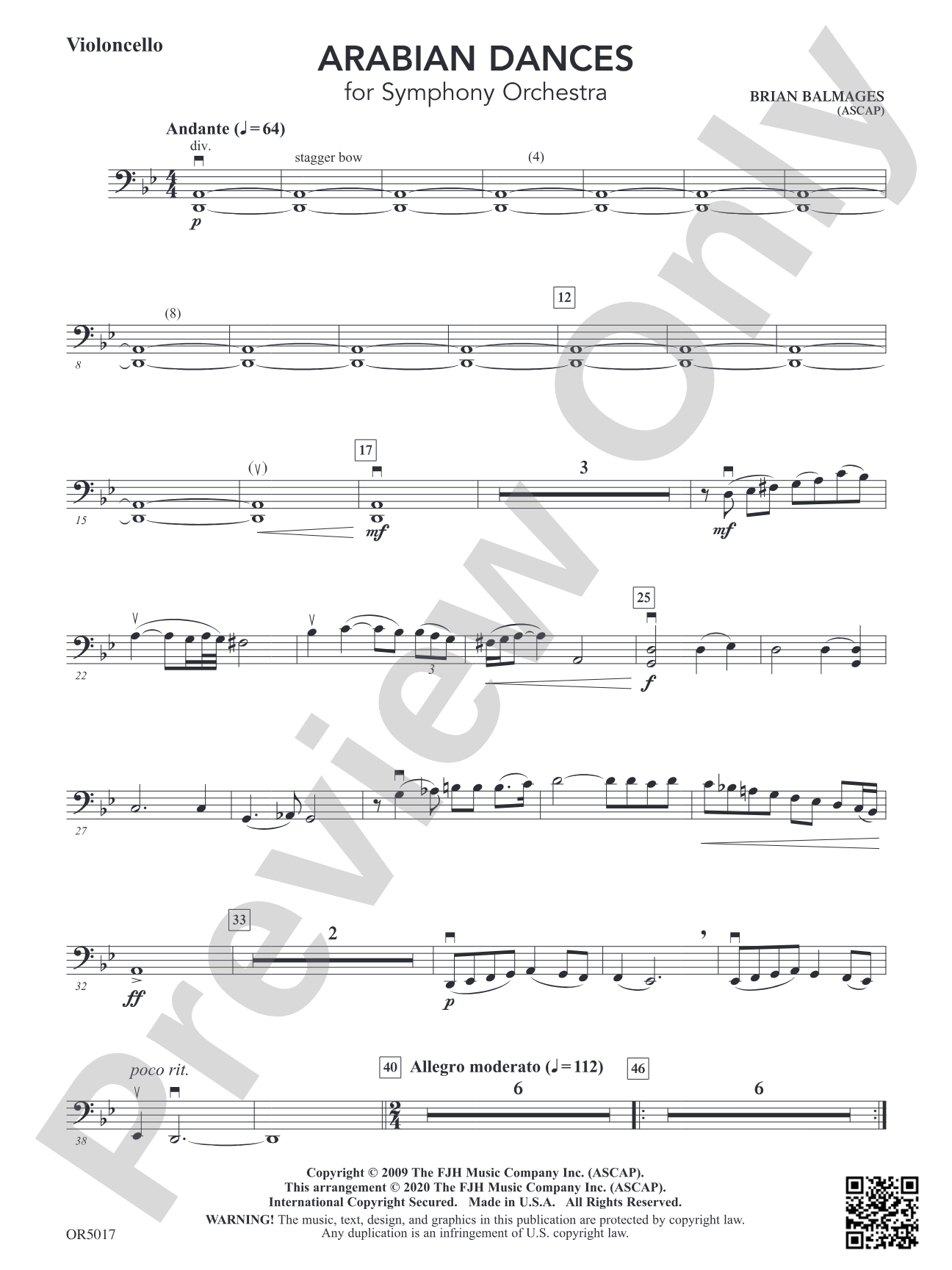

Arabian Dances: Violoncello
By Brian Balmages
Grade: 4
Item: 98-PC-DOR5017_VC1
$7.00
Pickup currently not available
Description
Explore Middle Eastern sounds with this work that combines traditional folk songs with original music. After a haunting opening, authentic Middle Eastern percussion instruments create the groove that accompanies the folk song Ala Dal’ona. As the orchestration builds, original themes are juxtaposed with existing material before an extended percussion ensemble takes center stage. The final folk song, Tafta Hindi, ultimately morphs into an ostinato over a magnificent presentation of the original theme found throughout the work. A dynamic work for symphony orchestra!


Arabian Dances: Violoncello isn't in MakeMusic Cloud just yet...but it could be. Let us know you'd like to see it, and you'll help shape what comes next. In the meantime, start a free trial and dive into thousands of interactive titles your students can play along with today.
Request This Title
Tell us you want it.
Start Your Free Trial
Explore everything that's ready to play right now.
Sample Audio
1
Audio File
--:--
0:00
0:00
Sample Video
No sample videos found.
Additional Details
Series:
FJH Symphony Orchestra
Publisher:
The FJH Music Company, Inc.
SKU:
98-PC-DOR5017_VC1
More about this title
About the Composer: Brian Balmages

Brian Balmages has established himself as a composer and conductor working fluidly across orchestral, band, and chamber repertoire. His works have reached audiences in some of the world's most prestigious venues, from Carnegie Hall to the Sydney Opera House, performed by ensembles spanning from professional orchestras to school groups. He holds membership in the American Bandmasters Association and received the A. Austin Harding Award from the American School Band Directors Association, along with the 2020 NBA William D. Revelli Composition Contest prize for Love and Light.
Balmages maintains an active conducting schedule with all-state, regional, university, and professional ensembles globally, and has guest conducted at major conferences including the Midwest Clinic and Western International Band Clinic. His music was performed at the 2013 Presidential Inaugural Prayer Service, and he was commissioned by the University of Miami to compose for the presidential inauguration of Dr. Julio Frenk. He currently serves as Director of MakeMusic Publications and Digital Education for Alfred and MakeMusic.
Why we love this
Balmages brings genuine cultural authenticity to orchestral writing without sacrificing the accessibility that makes a Grade 4 work teachable. The piece earns its contest appeal through inventive orchestration and structural sophistication rather than artificial difficulty, and the extended percussion section finale gives students a vivid reason to commit to rehearsal.
What to expect
The opening draws you into a contemplative Middle Eastern soundscape before traditional folk melodies anchor themselves over propulsive, authentic percussion patterns. As original themes weave with folk material, the orchestration becomes increasingly colorful and kinetic, culminating in a celebration where rhythm, tradition, and fresh composition converge.
Who it's for
Symphony orchestras at the secondary and early college level ready to explore non-Western musical traditions with sophistication and rigor. This work suits ensembles with solid fundamentals in rhythmic accuracy and balanced instrumentation who want to expand their repertoire beyond European classical models.
How to get the most out of it
- Balance the opening texture carefully so the haunting quality registers without the ensemble pulling back on support; the early mystery depends on clarity more than softness.
- Establish a solid rhythmic foundation for the Ala Dal'ona section before layering the orchestration; Middle Eastern grooves require precision from the rhythm section to breathe authentically.
- Shape the transition into the final folk song deliberately; this shift propels the momentum toward the ostinato and original theme recapitulation that closes the work.
- Let the percussion ensemble shine during its featured section without drowning it in orchestral accompaniment; this moment rewards their preparation and carries the audience through to the climax.
How to use it
Program this as the centerpiece of a concert exploring cultural intersections in contemporary composition, or place it strategically in a contest program where its blend of accessibility and musical substance makes a strong impression. The work's length and dramatic arc also serve well as a season opener that signals to audiences and students alike that the year will include adventurous, boundary-crossing repertoire.
Skills your students will build
- Reading and performing authentic Middle Eastern percussion patterns and timbral effects
- Balancing textural layers where folk melody, original themes, and rhythmic grooves coexist
- Responding to non-traditional orchestration and instrumentation choices
- Sustaining ensemble cohesion through shifts in harmonic language and cultural musical idioms
- Precision in rhythmic ensemble playing, particularly syncopated and polyrhythmic figures