
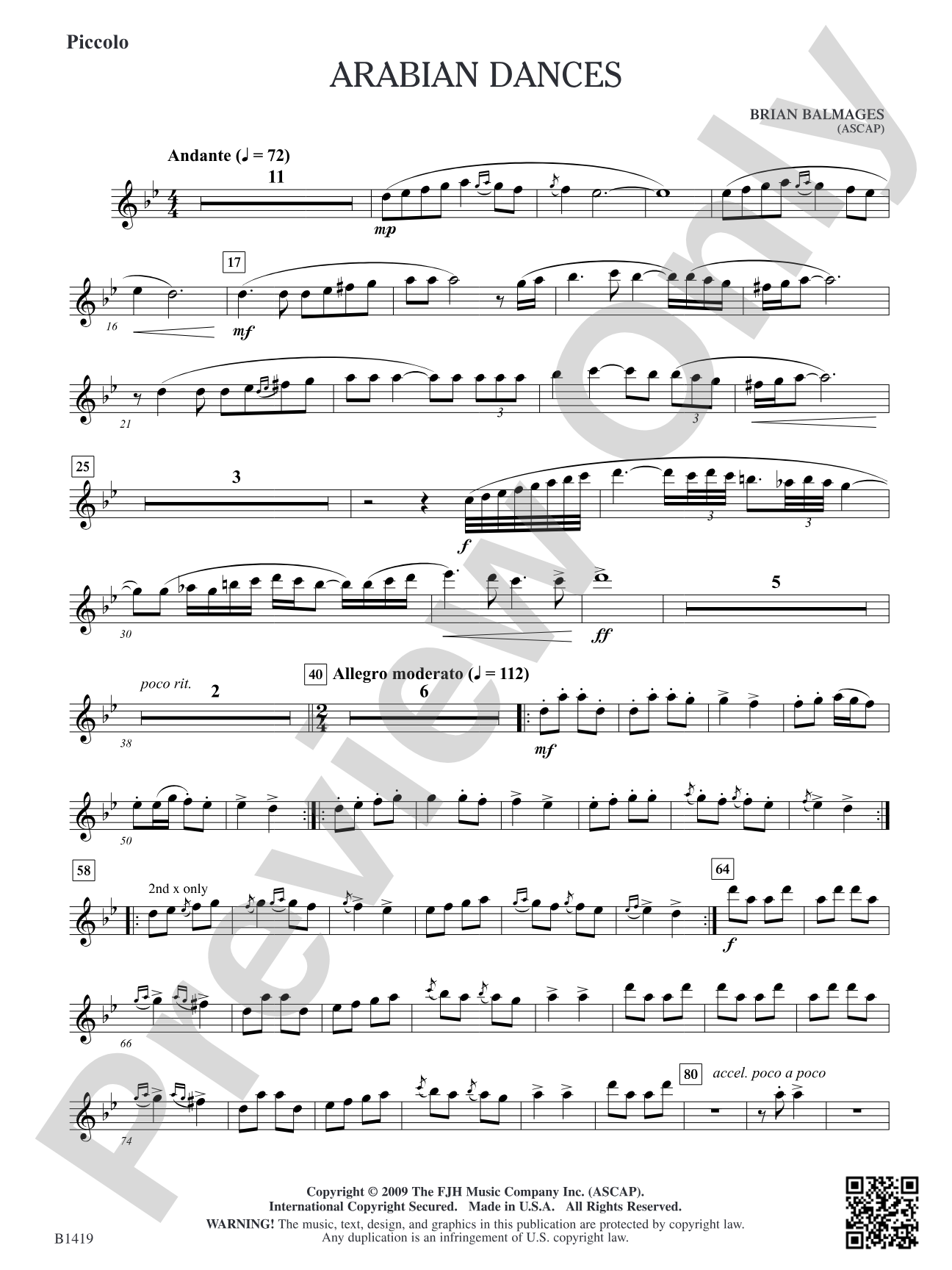

Arabian Dances: Piccolo
By Brian Balmages
Grade: 4
Item: 98-PC-DB1419_P1
$7.00
Pickup currently not available
Description
Explore Middle Eastern sounds with this work that combines authentic traditional melodies and rhythms with original music. After a haunting opening, authentic Middle Eastern percussion instruments create the groove that accompanies the folk song Ala Dal'ona. As the orchestration builds, original themes are intertwined before the percussion ensemble becomes the focus of the third section. The final melody, Tafta Hindi, develops until it morphs into an ostinato over a magnificent presentation of the original theme that is found throughout the work. A riveting ending brings this thrilling work to a dynamic close! (6:30)


Don't just read it, hear it, play along with it, and watch your students grow with it. In MakeMusic Cloud, Arabian Dances: Piccolo comes alive with professional accompaniment, adjustable tempo, and built-in practice tools that turn solo practice into real progress.
Open in the Player
Jump straight in and assign it today.
Start Your Free Trial
Open this title and explore the full library in minutes.
Sample Audio
1
Audio File
--:--
0:00
0:00
Sample Video
No sample videos found.
Additional Details
Series:
FJH Symphonic Band
Publisher:
The FJH Music Company, Inc.
SKU:
98-PC-DB1419_P1
More about this title
About the Composer: Brian Balmages

Brian Balmages has built a reputation as a composer and conductor equally at home in orchestral, band, and chamber music settings. His works have been heard in some of the world's most prestigious venues, from Carnegie Hall to the Sydney Opera House, performed by ensembles ranging from professional orchestras to elementary school groups. He holds membership in the American Bandmasters Association and received the A. Austin Harding Award from the American School Band Directors Association. His composition Love and Light won the 2020 NBA William D. Revelli Composition Contest.
Balmages has conducted at major conferences including the Midwest Clinic, Western International Band Clinic, and numerous state music education events across North America and internationally. He earned the inaugural James Madison University Distinguished Alumni Award and was commissioned by the University of Miami to compose for the inauguration of the institution's president. His music was performed at the 2013 Presidential Inaugural Prayer Service. Currently, he serves as Director of MakeMusic Publications and Digital Education for Alfred and MakeMusic.
Why we love this
Arabian Dances masterfully blends folk authenticity with original material, giving your band a chance to explore non-Western musical traditions without sacrificing the coherent, dramatic arc your audience expects. The carefully layered orchestration moves from intimate percussion writing to full ensemble tutti, and the inclusion of named folk melodies (Ala Dal'ona and Tafta Hindi) grounds students in real cultural music rather than generic exotica. This is the kind of concert piece that sounds exotic and ambitious while remaining accessible to Grade 4 ensembles.
What to expect
Arabian Dances opens with an evocative, mysterious atmosphere before propelling into an energetic groove anchored by percussion. The journey moves through lyrical folk melody, builds into rich orchestral textures, and culminates in a powerful fusion of theme and ostinato that feels both inevitable and thrilling.
Who it's for
Grade 4 bands seeking a concert piece that broadens musical horizons without oversimplifying cultural material. Directors programming festivals or contests will appreciate the dramatic arc and orchestral sophistication, while students gain exposure to Middle Eastern melodic and rhythmic traditions through direct engagement with folk material.
How to get the most out of it
- Balance the authentic Middle Eastern percussion instruments prominently in the opening and middle sections; these colors are central to the work's character and should never be buried beneath the winds.
- Shape the folk melody Ala Dal'ona with warmth and slight rubato, especially in the exposition, to honor its traditional origins before the band's orchestration builds around it.
- Bring the percussion ensemble fully forward during the third section so the audience hears the rhythmic conversation between various drums and instruments as compositional content, not accompaniment.
- Build the final development of Tafta Hindi as a gradual crescendo that feels inevitable; the ostinato underneath should have steady forward motion, creating contrast with the main theme's soaring line above it.
How to use it
Ideal as a centerpiece for a world music or multicultural concert, or as a high-energy closer for a festival program that showcases your band's range. The work's 6:30 duration and varied orchestration make it an excellent contrast piece alongside European classical or contemporary American works.
Skills your students will build
- Balance and blend of non-standard percussion instruments in ensemble context
- Phrasing and expression in folk melody traditions unfamiliar to Western classical training
- Rhythmic coordination across syncopated and non-metered percussion writing
- Dynamic control from intimate solos to full ensemble climaxes
- Understanding of cultural music integration and respectful representation of world traditions