
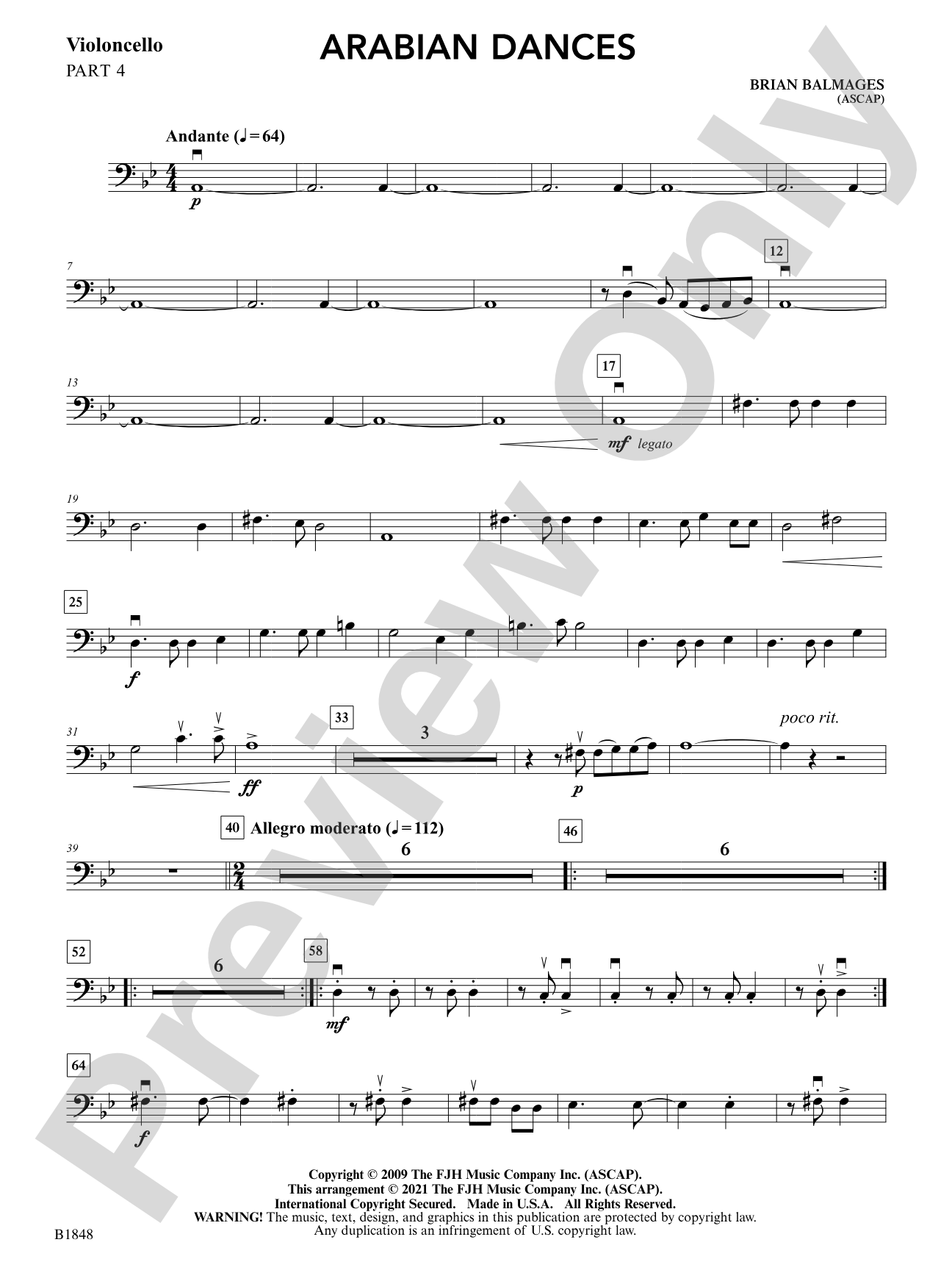

Arabian Dances: Part 4 - Violoncello
By Brian Balmages
Grade: 4
Item: 98-PC-DB1848_PART4_VCELLO
$7.00
Pickup currently not available
Description
Explore Middle Eastern sounds with Arabian Dances by Brian Balmages that combines authentic traditional melodies and rhythms with original music. After a haunting opening, authentic Middle Eastern percussion instruments create the groove that accompanies the folk song "Ala Dal'ona." As the orchestration builds, original themes are intertwined before the percussion ensemble becomes the focus of the third section. The final melody, "Tafta Hindi," develops until it morphs into an ostinato over a magnificent presentation of the original theme that is found throughout the work. A riveting ending brings this thrilling work to a dynamic close! (6:30)


Arabian Dances: Part 4 - Violoncello isn't in MakeMusic Cloud just yet...but it could be. Let us know you'd like to see it, and you'll help shape what comes next. In the meantime, start a free trial and dive into thousands of interactive titles your students can play along with today.
Request This Title
Tell us you want it.
Start Your Free Trial
Explore everything that's ready to play right now.
Sample Audio
1
Audio File
--:--
0:00
0:00
Sample Video
No sample videos found.
Additional Details
Series:
FJH Flex Series
Publisher:
The FJH Music Company, Inc.
SKU:
98-PC-DB1848_PART4_VCELLO
More about this title
About the Composer: Brian Balmages

Brian Balmages has built a career as both composer and conductor, creating music across orchestral, band, and chamber idioms that reaches audiences from elementary schools to major concert halls. His works have been heard at venues including Carnegie Hall, the Kennedy Center, and Sydney Opera House, and he has received the A. Austin Harding Award from the American School Band Directors Association, along with selection as a member of the American Bandmasters Association.
Beyond composition, Balmages maintains an active conducting schedule with all-state ensembles, university groups, and professional orchestras worldwide. He served as Director of MakeMusic Publications and Digital Education for Alfred and MakeMusic, and has been commissioned for high-profile events, including music for a U.S. Presidential Inaugural Prayer Service and the inauguration of the University of Miami's sixth president.
Why we love this
This piece succeeds because it treats Middle Eastern musical traditions as equal partners to original composition rather than exotic backdrop. Balmages structures the work so that traditional folk melodies and authentic percussion instruments drive the narrative, making it compelling for both audiences and performers while remaining genuinely musical across all ability levels in the ensemble.
What to expect
Arabian Dances begins with an atmospheric, mysterious quality that gradually draws the ensemble into rhythmic motion. As the work builds, percussion textures become increasingly prominent and energetic, creating a sense of festivity and forward momentum that carries through interwoven melodies before culminating in a dynamic, triumphant finish.
Who it's for
Grade 4 bands and flexible ensembles looking to program music that authentically represents non-Western traditions while remaining accessible and engaging at this level. Directors seeking contest or festival material that challenges students musically without requiring advanced technique will find this piece rewarding.
How to get the most out of it
- Invest rehearsal time in the percussion section early. The authentic Middle Eastern percussion writing shapes the entire character of the work, and securing clean articulation and tonal control in these instruments will elevate every section that follows.
- Balance the traditional folk melodies against original thematic material by adjusting dynamic levels in rehearsal rather than relying on the printed scores alone. The interweaving of both musical ideas rewards thoughtful phrasing in the melody sections.
- Treat the final ostinato-to-theme transition as a dramatic moment. This passage mirrors the opening's haunting quality but with accumulated energy, so clarity in the rhythmic pulse during this section will heighten the impact of the riveting ending.
How to use it
This works beautifully as a centerpiece for a concert exploring global musical traditions, or as a concert festival entry that showcases the ensemble's ability to handle both lyrical and rhythmically complex material. Its six-and-a-half-minute length makes it substantial enough to anchor a program without dominating the overall scope.
Skills your students will build
- Sight-reading flexible instrumentation across full band and string options
- Sustaining independent parts within rhythmically dense passages
- Responding to culturally authentic percussion writing and non-traditional rhythmic structures
- Balancing dynamic and timbral contrasts when original themes layer with folk melodies
- Managing tempo and articulation consistency through a multi-sectional form