
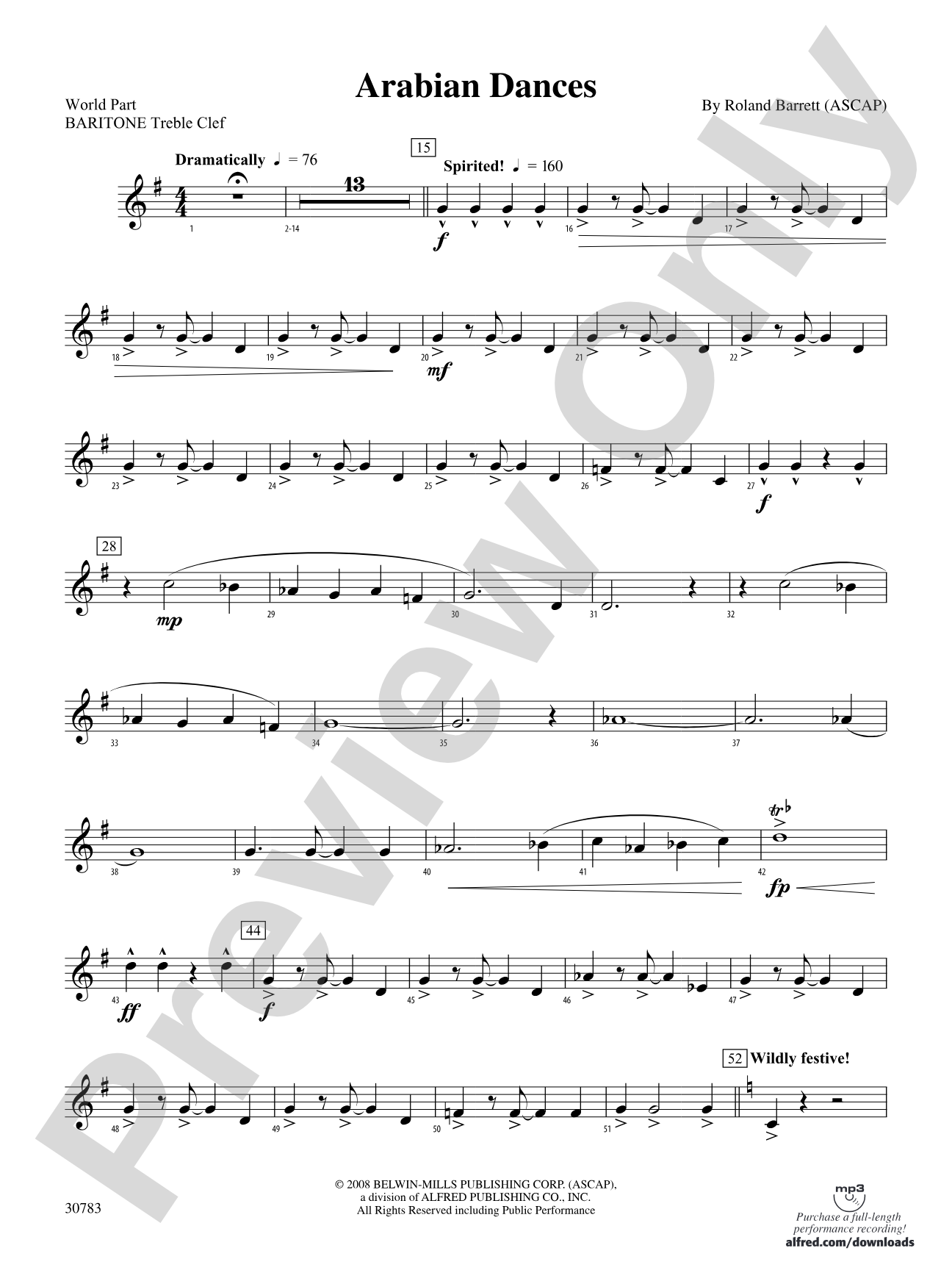

Arabian Dances: Baritone T.C.
By Roland Barrett
Grade: 2 (Easy)
Item: 00-PC-0001676_BTC1
$3.00
Pickup currently not available
Description
Join Roland Barrett on this multicultural musical journey depicting a nighttime celebration dancing around a roaring campfire. The work opens featuring a brief clarinet solo setting the stage and the bold dance commences. A real treat for your entire band is the relentless energy depicted by combining characteristic melodies with energetic hand clapping. A rousing choice! (3:05) This title is available in MakeMusic Cloud.


Don't just read it, hear it, play along with it, and watch your students grow with it. In MakeMusic Cloud, Arabian Dances: Baritone T.C. comes alive with professional accompaniment, adjustable tempo, and built-in practice tools that turn solo practice into real progress.
Open in the Player
Jump straight in and assign it today.
Start Your Free Trial
Open this title and explore the full library in minutes.
Sample Audio
1
Audio File
--:--
0:00
0:00
Sample Video
Additional Details
Series:
Belwin Young Band
Publisher:
Alfred Music
Page Count:
264
SKU:
00-PC-0001676_BTC1
More about this title
About the Composer: Roland Barrett

Roland Barrett has spent his career bridging practical musicianship with rigorous compositional craft. As a faculty member at the University of Oklahoma since 2001, he teaches music theory and composition while continuing his role as arranger for the Pride of Oklahoma marching band, maintaining direct contact with the ensemble world he writes for.
With over two hundred published works for symphonic band, chamber groups, and marching ensembles, Barrett has earned recognition that extends across the profession. His compositions appear regularly on All-State and All-Region programs, and his work has been featured on NPR and at major national conventions. A multiple recipient of the ASCAP Plus award, he writes with deep understanding of what makes music both accessible to young musicians and satisfying to perform.
Why we love this
Arabian Dances proves that Grade 2 doesn't mean simplistic. The opening clarinet solo immediately establishes character, and the piece builds from there with genuine compositional intelligence rather than just filling time. Barrett's use of hand clapping alongside melody creates a physicality that Grade 2 students rarely encounter, making this work feel alive in ways most easy-level selections don't.
What to expect
A campfire celebration with real momentum. The piece captures the warmth of gathering around flame while maintaining forward energy through hand clapping and interlocking rhythms. There's joy in the writing, and a sense of shared participation rather than spectacle.
Who it's for
Directors seeking accessible yet musically substantial repertoire for Grade 2 bands. This works equally well for bands building confidence and musicality as for festival/contest programming where you need a piece that sounds engaged and alive without requiring advanced technique.
How to get the most out of it
- Bring out the clarinet solo in the opening with enough space and resonance that it feels like a genuine moment, not just a transition. This sets the listener's ear for what comes next.
- The hand clapping needs precision and consistency from your ensemble. Mark the rhythm clearly in rehearsal and have everyone clap together to lock it in before adding it to the full texture.
- Maintain the energetic pulse throughout. At 3:05, pacing matters. The relentless quality Barrett writes comes from steady forward motion, not from pushing the tempo.
- Balance your melodic voices carefully so characteristic themes cut through the rhythmic and percussive activity without the ensemble working harder.
How to use it
Arabian Dances functions well as a mid-concert selection where you want to shift energy and mood without dropping to a ballad. It also pairs effectively on festival programs where judges need to hear your ensemble's rhythmic precision and ability to balance multiple musical ideas at once.
Skills your students will build
- Ensemble rhythmic precision in mixed meters and syncopated figures
- Balance between melodic lines and rhythmic accompaniment
- Phrasing and articulation clarity within energetic textures
- Coordination of body percussion (hand clapping) with instrumental parts
- Reading and executing characteristic melodic figures across the full band