

April Is in My Mistress' Face: 3-Part Mixed, a cappella Choral Octavo
Music by Thomas Morley / arr. Russell Robinson
Item: 00-PO-0002133
$2.25
Minimum order quantity: 20 copies
Pickup currently not available
Description
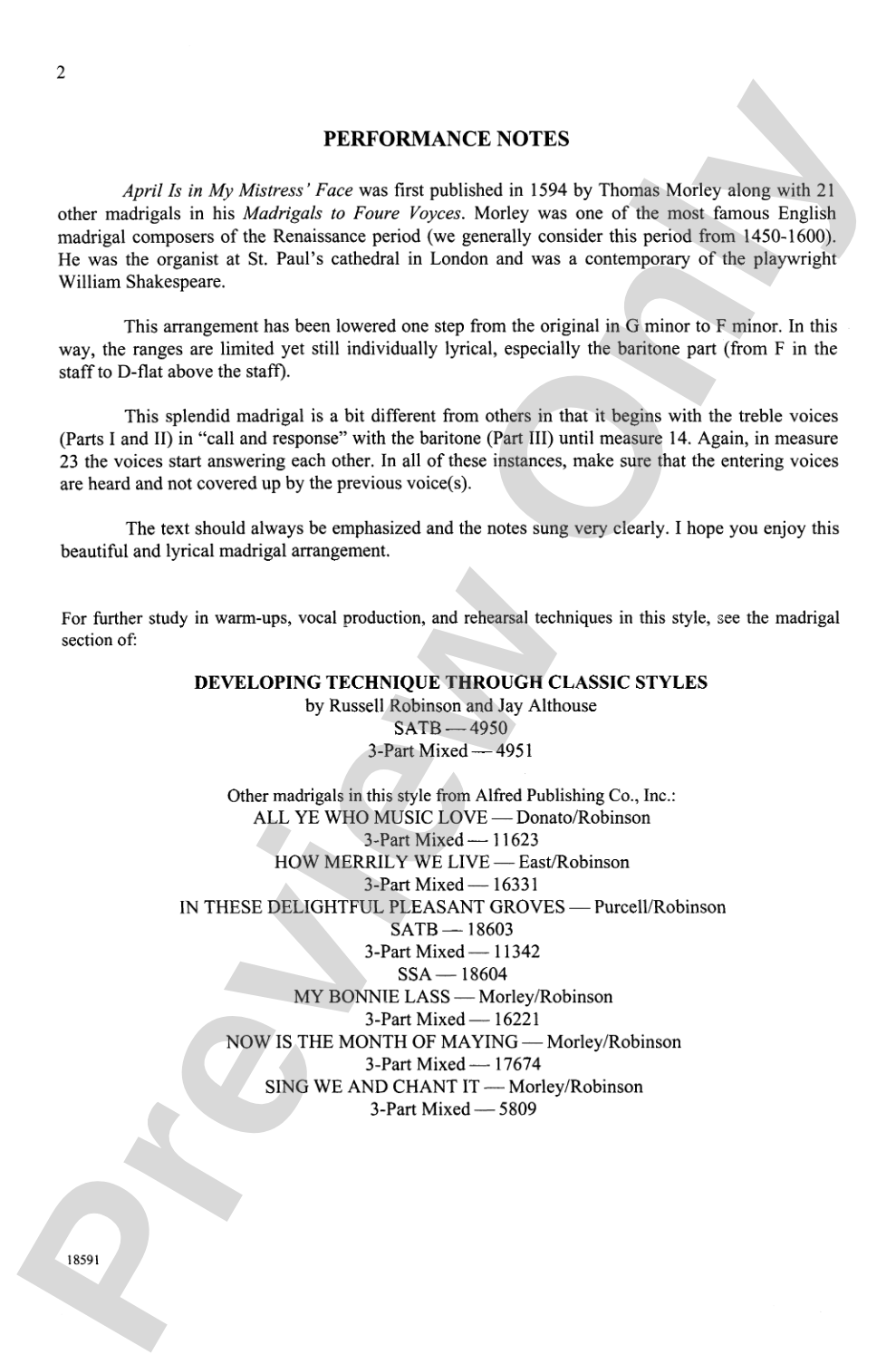
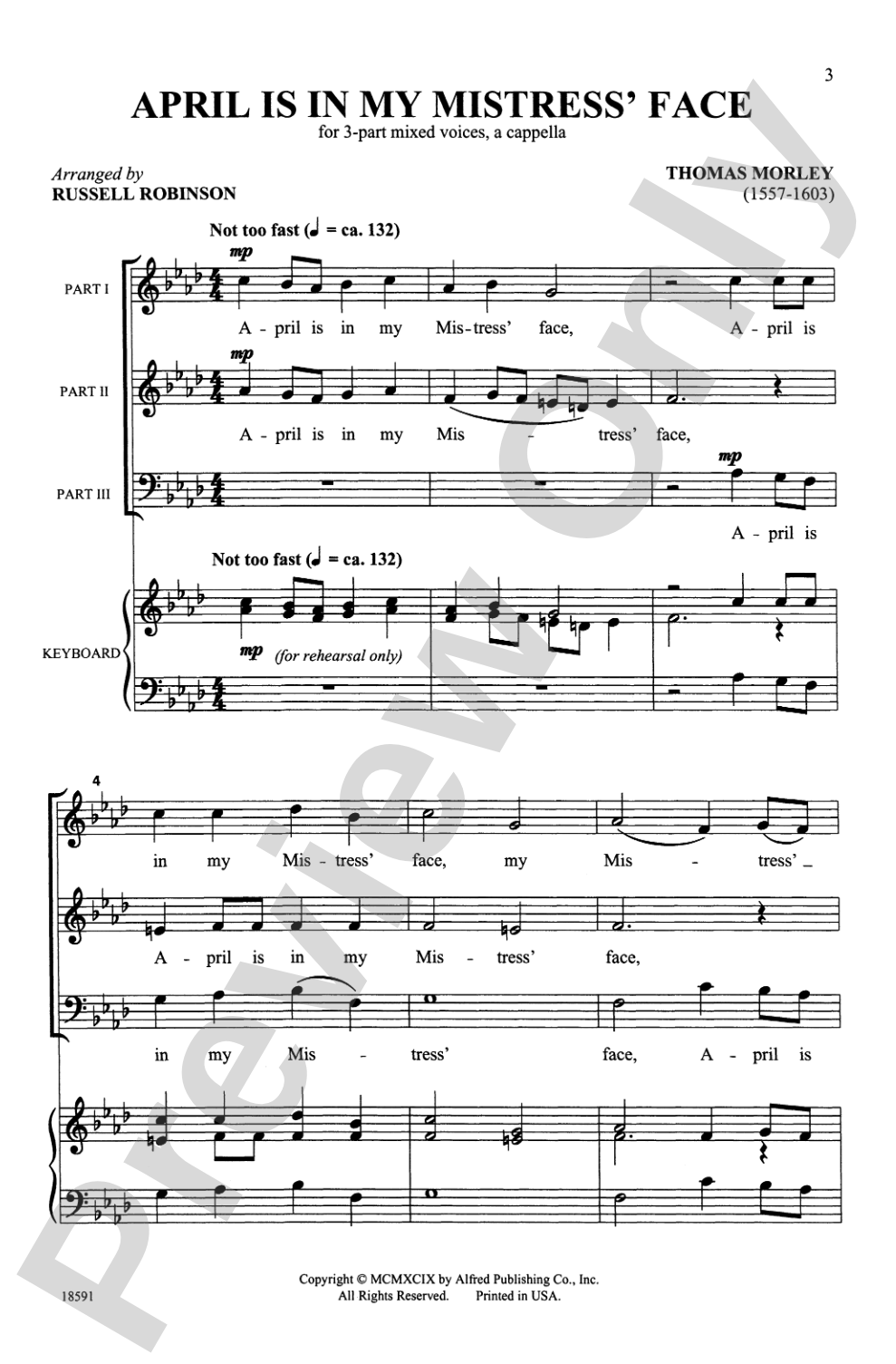
Feature your men with this sumptuous edition of an a cappella standard from the madrigal repertoire by Thomas Morley. Formerly available for 3-part mixed voices, Russell Robinson's new TBB adaptation features flowing contrapuntal lines, appropriate vocal ranges, and tasteful editor's marks for a truly authentic performance. Enjoyable to sing, valuable to teach, and splendid to hear.


April Is in My Mistress' Face: 3-Part Mixed, a cappella Choral Octavo isn't in MakeMusic Cloud just yet...but it could be. Let us know you'd like to see it, and you'll help shape what comes next. In the meantime, start a free trial and dive into thousands of interactive titles your students can play along with today.
Request This Title
Tell us you want it.
Start Your Free Trial
Explore everything that's ready to play right now.
Sample Audio
1
Audio File
--:--
0:00
0:00
Sample Video
No sample videos found.
Additional Details
Series:
Alfred Archive Edition: Alfred Choral Designs
Publisher:
Alfred Music
Page Count:
8
SKU:
00-PO-0002133
More about this title
About the Composer: Thomas Morley
Thomas Morley (1557-1602) was an English composer and theorist who shaped the development of the English madrigal during the Renaissance. A student of Christopher Tallis and William Byrd, Morley became one of the most prolific madrigal composers of his era, publishing over 180 works across multiple collections. His gift for text painting, rhythmic vitality, and singable melodic lines made his madrigals accessible to amateur musicians while remaining musically sophisticated enough to sustain professional performance.
Morely's theoretical writings, particularly his influential treatise "A Plain and Easy Introduction to Practical Music" (1597), profoundly shaped music education for generations. In his dual role as composer and pedagogue, he demonstrated that technically rigorous music could also be joyful and immediately engaging for singers at all levels—a principle that continues to make his madrigals essential to choral curricula today.
Why we love this
Russell Robinson's TBB adaptation opens this madrigal masterpiece to men's voices without sacrificing the flowing counterpoint and textual clarity that make Morley's original so enduring. The edition strikes an ideal balance between authenticity and singability; Robinson's careful voice leading respects the Renaissance harmonic language while accommodating realistic vocal ranges, making this a piece your men will actually enjoy rehearsing and performing rather than tolerate.
What to expect
Warm, intimate, and declarative. Morley's text painting on "April is in my mistress' face" creates moments of genuine tenderness, while the contrapuntal motion gives the piece forward momentum and elegance. There's a distinctly English Renaissance character here: refined without being precious, emotionally direct without sentimentality.
Who it's for
Men's choirs and mixed ensembles looking to add Renaissance repertoire that showcases musicianship without requiring soloistic voices. Directors building competitive festival programs will find this edition particularly valuable; its manageable ranges and clear scoring make it accessible for high school men's choirs while its sophisticated counterpoint satisfies adjudicators.
How to get the most out of it
- Shape each phrase according to the text rather than squaring off at barlines; Morley's madrigal style thrives on gentle arcs that match the poetry's natural speech rhythms.
- Blend vowels consistently across the three parts, especially in moments where voices move in parallel motion; this amplifies the textural warmth Morley's writing creates.
- Attend closely to editor's marks for dynamics and articulation; Robinson's annotations reflect performance practice conventions that bring out the piece's expressive potential without over-interpreting the score.
- Allow the harmonic progressions to breathe at authentic tempos; resist the urge to rush, as static harmony invites listeners into the emotional world of the text.
How to use it
Program this as a centerpiece for a Renaissance or early English music concert, pairing it with other madrigals or motets from the same era. It also works beautifully as an encore or as part of a thematic concert exploring love poetry across centuries; the work's brevity and immediate appeal make it memorable without demanding excessive rehearsal time from your ensemble.
Skills your students will build
- Reading independent contrapuntal lines within a three-part texture
- Sustaining intonation across relatively static harmonic movement
- Text painting and expressive shaping in Renaissance harmonic language
- Maintaining blend and balance across shifting voice registers in men's voices