
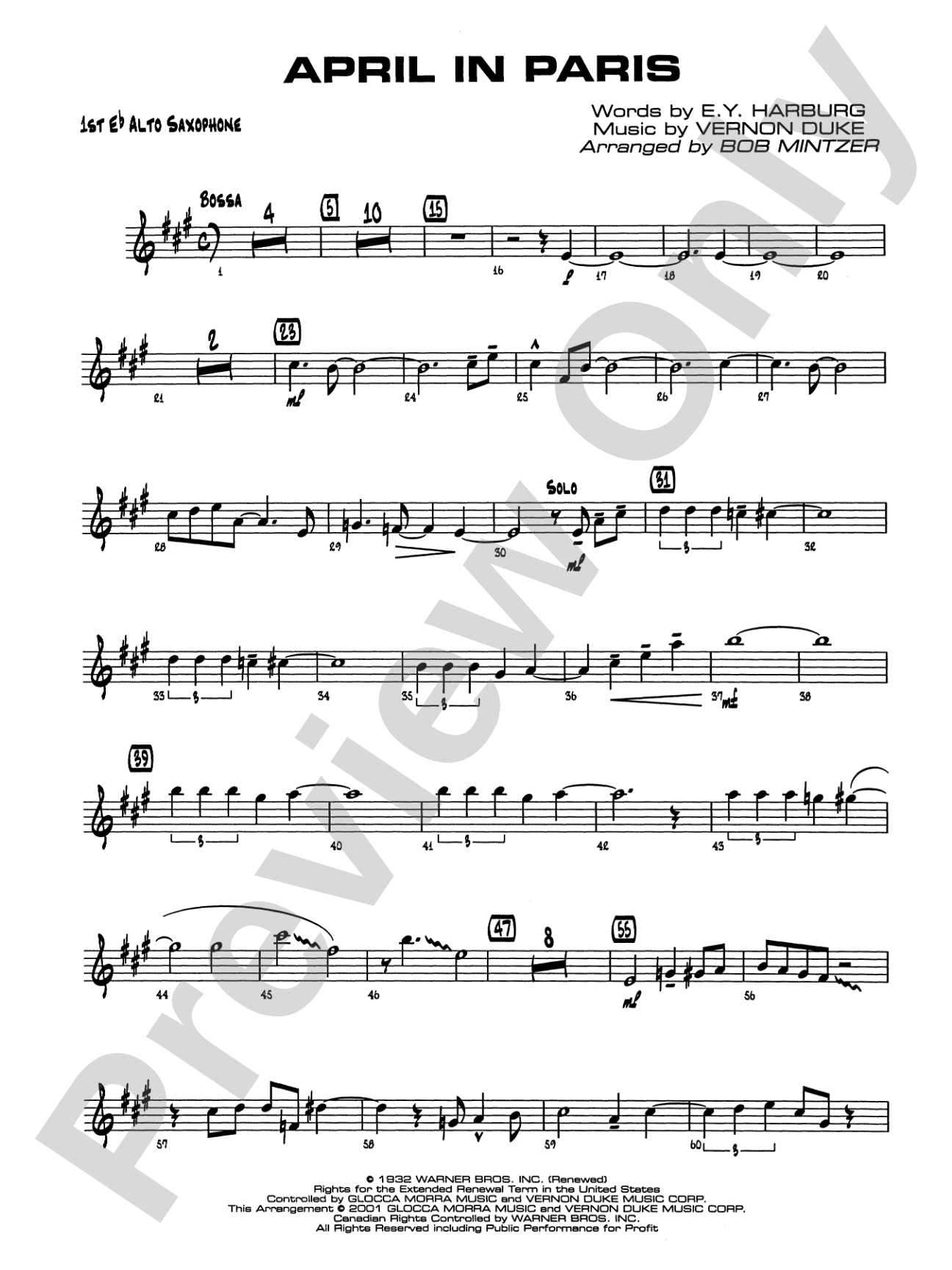

April in Paris: E-flat Alto Saxophone
Words by E. Y. Harburg, music by Vernon Duke / arr. Bob Mintzer
Grade: 4.5 (Medium Advanced / Difficult)
Item: 00-PC-0017099_AX1
$3.00
Pickup currently not available
Description
Arranger/composer Bob Mintzer adds brand new life to this dynamic jazz swing tune, as recorded on his recent Grammy winning CD Homage to Count Basie. The bossa nova treatment serves as a perfect blend of Bob's contemporary harmonies with the traditional Basie sound. There is solo space for piano and optional solos for alto or trumpet. The brass range is very accessible with trumpet only to written G on top of the staff. This highly recommended chart belongs in every jazz library. (6:05)


Don't just read it, hear it, play along with it, and watch your students grow with it. In MakeMusic Cloud, April in Paris: E-flat Alto Saxophone comes alive with professional accompaniment, adjustable tempo, and built-in practice tools that turn solo practice into real progress.
Open in the Player
Jump straight in and assign it today.
Start Your Free Trial
Open this title and explore the full library in minutes.
Sample Audio
1
Audio File
--:--
0:00
0:00
Sample Video
No sample videos found.
Additional Details
Series:
Premier Jazz Series
Publisher:
Alfred Music
Page Count:
124
SKU:
00-PC-0017099_AX1
More about this title
About the Composer: Vernon Duke
Vernon Duke (1903-1969) was an American composer equally at home in classical, theatrical, and popular music idioms. His versatility made him a prolific voice across Broadway, film, and concert halls; he wrote the standard "April in Paris" in 1932 for a theatrical revue, and the song has since become a jazz repertoire staple.
Duke's gift was melodic invention paired with sophisticated harmonic sensibility. His works have attracted arrangers across generations because the melodies sustain reharmonization beautifully; they remain instantly recognizable even when cast in entirely new contexts. For jazz ensembles, Duke's standards offer both accessibility and depth.
Why we love this
Bob Mintzer's arrangement respects the song's melodic foundation while reimagining it through a bossa nova lens that sits comfortably alongside Basie-influenced swing vocabularycharacteristic of a master arranger working at the top of his craft. The brass writing stays genuinely playable at the Grade 4.5 level despite the harmonic sophistication, and the optional solo spaces (piano, alto, trumpet) give ensembles room to feature strong soloists without locking them into written requirements. This is the kind of chart that sounds impressive without punishing your section leaders.
What to expect
Sophisticated yet swinging, with a bossa nova pulse that feels contemporary rather than dated. The melody floats over rich, modern harmonies that nod respectfully to the Basie tradition without imitating it; expect an elegant groove that engages listeners immediately and reveals harmonic depth on repeated listenings.
Who it's for
Jazz ensemble directors programming Grade 4.5 repertoire who want a chart that impresses adjudicators and audiences alike. This works for ensembles with solid fundamental swing feel and at least one or two capable soloists, since the arrangement invites improvisation while remaining fully playable if soloists choose not to take optional passages.
How to get the most out of it
- Balance the ensemble so the melody sings through the collective texture; the bossa nova groove depends on rhythmic precision in the rhythm section, which means the horns can breathe and phrase rather than lock mechanically.
- Take advantage of the piano solo space to showcase your strongest improviser and use it as a rehearsal opportunity to coach rhythm section members on comping and responding to a soloist.
- Nail the attack and release of the ensemble figures in the brass; Mintzer's contemporary harmonies come alive when the tuning is clean and the articulation is unified.
- If you feature the alto or trumpet optional solos, prepare them during section rehearsals well before ensemble run-throughs so the soloists feel ownership of their time and the rhythm section can lock into their pulse.
How to use it
Ideal for concert programming where you want to showcase your ensemble's maturity and harmonic sophistication alongside their rhythmic pocket. Works beautifully in a set with other Mintzer arrangements or other Grade 4-5 jazz standards, and its contest/festival credentials make it a smart choice for adjudicated events where judges recognize quality orchestration.
Skills your students will build
- Bossa nova groove and swing feel integration
- Reading and executing contemporary jazz harmonies
- Section articulation and ensemble balance in jazz writing
- Improvisation over chord changes (optional solos)
- Listening to and responding to soloists as a rhythm section