
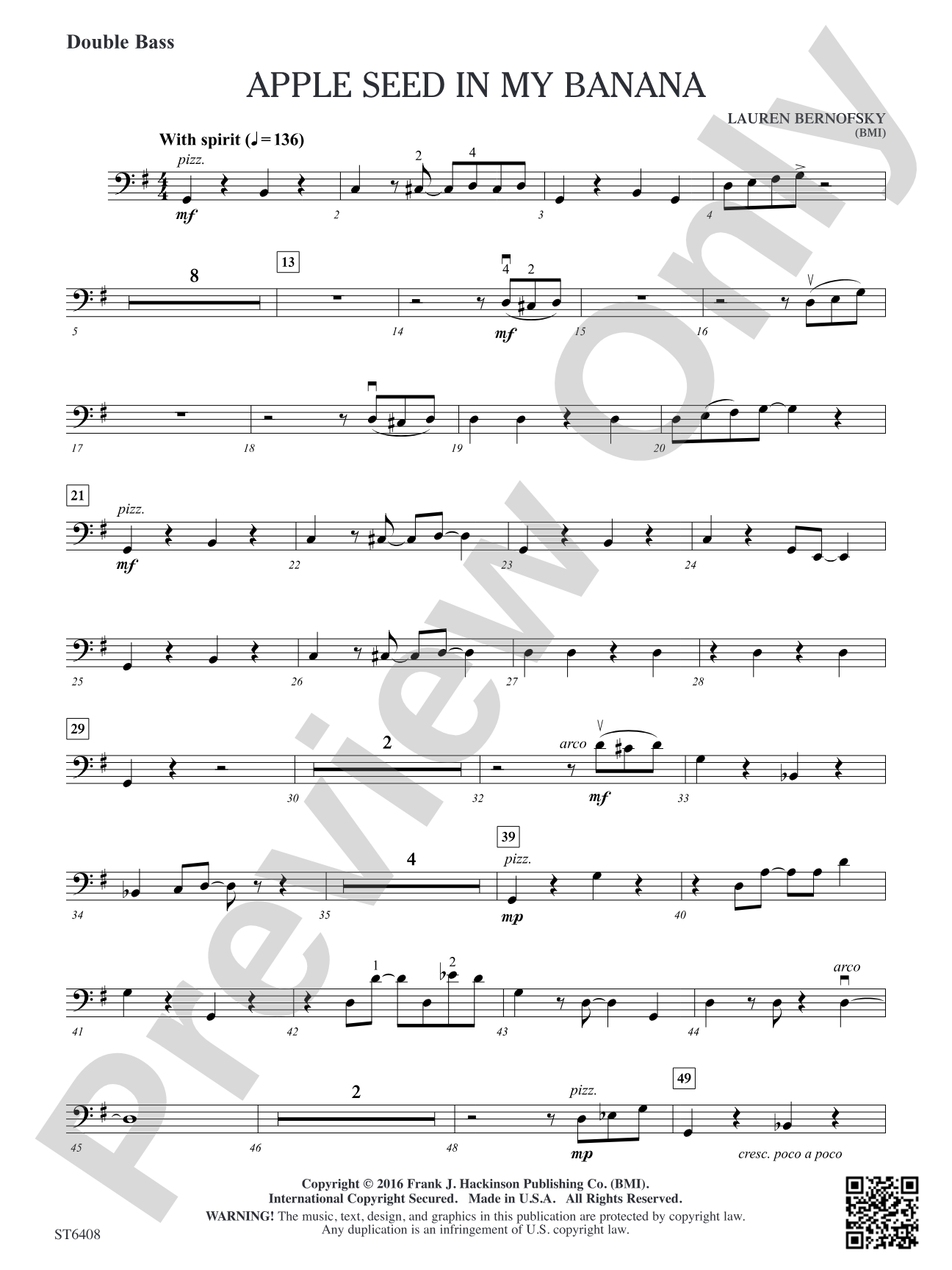

Apple Seed in My Banana: Double Bass
By Lauren Bernofsky
Grade: 3
Item: 98-PC-DST6408_SB
$7.00
Pickup currently not available
Description
Take your orchestra in a new direction with this infectiously catchy tune. Written by a seasoned composer of pedagogical music for strings, the piece features extremely playable chromatic passages. The most notable feature of the piece is an optional vamp section, which allows players to improvise a solo as the orchestra accompanies. Unleash your players' creativity, and prepare to be amazed by what your students can do!


Apple Seed in My Banana: Double Bass isn't in MakeMusic Cloud just yet...but it could be. Let us know you'd like to see it, and you'll help shape what comes next. In the meantime, start a free trial and dive into thousands of interactive titles your students can play along with today.
Request This Title
Tell us you want it.
Start Your Free Trial
Explore everything that's ready to play right now.
Sample Audio
1
Audio File
--:--
0:00
0:00
Sample Video
No sample videos found.
Additional Details
Series:
FJH String Orchestra
Publisher:
The FJH Music Company, Inc.
SKU:
98-PC-DST6408_SB
More about this title
About the Composer: Lauren Bernofsky

Lauren Bernofsky is a prolific composer whose works span solo repertoire, chamber music, choral literature, and large-scale orchestral, operatic, and ballet compositions. Her music has earned recognition from major institutions and commissions from ensembles worldwide, including the Bloomington Symphony and the Harford Ballet. Lukas Foss called her "a master composer," and her work has been praised for balancing emotional depth with intellectual rigor and technical demands.
Bernofsky's compositions have achieved significant recognition in prestigious competitions and media. Her Sonatine won the National Flute Association's Newly Published Music Competition, her opera Mooch the Magnificent received the Opera Puppets Award at Boston Metro Opera, and her choral work Prayer of Shantideva was commissioned as the winning entry of the Dalai Lama Composition Contest. She holds degrees from the Hartt School, New England Conservatory, and Boston University, and has served on the faculties of the Peabody Institute and Interlochen Center for the Arts.
Why we love this
A composer of pedagogical string music knows what sounds impressive without asking students to leap beyond their technical abilities, and Bernofsky delivers exactly that. The optional vamp section is genuinely inventive: it gives students a structured framework for improvisation while keeping the ensemble grounded, making this piece a natural gateway to creative playing without the chaos of open-ended experimentation.
What to expect
Bright and playful, with a melodic hook that sticks with you long after rehearsal ends. The chromatic writing adds sophistication and color without sacrificing the piece's infectious, crowd-pleasing energy. When the vamp section opens for a student solo, the piece shifts into a moment of genuine musical risk-taking that engages both the soloist and the ensemble.
Who it's for
String orchestras at the Grade 3 level looking for repertoire that combines accessibility with genuine musical interest. This piece works well for student groups that have steady intonation and rhythmic control but may still be building fluency with more complex technical passages.
How to get the most out of it
- Spend rehearsal time exploring the vamp section before assigning solos. Let the orchestra hear how different melodic ideas work over the accompaniment pattern so individual improvisers have a clear sense of harmonic and rhythmic context.
- Balance the chromatic passages with clean articulation; resist the urge to rush them for effect. Slight separation between notes keeps the line clear and makes the technical passages feel assured rather than hurried.
- Rotate student soloists through the vamp section across performances. This builds confidence across the section and ensures everyone experiences the creative opportunity, not just your most advanced players.
How to use it
This piece brings welcome levity to a concert program dominated by standard repertoire or more serious works. Program it in the middle of a set to reset audience energy, or place it as a closing number for a spring pops concert where student improvisations become a highlight.
Skills your students will build
- Navigating chromatic melodic lines with rhythmic accuracy
- Listening and responding as an accompaniment to a solo voice
- Improvisation within a harmonic structure
- Maintaining rhythmic precision during a vamp pattern