
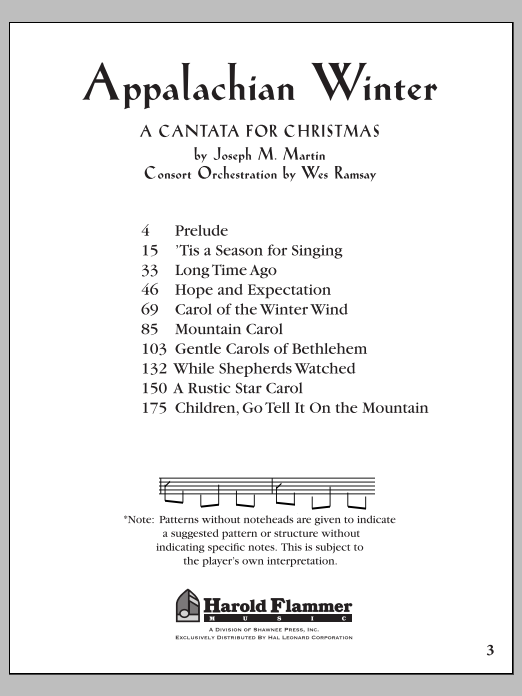

Appalachian Winter (A Cantata For Christmas): Choral Instrumental Pak
Item: 35-PK00294083
$200.00
Pickup currently not available
Buy Extra Parts (Digital PDF Download)
Parts Added to Cart!
Description
From the composer of "Festival of Carols" and "The Winter Rose" comes a cantata that celebrates the legacy of early American carols and hymnody. Composed in the spirit of folk music, the cantata combines traditional sounds with more rustic elements creating a blend that is fresh and pleasing. Popular American carols like "Away In a Manger" and "O Little Town of Bethlehem" dance with traditional spirituals such as "Children, Go Where I Send Thee" and "Go, Tell It on the Mountain." Sacred Harp tunes are re-tooled for Advent and stand alongside new versions of Shaker hymns and Appalachian melodies. Thoughtful narration weaves the movements together in a meaningful tapestry of song and Scripture. Two orchestral options are available allowing maximum flexibility in performance.
Trombone 1 2, Bass Trombone/Tuba, Timpani, Percussion, Acoustic Guitar, Banjo, Harp, Piano, Synth, Solo fiddle, Violin 1 2, Viola, Cello, Double Bass), Printed Full Orchestration, Appalachian Consort Orchestration (Score parts for Flute, Violin, Cello, Mandolin, Guitar, Percussion and Piano), StudioTrax CD (accompaniment only), SplitTrax CD, Listening CD, 10-Pack Listening


Appalachian Winter (A Cantata For Christmas): Choral Instrumental Pak isn't in MakeMusic Cloud just yet...but it could be. Let us know you'd like to see it, and you'll help shape what comes next. In the meantime, start a free trial and dive into thousands of interactive titles your students can play along with today.
Request This Title
Tell us you want it.
Start Your Free Trial
Explore everything that's ready to play right now.
Sample Audio
No sample audio found.
Sample Video
No sample videos found.
Additional Details
Publisher:
Hal Leonard
SKU:
35-PK00294083
More about this title
Why we love this
The orchestration options alone make this a director's dream: you can mount it with a full ensemble or strip it down to the Appalachian Consort version and maintain complete musical integrity. What sets this apart from standard holiday fare is how it honors the source material without sanitizing it, letting spirituals and Sacred Harp tunes breathe in their native harmonic language while still speaking to contemporary singers.
What to expect
Walking into a chapel where centuries of American voices overlap and conversation: there's the intimacy of Shaker simplicity, the spiritual call and response woven through spirituals, the sturdy faith of early hymody. The orchestration pulls you between folk authenticity and genuine musical sophistication, creating something that feels both rooted and vital.
Who it's for
Choirs with strong harmonic reading skills who want holiday programming beyond the expected; ensembles in communities with Appalachian heritage or those seeking meaningful sacred music for Advent through Christmas. Directors looking for a cantata that respects American musical traditions without abandoning musical substance.
How to get the most out of it
- Study both orchestration options before committing to one; the Appalachian Consort arrangement benefits from acoustic guitar and mandolin clarity, while the full orchestration demands careful balance between strings and brass to keep the folk origins visible.
- Work the narration sections with the same attention to pacing and text clarity you'd give a dramatic monologue; these transitions carry weight and shouldn't feel rushed or decorative.
- Layer your rehearsals by movement, anchoring each one to its source tradition (spirituals, Sacred Harp, Shaker hymns) so singers understand what they're interpreting, not just what they're singing.
How to use it
Perfect as a standalone Christmas concert or the centerpiece of an Advent service where you want to build meaning through narrative and thematic depth. It also pairs naturally with instrumental Christmas classics or congregational singing if you're in a sacred setting.
Skills your students will build
- Singing in extended harmonic language typical of Sacred Harp and shape-note traditions
- Navigating stylistic contrasts between spirituals, hymns, and contemporary choral writing within a single work
- Interpreting text through narration cues and understanding how stories shape musical phrases
- Ensemble balance when working with multiple orchestration options and unfamiliar instrumental colors