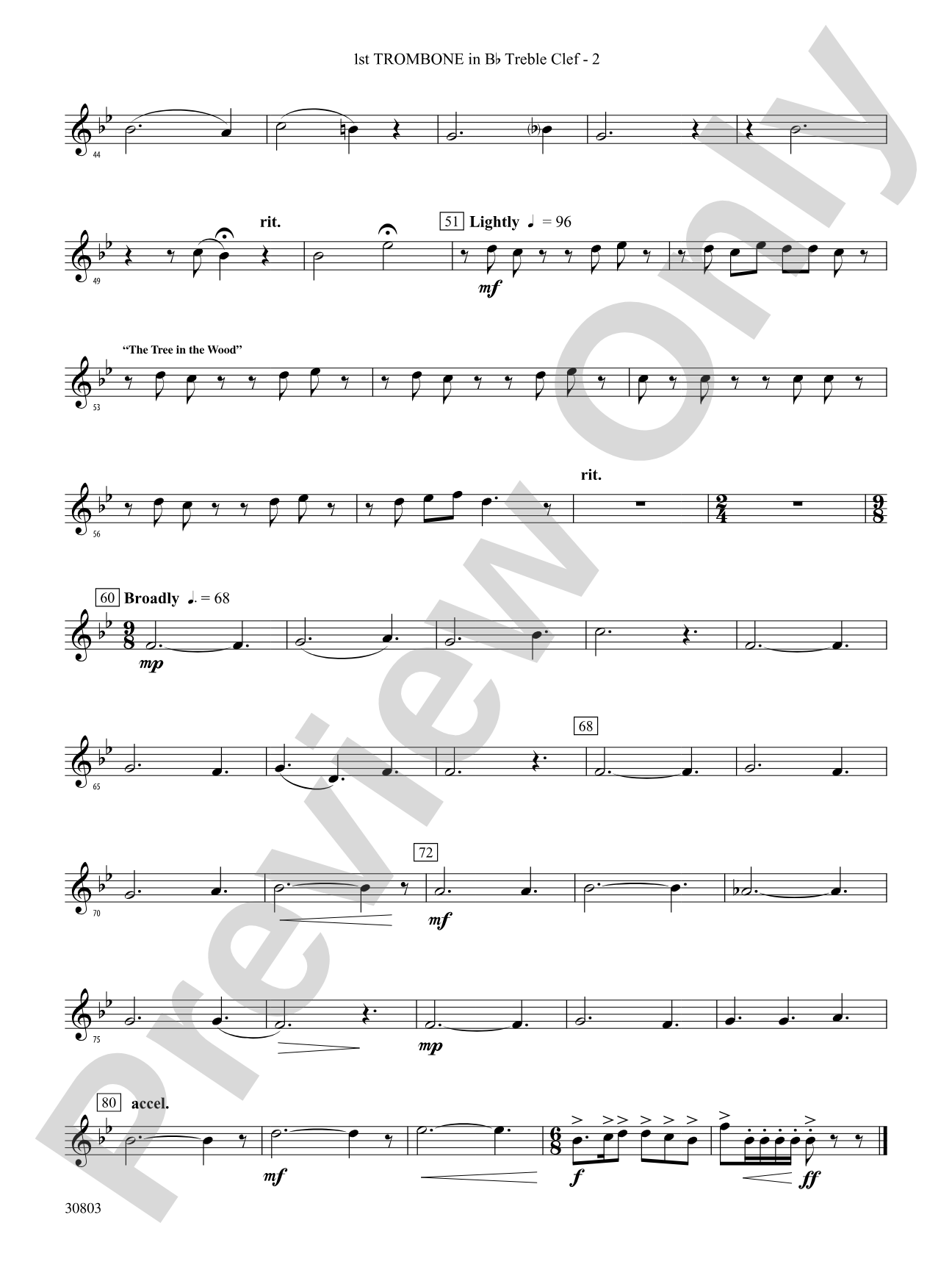
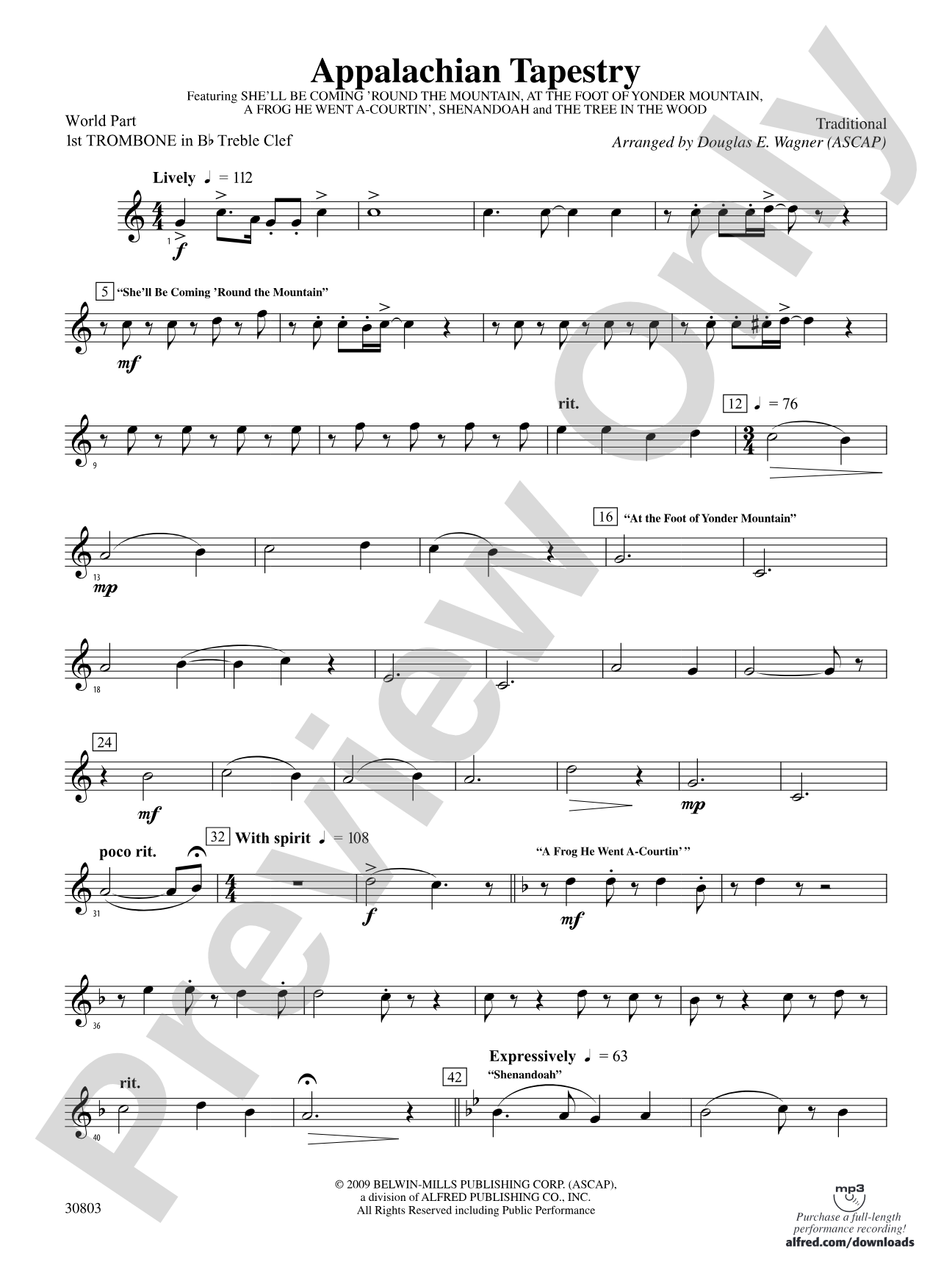
Appalachian Tapestry: (wp) 1st B-flat Trombone T.C. Sheet Music Preview

Appalachian Tapestry: (wp) 1st B-flat Trombone T.C.

Featuring: She'll Be Coming 'Round the Mountain / At the Foot of Yonder Mountain / A Frog He Went A-Courtin' / Shenandoah / The Tree in the Wood

Traditional / arr. Douglas E. Wagner

Grade: 3 (Medium Easy)

Item: 00-PC-0001684_wpTN1TC

Digital Download
$3.00
Description
Rich in musical heritage, Appalachian Tapestry warmly depicts five varied folk tunes representative of this region. The awesome beauty and grandeur of the Appalachian mountain range is presented through folk and fiddle tunes all intertwined in this musical journey. A cherished new setting sure to please. This title is available in MakeMusic Cloud.

Don't just read it, hear it, play along with it, and watch your students grow with it. In MakeMusic Cloud, Appalachian Tapestry: (wp) 1st B-flat Trombone T.C. comes alive with professional accompaniment, adjustable tempo, and built-in practice tools that turn solo practice into real progress.

Sample Audio
0:00
0:00
Sample Video
Additional Details
Series: Belwin Concert Band
Publisher: Alfred Music
Page Count: 226
SKU: 00-PC-0001684_wpTN1TC

More about this title

About the Arranger: Douglas E. Wagner

Douglas E. Wagner

Douglas E. Wagner grew up in Chicago and earned degrees in music from Butler University before launching a three-decade career as a high school music educator and administrator. Since 1973, he has composed and arranged over 3,500 works spanning concert band, orchestra, choir, handbell ensemble, organ, piano, and vocal literature.

Wagner's output has reached performers and audiences globally, with more than seventeen million copies of his music in circulation. He now focuses full-time on composition and arranging from his home in Indianapolis, Indiana.

Why we love this

Wagner brings genuine pedagogical insight to folk material, constructing five distinct musical narratives within a Grade 3 framework without oversimplifying the idiom. The piece balances accessibility with authentic regional character, giving your band genuine cultural content rather than mere decoration. Programming this alongside standard concert works signals to students and audiences that folk heritage deserves serious artistic attention.

What to expect

Five interwoven folk narratives unfold like a journey through Appalachian landscapes, each tune revealing its own character before blending into the next. The writing honors fiddle traditions and mountain sensibilities while maintaining the warmth and grandeur that define this region's musical legacy.

Who it's for

Concert bands at the intermediate level will find this arrangement musically substantial yet technically manageable. Directors seeking meaningful repertoire that connects students to American musical roots will appreciate both the pedagogical value and performance appeal.

How to get the most out of it

  • Shape each folk tune as a complete musical thought rather than transitional material. Attend to phrasing and rubato even in the easier passages; folk music thrives on natural breathing and subtle rhythmic flexibility.
  • Balance the intertwining parts so no single instrumental line drowns out the melodic content. The arrangement's richness depends on transparent voicing across sections.
  • Lean into the regional character of each tune through dynamic nuance and articulation choices. Let the mountain heritage speak through your interpretation rather than treating folk tunes as generic filler.

How to use it

This works beautifully as an opener to establish regional or American heritage programming, or as a centerpiece that explores folk roots alongside contemporary works. Consider pairing it with patriotic selections or other folk-based arrangements to create a unified concert theme that resonates with diverse audiences.

Skills your students will build

  • Balancing multiple melodic lines with contrasting timbres
  • Interpreting folk music idioms and phrasing conventions
  • Managing dynamic clarity across five distinct thematic sections
  • Ensemble blend when transitioning between different orchestrations

You May Also Like