
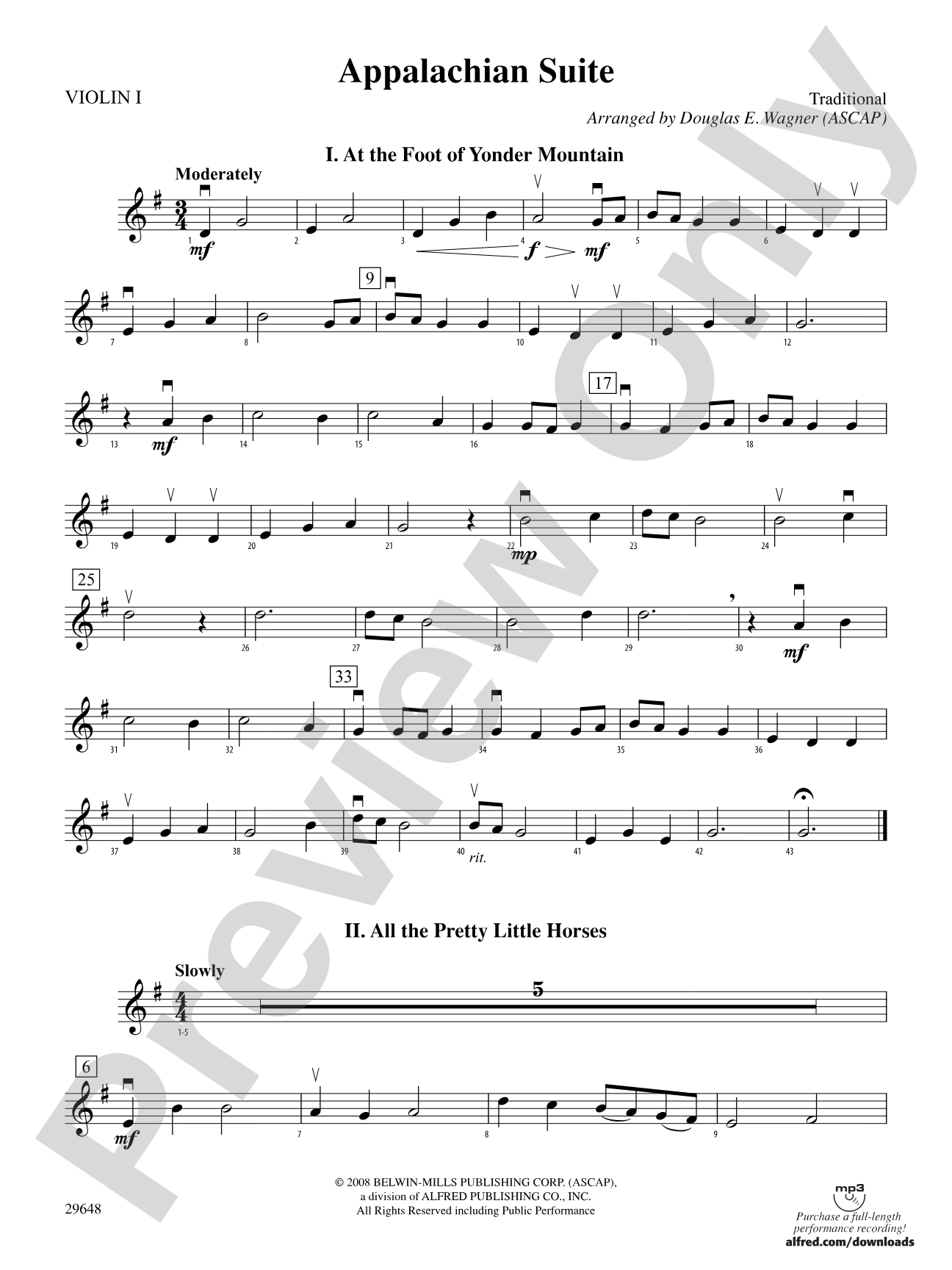

Appalachian Suite: 1st Violin
Traditional / arr. Douglas E. Wagner
Grade: 1.5
Item: 00-PC-0001526_VN1
$5.99
Pickup currently not available
Description
The rich heritage of musical Americana is delightfully presented in three contrasting movements based on traditional folk songs from the Southern Appalachian Mountains. "At the Foot of Yonder Mountain" (G major), a beautiful pentatonic love ballad, is followed by the tender lullaby, "All the Pretty Little Horses" (E minor). A rollicking fiddle tune, "Sourwood Mountain" (G major), brings the work to a rousing close. Folk song tunes are distributed throughout all parts, giving everyone from Violin I down to String Bass a chance to shine on the melody. (5:30)


Don't just read it, hear it, play along with it, and watch your students grow with it. In MakeMusic Cloud, Appalachian Suite: 1st Violin comes alive with professional accompaniment, adjustable tempo, and built-in practice tools that turn solo practice into real progress.
Open in the Player
Jump straight in and assign it today.
Start Your Free Trial
Open this title and explore the full library in minutes.
Sample Audio
1
Audio File
--:--
0:00
0:00
Sample Video
No sample videos found.
Additional Details
Series:
Belwin Beginning String Orchestra
Publisher:
Alfred Music
Page Count:
284
SKU:
00-PC-0001526_VN1
More about this title
About the Arranger: Douglas E. Wagner

Douglas E. Wagner grew up in Chicago and earned both undergraduate and graduate degrees in music from Butler University. After spending three decades as a high school music educator and administrator, he transitioned to full-time composition and arranging work.
Wagner has published more than 3,500 compositions across multiple genres: choral literature for school and church ensembles, concert band, orchestra, handbell music, organ, piano, and vocal works. His output has reached audiences globally through concert performances, broadcasts, and recordings. He currently lives in Indianapolis with his wife, Sandy.
Why we love this
Wagner distributes the melody across every voice from Violin I through String Bass, ensuring that beginning orchestras get genuine musical satisfaction rather than relegated accompaniment lines. The three movements offer real contrast without technical overreach, and the Appalachian folk material gives students direct connection to American musical tradition while building ensemble fundamentals.
What to expect
The music unfolds like a journey through the Appalachian landscape, beginning with the ache of a mountain love song, moving into the quiet intimacy of a mother's lullaby, and exploding into the joyful energy of a barn dance. The pentatonic melodies and open harmonies create warmth without complexity, letting young musicians experience the emotional arc of genuine folk storytelling.
Who it's for
Beginning string orchestras (Grade 1.5) seeking repertoire that honors folk tradition while keeping technical demands manageable. This works equally well for middle school ensembles, elementary string programs preparing for their first full-orchestra experience, and community string groups building confidence with accessible material.
How to get the most out of it
- Shape each melody with sensitivity to its character: 'At the Foot of Yonder Mountain' needs sustained legato phrasing, while the lullaby benefits from a gentle, floating tone that breathes with the text imagery.
- Balance the lower strings carefully when they carry the tune in "Sourwood Mountain." Young cellists and bassists deserve rehearsal time to realize they're leading the ensemble in this section.
- Use the tempo contrast between movements to refresh the ensemble's attention. The shift from E minor tenderness to G major fiddle energy gives you a natural reset point to check tuning and reestablish bow control.
- Let the pentatonic character of the first movement guide your intonation work. These melodies have fewer sharp/flat tendencies than chromatic material, making them ideal for teaching pure interval singing on instruments.
How to use it
Program this as a complete suite at a spring concert or festival where you want to showcase the orchestra's growing musicality. The three-movement structure and moderate length (5:30) make it ideal for opening a program or for competition settings where you need strong, audience-friendly material that demonstrates growth without overwhelming beginners.
Skills your students will build
- Legato articulation and sustain across phrase lines
- Playing melodies in all voice parts, not just Violin I
- Tuning within pentatonic tonality
- Ensemble balance with melody distributed among sections
- Tempo and character changes between connected movements
- Familiarity with American folk music idioms