
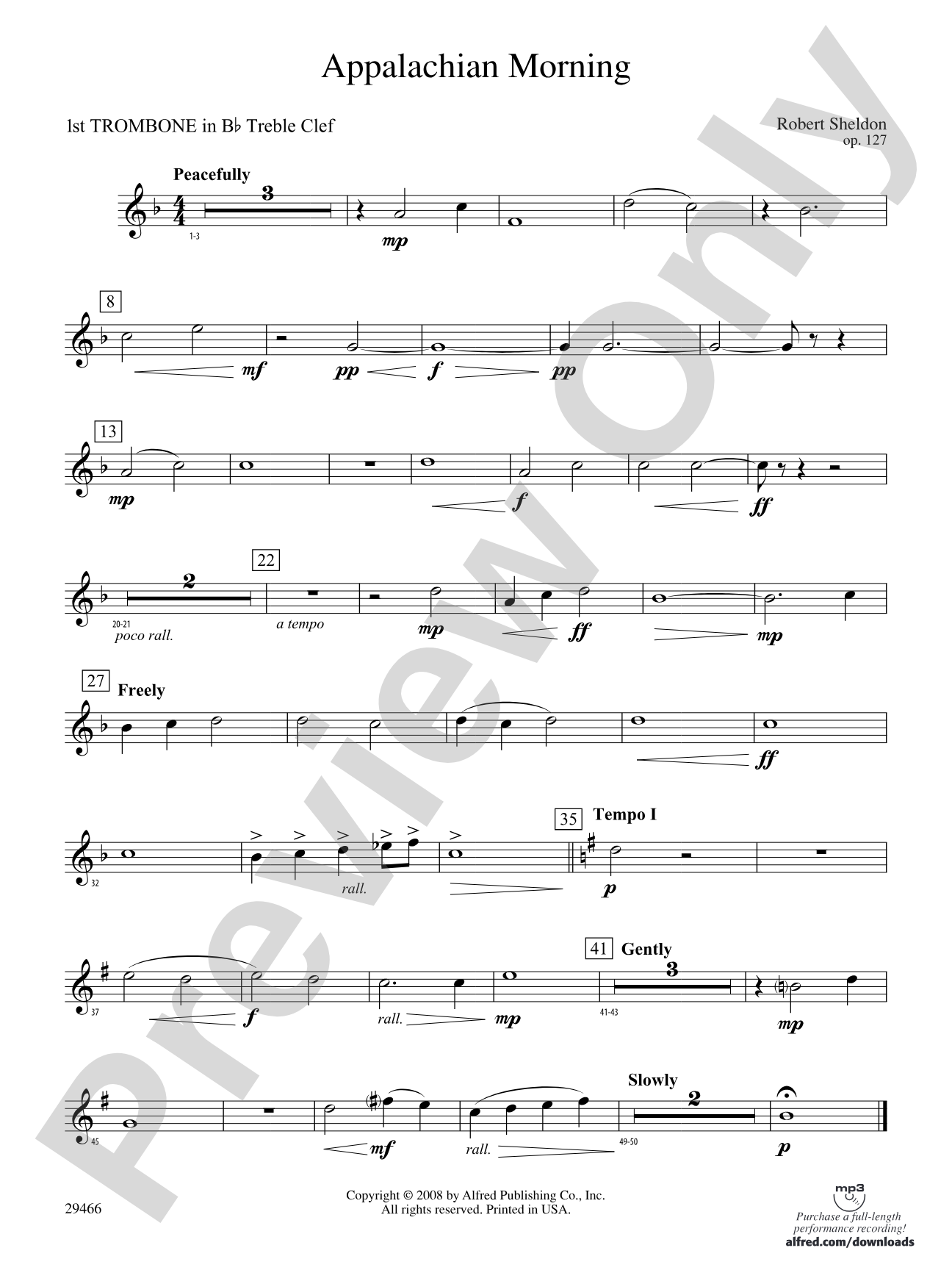

Appalachian Morning: (wp) 1st B-flat Trombone T.C.
By Robert Sheldon
Grade: 2.5 (Medium Easy)
Item: 00-PC-0001423_wpTN1TC
$3.00
Pickup currently not available
Description
Much of Kentucky's musical heritage is steeped in the traditions of Appalachia, an area largely influenced by the settlers from Scotland and Ireland. Appalachian Morning acknowledges these pioneers with a musical walk through the woods and mountains of the Cumberland Gap. In addition to providing solo opportunities for several players, this lovely composition allows for a moment of reflection and lyrical expression on any concert program. (3:00) This title is available in MakeMusic Cloud.


Don't just read it, hear it, play along with it, and watch your students grow with it. In MakeMusic Cloud, Appalachian Morning: (wp) 1st B-flat Trombone T.C. comes alive with professional accompaniment, adjustable tempo, and built-in practice tools that turn solo practice into real progress.
Open in the Player
Jump straight in and assign it today.
Start Your Free Trial
Open this title and explore the full library in minutes.
Sample Audio
1
Audio File
--:--
0:00
0:00
Sample Video
Additional Details
Series:
Young Symphonic
Publisher:
Alfred Music
Page Count:
130
SKU:
00-PC-0001423_wpTN1TC
More about this title
About the Composer: Robert Sheldon

Robert Sheldon stands among the most widely performed composers for wind band in the world. His works appear regularly on state and national contest lists, performed by ensembles across the United States and internationally. Sheldon has received major awards from the American School Band Director's Association, Phi Beta Mu, and the American Society of Composers, Authors and Publishers, recognizing the expressive depth and craftsmanship that characterize his output.
Beyond composing, Sheldon has shaped wind band pedagogy as lead author of Sound Innovations for Concert Band. He maintains an active schedule as a guest conductor for All-State and regional honor bands, clinician at universities and state music education conferences, and commissioned composer. His works have been performed at Carnegie Hall, Orchestra Hall, Boston Symphony Hall, the Sydney Opera House, and the Kennedy Center. In 2020, VanderCook College of Music awarded him an honorary doctorate in recognition of his contributions to music education.
Why we love this
Sheldon crafts Grade 2.5 writing that never feels condescending. The solo opportunities scattered throughout the ensemble invite your talented players to shine while keeping the musical narrative intact. The Appalachian material gives your band something with genuine regional character to perform, not generic filler.
What to expect
A journey through forested Appalachian terrain, unhurried and contemplative. The writing captures the quiet confidence of traditional Scottish and Irish melodies transplanted to American soil, offering moments of intimacy alongside fuller ensemble textures.
Who it's for
Bands at the 2.5 grade level looking for accessible concert repertoire with musical substance. Directors seeking pieces that build positive soloist experiences while developing the ensemble's lyrical expression. Bands preparing for festival or contest programs that benefit from a reflective moment between more energetic works.
How to get the most out of it
- Balance the solo passages by drawing the ensemble back slightly during exposures. These moments belong to individuals, and your accompaniment should support rather than compete.
- Shape the lyrical sections with long, connected phrasing. Grade 2.5 writing is often attacked rhythmically; resist the urge to subdivide and instead conduct through the larger melodic arc.
- Let the folk melody breathe in the opening measures. Resist rushing; the Cumberland Gap walk happens at a contemplative pace.
- Feature the principal players during their solos. A strategic stand up or a quiet section cue from the podium signals to the audience that someone special is playing.
How to use it
Program this as the centerpiece of a concert celebrating regional American musical heritage, or use it to provide necessary contrast in a set dominated by march-based or purely energetic selections. Its three-minute duration fits naturally between larger works, and the moment of reflection it offers can reset an audience's attention for what follows.
Skills your students will build
- Balancing solo melody with ensemble accompaniment
- Sustaining long lyrical phrases with consistent tone quality
- Reading and responding to sectional cues and dynamic shaping
- Performing in folk melody style with appropriate rhythmic flexibility
- Listening for intonation across the full ensemble in slower tempos