
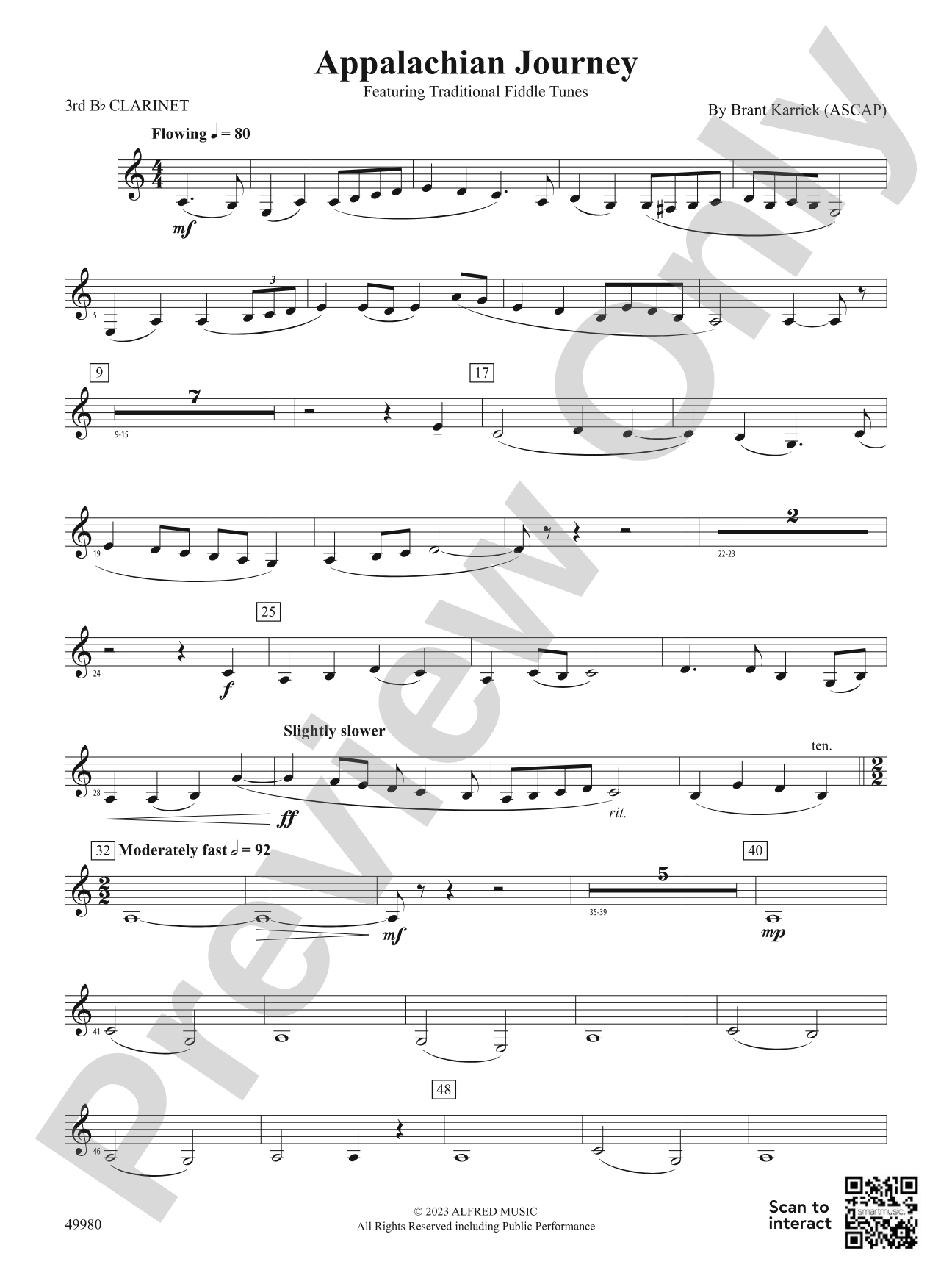

Appalachian Journey: 3rd B-flat Clarinet
Featuring Traditional Fiddle Tunes
By Brant Karrick
Grade: 3.5
Item: 00-PC-0018970_C3
$3.00
Pickup currently not available
Description
The Appalachians represented one of America's first frontiers, and frontier music became one of the first truly American forms of musical expression. Based on traditional fiddle tunes, Appalachian Journey combines four folk songs, providing players and the audience with a real toe-tapping treat! The melodies included are: "After the Battle of Aughrim" and "Lord Mayo I," both Irish in origin, and "Bonaparte Crossing the Rocky Mountains" along with "Whiskey Before Breakfast," adapted from the old-time fiddling tradition. (4:45)


Don't just read it, hear it, play along with it, and watch your students grow with it. In MakeMusic Cloud, Appalachian Journey: 3rd B-flat Clarinet comes alive with professional accompaniment, adjustable tempo, and built-in practice tools that turn solo practice into real progress.
Open in the Player
Jump straight in and assign it today.
Start Your Free Trial
Open this title and explore the full library in minutes.
Sample Audio
1
Audio File
--:--
0:00
0:00
Sample Video
Additional Details
Series:
Alfred Concert Band
Publisher:
Alfred Music
SKU:
00-PC-0018970_C3
More about this title
About the Composer: Brant Karrick

Brant Karrick (b. 1960) brings deep roots in both public school and university music education to his work as a composer and conductor. Since 2003, he has served as Director of Bands at Northern Kentucky University, where he oversees the full band curriculum, teaches conducting and orchestration, and mentors future music educators. His teaching career spans sixteen years in Kentucky public schools and nine years at the University of Toledo before joining NKU.
Karrick earned his Ph.D. in music education from Louisiana State University (1994), his M.A. in education from Western Kentucky University (1984), and his B.M.Ed. from the University of Louisville (1982). As a composer and arranger, his work has been performed across North America, Europe, South Africa, South America, Asia, and Australia. He maintains active involvement as a guest conductor, adjudicator, and clinician, and holds memberships in NAFME, ASCAP, Phi Beta Mu, and the College Band Directors National Association.
Why we love this
Karrick captures the rhythmic vitality and melodic character of Appalachian fiddle traditions without oversimplifying the harmonic language or orchestration. At Grade 3.5, the piece sits in that sweet spot where developing bands can handle modest technical demands while delivering authentic, audience-engaging music that doesn't sound elementary. The four interlocking folk melodies create natural sectional variety, giving different parts meaningful moments and keeping rehearsals productive.
What to expect
Appalachian Journey captures the spirit of frontier fiddling: energetic, unpretentious, and rooted in melody passed down through generations. The arrangement honors those four folk tunes while giving them modern harmonic and orchestral color, creating something that feels both historically grounded and fresh.
Who it's for
Band directors building a Grade 3-4 concert program who want genuine American repertoire that engages students and audiences alike. The scoring accommodates standard concert band instrumentation with flexible doubling, making it accessible to ensembles of varying sizes.
How to get the most out of it
- Bring out the ornamentation and rhythmic freedom of the fiddle idiom by encouraging slight pushes and pulls in the phrasing rather than metronomic steadiness; these tunes were never meant to sound mechanical.
- Balance the melody across the band so the tune sings clearly, even as countermelodies and harmonic figures fill the texture; clarity serves the folk tradition better than homogenized blend.
- Use the full four-minute-plus duration as a rehearsal advantage: the moderate tempo and repeated melodic material give students time to settle into the style and refine details across multiple playings.
- Pay attention to dynamic shape within phrases; Appalachian music relies on storytelling and natural breathing, not just volume contrasts.
How to use it
Program this as a centerpiece for a concert celebrating American roots music or folk traditions, or use it to anchor a set of contrasting Americana repertoire. Its moderate length and upbeat character make it an ideal opener or closer, and the absence of complex technical passages frees rehearsal time for exploring musical style and interpretation.
Skills your students will build
- Phrasing and dynamic shaping within diatonic melodies
- Balancing melody with harmonic accompaniment across the ensemble
- Performing folk idioms with appropriate rhythmic flexibility and ornamentation
- Reading and executing straightforward concert band voicing at Grade 3.5 level