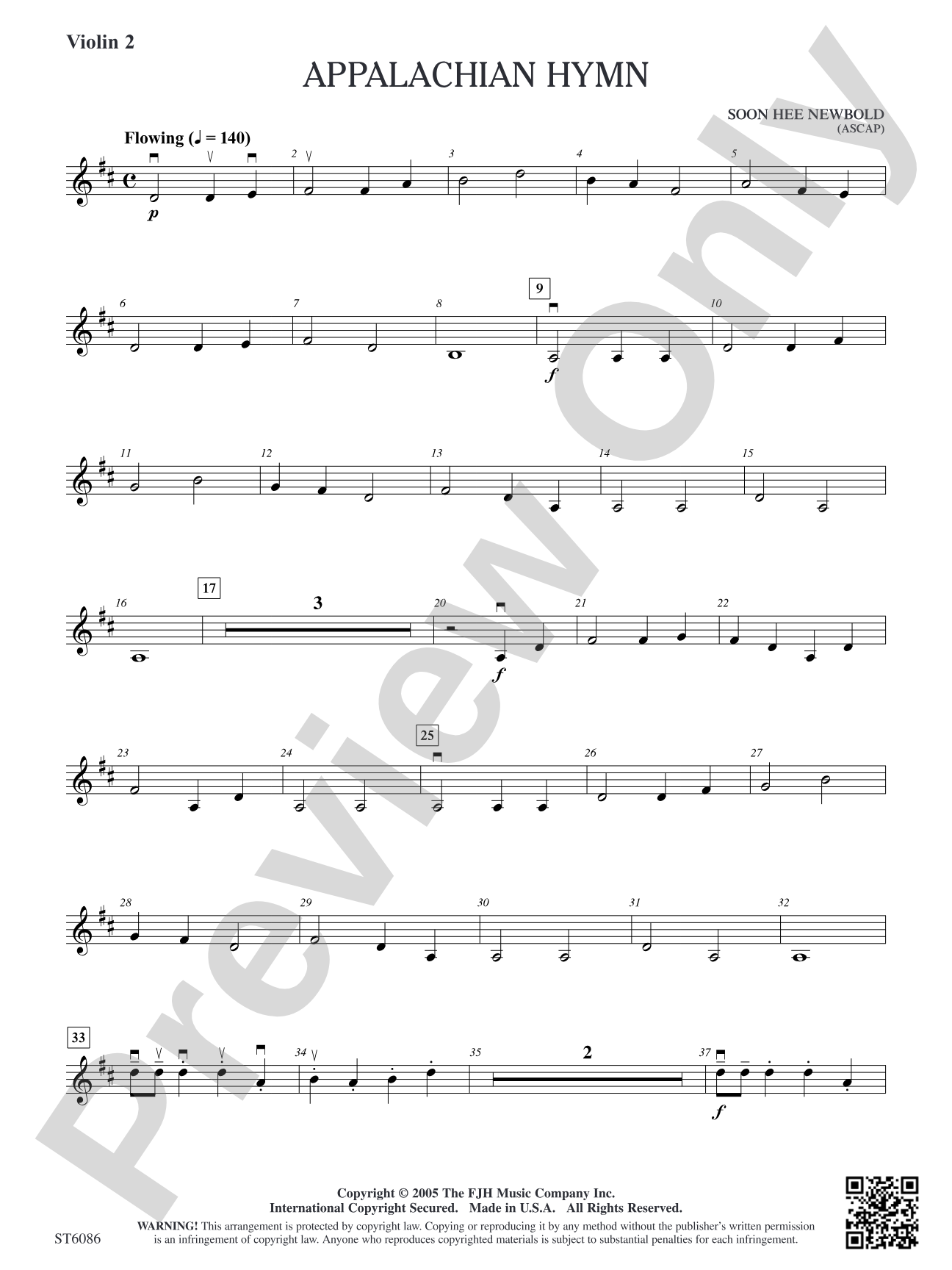
Appalachian Hymn: Violin 2 Sheet Music Preview

Appalachian Hymn: Violin 2

By Soon Hee Newbold

Grade: 1

Item: 98-PC-DST6086_VN2

Digital Download
$7.00
Description
Your young orchestra will sound rich and mature with this lyrical work by Soon Hee Newbold. Reminiscent of traditional hymns and popular folk tunes, this work uses legato and staccato passages to portray scenic views of nature trails, flowing rivers, and wildflowers. A wonderful selection that will add a lot of depth to the sound of your ensemble! (2:00)

Don't just read it, hear it, play along with it, and watch your students grow with it. In MakeMusic Cloud, Appalachian Hymn: Violin 2 comes alive with professional accompaniment, adjustable tempo, and built-in practice tools that turn solo practice into real progress.

Sample Audio
0:00
0:00
Sample Video
Additional Details
Series: FJH Beginning Strings
Publisher: The FJH Music Company, Inc.
SKU: 98-PC-DST6086_VN2

More about this title

About the Composer: Soon Hee Newbold

Soon Hee Newbold

Soon Hee Newbold brings a global perspective to orchestral writing, shaped by her own path from child prodigy to internationally performed composer. Beginning violin and piano studies in childhood, she developed into a concert artist and conductor whose work has graced stages including Carnegie Hall, the Kennedy Center, and Lincoln Center, as well as venues across the Netherlands, Belgium, Australia, Indonesia, Singapore, and China.

Newbold's compositional voice blends cultural and ethnic influences drawn from her extensive travel and conducting experience. Her output spans from premiere orchestras to beginning ensembles, and her work extends into film composition and recording projects in Hollywood. She is frequently invited as a guest clinician and keynote speaker, bringing her expertise directly to music educators and their students.

Why we love this

This piece delivers maturity without complexity. Newbold writes for Grade 1 orchestras with genuine musicality, using legato and staccato textures to paint a clear landscape rather than relying on technical pyrotechnics. Your young players will experience what it means to shape a phrase and create depth in sound, making this an ideal selection when you want students to sound and feel accomplished.

What to expect

Appalachian Hymn wraps listeners in the quiet beauty of open spaces: the gentle flow of water, the soft colors of wildflowers against a backdrop of green hills. The writing breathes with the unhurried quality of a hymn, inviting players to find warmth and resonance in their sound rather than rushing toward notes on a page.

Who it's for

Young string orchestras at the beginning level who are ready to move beyond basic rhythmic and technical exercises into genuine musical expression. This work suits ensembles preparing for festivals, competitions, or concert programs where you want to showcase both growth and artistry.

How to get the most out of it

  • Shape the legato passages with a gentle swell at the phrase midpoint; allow students to breathe naturally between phrases rather than stopping abruptly.
  • Balance the staccato figures so they articulate cleanly without losing the lyrical quality of the surrounding material.
  • Use the hymn-like melody as a reference point for intonation; these familiar contours help young players lock in on pitch centers.
  • Let the conductor's gesture follow the natural breathing and phrasing of a sung hymn, encouraging strings to respond with vocal warmth rather than mechanical precision.

How to use it

Place this piece mid-program to anchor a set of lighter, more technical selections, or open a concert with it to establish an emotional foundation that contrasts with faster works later in your set. It pairs naturally with other folk-inspired or Americana repertoire and works especially well in spring or outdoor concert contexts.

Skills your students will build

  • Sustaining legato tone across phrases without deterioration
  • Contrasting articulation between legato and staccato figures
  • Shaping melody and supporting harmonic lines with equal care
  • Reading and responding to conductor phrasing cues
  • Intonation in hymn-like melodies with clear tonal centers

You May Also Like