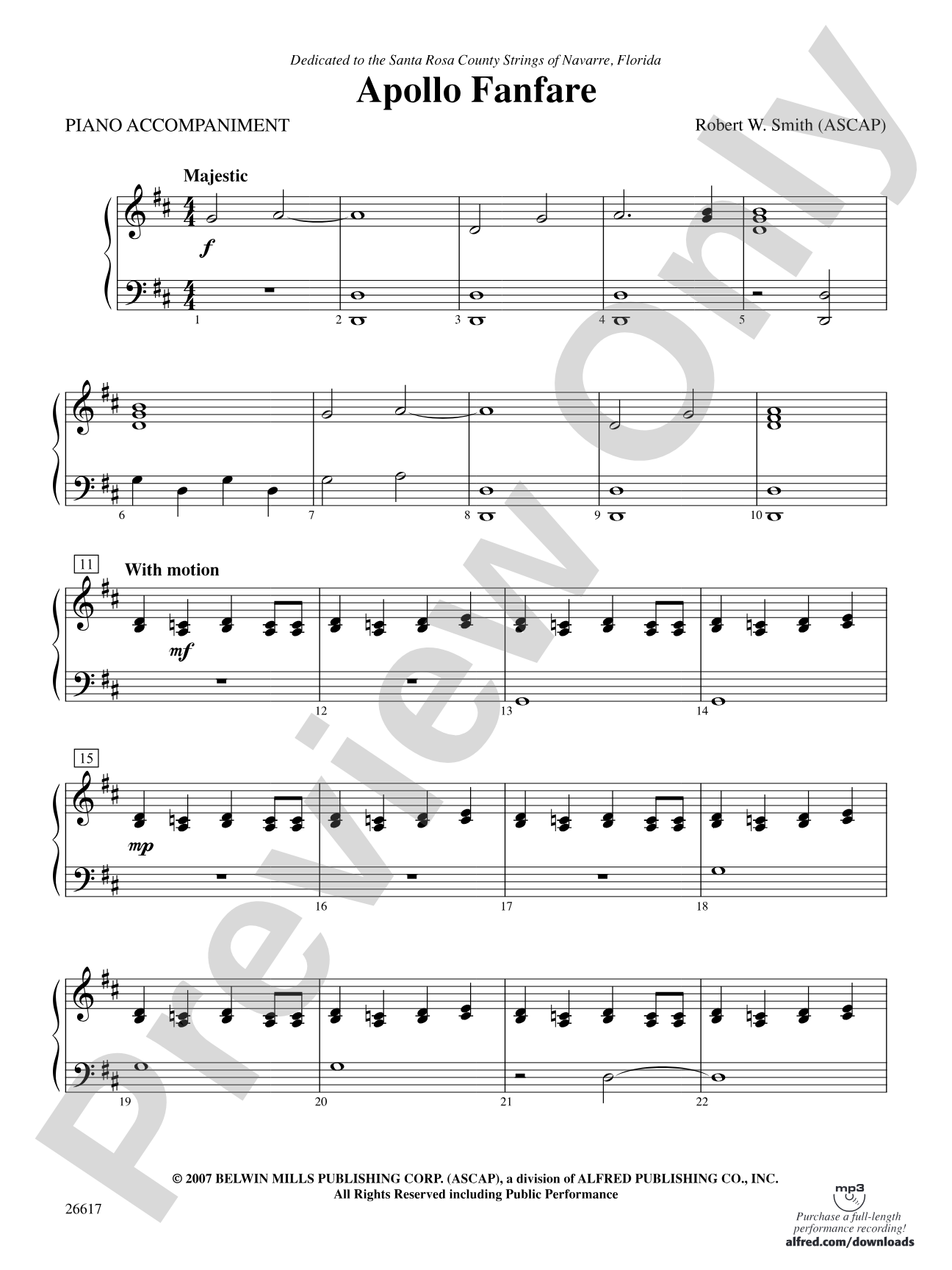
Apollo Fanfare: Piano Accompaniment Sheet Music Preview

Apollo Fanfare: Piano Accompaniment

By Robert W. Smith

Grade: 1.5

Item: 00-PC-0001121_K

Digital Download
$5.99
Description
An enthusiastic opener or closer for spring concerts! The musical celebration runs wild but works perfectly for beginning players! Correlates with Orchestra Expressions, Book One. This title is available in MakeMusic Cloud.

Don't just read it, hear it, play along with it, and watch your students grow with it. In MakeMusic Cloud, Apollo Fanfare: Piano Accompaniment comes alive with professional accompaniment, adjustable tempo, and built-in practice tools that turn solo practice into real progress.

Sample Audio
0:00
0:00
Sample Video
Additional Details
Series: Orchestra Expressions
Publisher: Alfred Music
Page Count: 66
SKU: 00-PC-0001121_K

More about this title

About the Composer: Robert W. Smith

Robert W. Smith

Robert W. Smith has established himself as one of America's most prolific composers of orchestral and band literature, with over 400 published works to his credit. His training at Troy State University and the University of Miami shaped a compositional voice that balances accessibility with musicality, making his work a staple in school music programs worldwide.

Smith's catalog spans symphonic works performed across North America, Europe, Australia, and Asia, alongside pieces specifically written for developing ensembles that have become foundational to the orchestral repertoire. Beyond the concert hall, his music has appeared in major television broadcasts, Olympic ceremonies, and iconic American celebrations, reflecting both the breadth of his output and the clarity of his compositional intent.

Why we love this

Smith understands exactly what beginning string players need: music that sounds impressive without demanding technical sophistication. The energy and celebratory character of Apollo Fanfare give your orchestra genuine confidence in the performance, which translates directly to audience engagement and student pride. It's the kind of opener or closer that makes a spring concert feel like an event.

What to expect

Bright, celebratory, and purposeful. Apollo Fanfare radiates the kind of uninhibited joy that feels natural for a spring concert, with forward-moving energy that never demands complexity. The musical language is direct and memorable, designed so players feel the excitement of the piece in their hands.

Who it's for

Beginning string orchestras seeking repertoire that combines accessibility with genuine concert impact. This piece suits programs where Grade 1.5 players need something that excites both musicians and audiences without requiring advanced technique or ensemble maturity.

How to get the most out of it

  • Keep the tempo steady and energetic from the top. Beginning players will find rhythm security in a conductor who commits fully to the pulse; allow the enthusiasm to build organically rather than rushing ahead.
  • Shape the melodic lines through dynamics and vibrato rather than tempo changes. A bright forte and a softer mezzopiano will give the piece dimension without asking for expressive maturity that Level 1.5 players may not yet possess.
  • Balance your string sections carefully so the melody speaks clearly. Violins carrying the primary material should sound confident, but violas and cellos need audible presence to anchor the sound.
  • Invest rehearsal time in unison passages and rhythmic precision in the opening measures. Clean attacks and clean releases in these moments establish the fanfare character immediately.

How to use it

Use this as either your concert opener to establish an energetic, celebratory tone from the first moment, or as your finale to send the audience out with momentum and spirit. It pairs well alongside contrasting mid-concert selections and works equally effectively as a festival or contest opener where you want to showcase your orchestra's technical cleanliness and enthusiasm.

Skills your students will build

  • Maintaining steady tempo and rhythmic precision in fanfare figures
  • Executing clean articulations and releases in unison passages
  • Balancing ensemble sound across multiple string sections
  • Building dynamic contrast from pianissimo to forte within a single phrase
  • Responding to conductor cueing in an energetic, forward-moving context

You May Also Like