
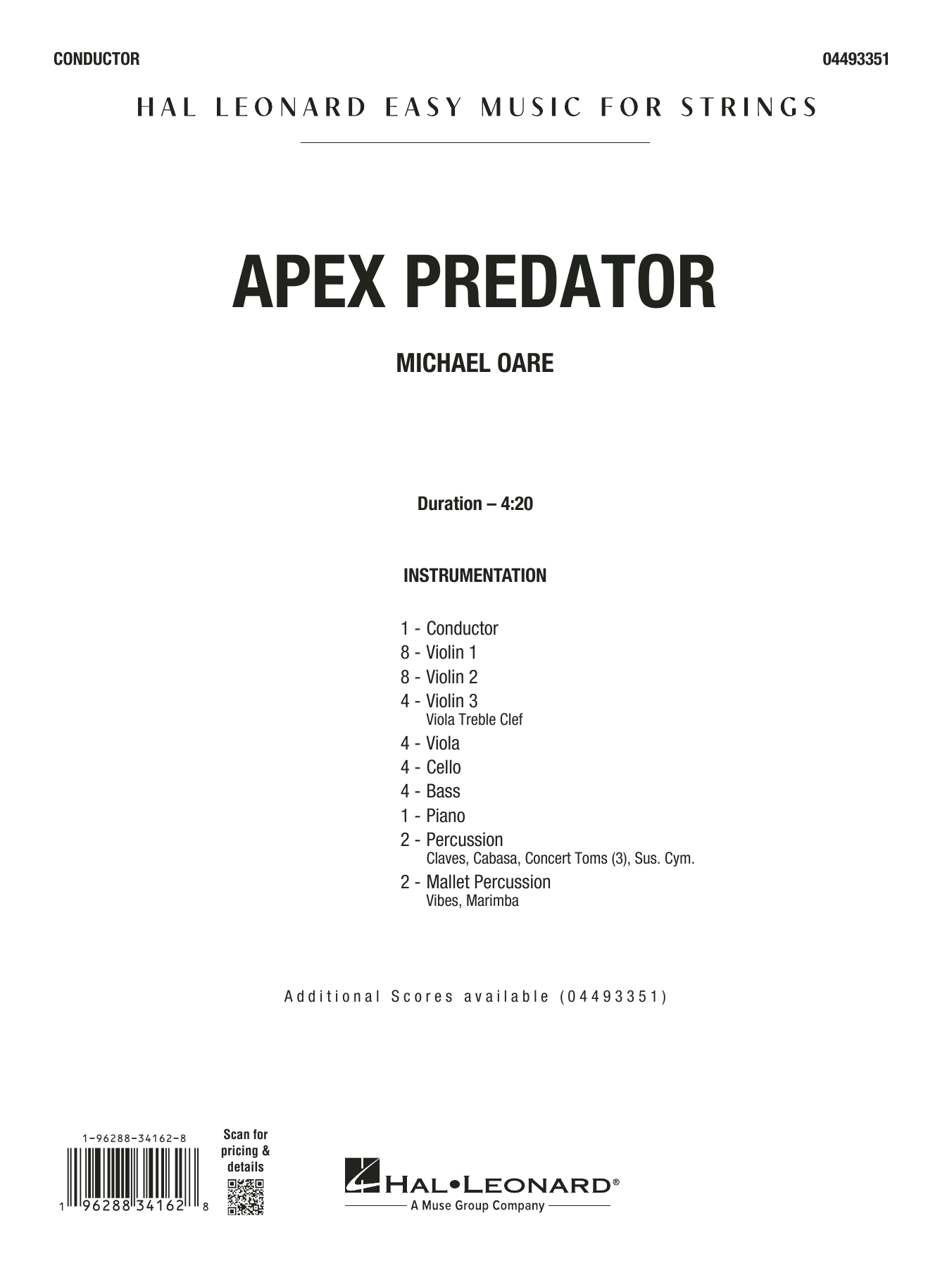

Apex Predator: String Orchestra Conductor Score & Parts
By Michael Oare
Grade: 2
Item: 35-PK01775430
$50.00
Pickup currently not available
Buy Extra Parts (Digital PDF Download)
| Product | Price | Quantity |
|---|---|---|
| Apex Predator - Conductor Score (Full Score) | $7.50 | |
| Apex Predator - Violin 1 | $7.00 | |
| Apex Predator - Violin 2 | $7.00 | |
| Apex Predator - Violin 3 (Viola Treble Clef) | $7.00 | |
| Apex Predator - Viola | $7.00 | |
| Apex Predator - Cello | $7.00 | |
| Apex Predator - Bass | $7.00 | |
| Apex Predator - Piano | $7.00 | |
| Apex Predator - Percussion | $7.00 | |
| Apex Predator - Mallet Percussion | $7.00 |
Parts Added to Cart!
Description
This arrangement for string orchestra of the popular concert band work offers the perfect blend of musical stealth and pursuit and covers a wide variety of musical concepts including syncopation, low 1st fingers, meter changes, dynamics and four note slurs. Easy shifting in 1st Violin. An array of pitched and non-pitched percussion adds to the excitement!


Apex Predator: String Orchestra Conductor Score & Parts isn't in MakeMusic Cloud just yet...but it could be. Let us know you'd like to see it, and you'll help shape what comes next. In the meantime, start a free trial and dive into thousands of interactive titles your students can play along with today.
Request This Title
Tell us you want it.
Start Your Free Trial
Explore everything that's ready to play right now.
Sample Audio
No sample audio found.
Sample Video
No sample videos found.
Additional Details
Publisher:
Hal Leonard
SKU:
35-PK01775430
More about this title
About the Composer: Michael Oare

Michael Oare has shaped music education for over three decades as Director of Bands at Great Bridge Middle School in Chesapeake, Virginia, where he built a program that earned superior ratings on 32 of his 33 years leading the ensemble. His dual expertise in composition and pedagogy earned recognition as the 2016 Chesapeake Public Schools Middle School Teacher of the Year and two National Band Association Citations of Excellence.
Oare holds undergraduate degrees in both Music Composition and Music Education from Old Dominion University. His published works, including "To Dream in Brushstrokes" and "Equilibrium," appear in GIA Publications' "Teaching Music Through Performance" series. Beyond the classroom, he conducts the Bay Youth Orchestras of Virginia Concert Band, serves as an adjudicator, and maintains an active performance schedule with the Virginia Wind Symphony.
Why we love this
Oare writes with genuine understanding of what intermediate string players can handle and enjoy. The musical content rewards careful attention to detail without overwhelming young musicians, and the syncopation, meter changes, and shifting challenges build real skills within a piece that sounds exciting in performance.
What to expect
The opening establishes a tense, stealthy atmosphere. Energy builds through syncopated rhythms and dynamic swells, capturing the pursuit of apex predators with orchestral clarity. The piece balances moments of calculated restraint with bursts of coordinated intensity, all while maintaining accessibility for young performers.
Who it's for
Grade 2 string orchestras ready to explore rhythmic sophistication and technical shifts without drowning in complexity. Directors seeking a concert piece with genuine musical narrative and tangible pedagogical goals will find Oare's approach direct and rewarding.
How to get the most out of it
- Balance the percussion layers carefully. The non-pitched percussion should enhance the predatory feel without masking the string melody, especially in moments of musical stealth.
- Rehearse the meter changes as isolated sections before putting them into tempo. Students need confidence in the shifts between meters before the full musical context can land properly.
- Work the four-note slurs in isolation using a slow bow, emphasizing the release at the end rather than collapsing into the next phrase. Clean articulation of the slur shape defines the predatory character.
- Mark the low first finger passages in rehearsal and watch for intonation shifts. These positions tend to drift when students focus on rhythmic accuracy, so give them a visual cue to check their placement.
How to use it
Program this as a standout centerpiece on a Grade 2 concert, especially if you want to demonstrate student progress in rhythmic independence and ensemble maturity. The percussion scoring and musical narrative also make it a strong selection for school assemblies or family concerts where non-traditional programming has space to breathe.
Skills your students will build
- Syncopated rhythm reading in ensemble context
- Meter changes (identified transitions between different time signatures)
- Low first finger intonation and shifting
- Four-note slur articulation and phrasing
- Dynamic control and dramatic contrast
- Coordination with percussion layers