
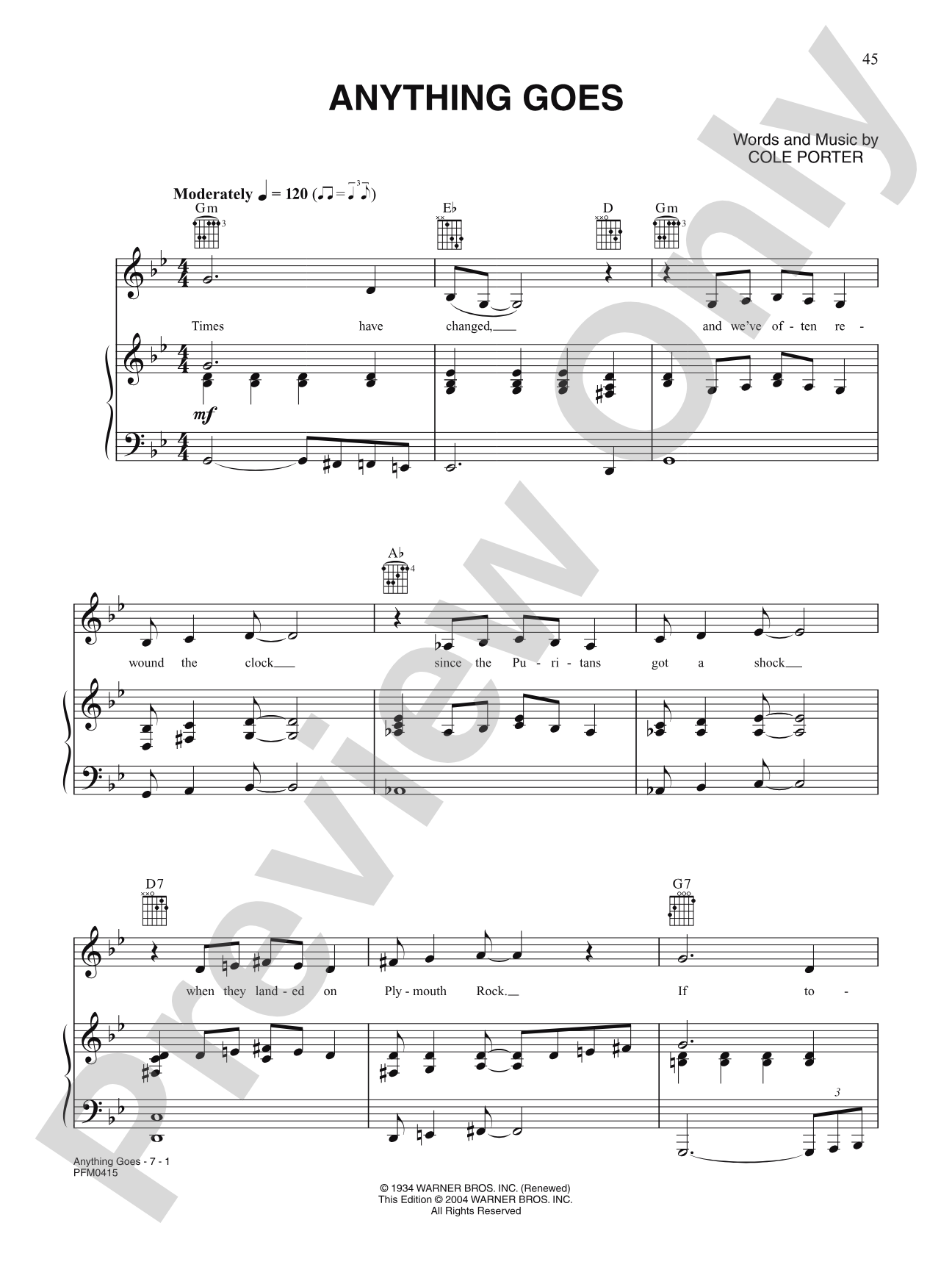
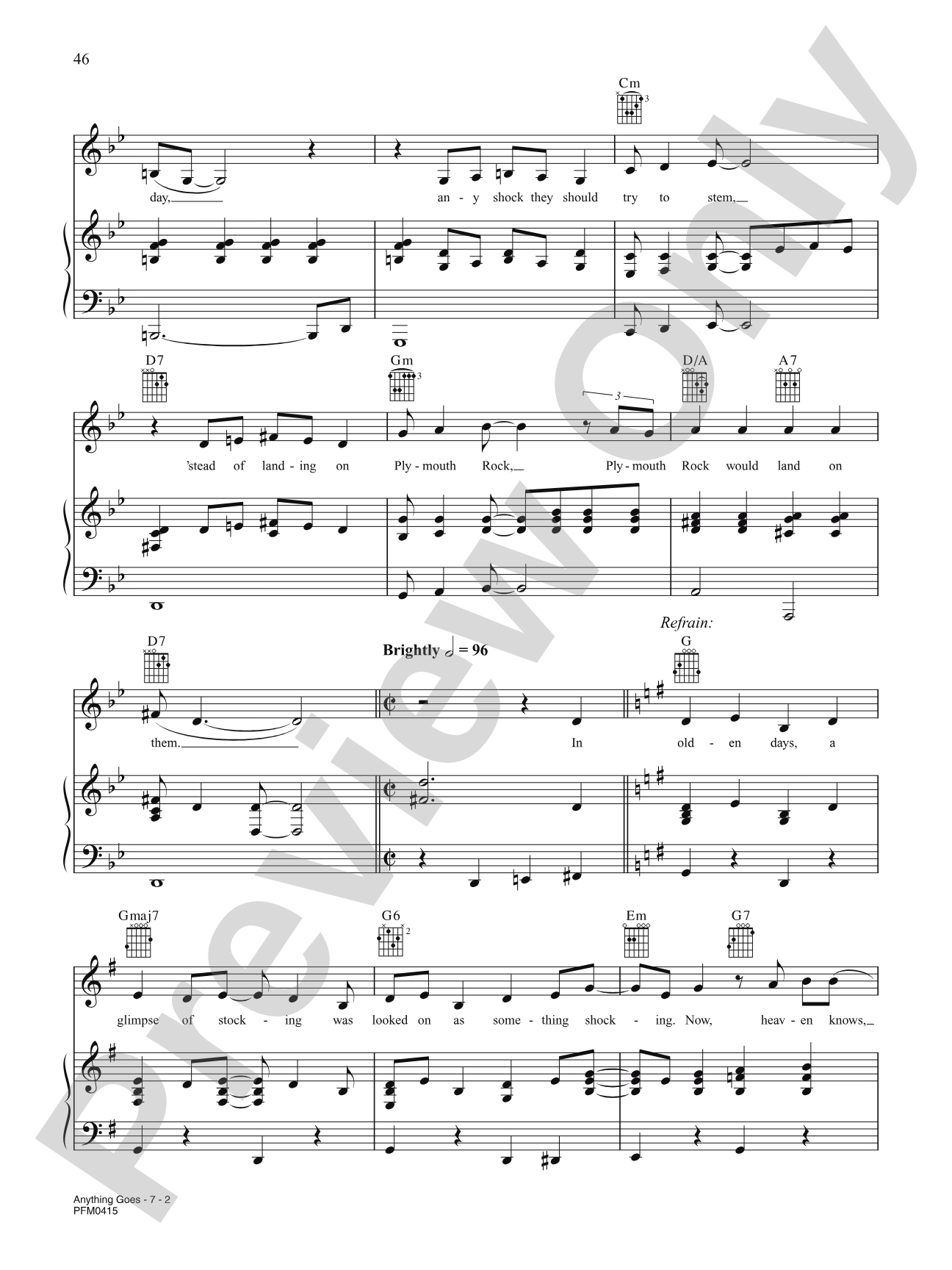

Anything Goes (From "Anything Goes"): Piano/Vocal/Chords
Music and lyrics by Cole Porter
Item: 00-PSP-000301
$5.99
One moment…
Description
The motion picture De-Lovely, an original musical portrait of American composer Cole Porter, is filled with Porter's own unforgettable songs, and stars some of the biggest names in film and music, including Kevin Kline, Ashley Judd, Natalie Cole, Sheryl Crow, and Robbie Williams. Our spectacular folio is sure to be a collector's item, including songs performed in the film along with an elaborate section featuring six panels of color artwork that includes a gate-fold display featuring an array of artist and actor photos on a three-page spread. The book is printed on an antique ivory stock reminiscent of the quality publications available during Porter's lifetime. Titles are: It's De-Lovely * Ev'ry Time We Say Goodbye * Just One of Those Things * Be a Clown * Let's Do It, Let's Fall in Love * Begin the Beguine * Anything Goes * I Love You * So in Love * True Love * Love for Sale * What Is This Thing Called Love * Easy to Love * Night and Day * Let's Misbehave * Blow, Gabriel, Blow * In the Still of the Night * You're the Top.


Anything Goes (From "Anything Goes"): Piano/Vocal/Chords isn't in MakeMusic Cloud just yet...but it could be. Let us know you'd like to see it, and you'll help shape what comes next. In the meantime, start a free trial and dive into thousands of interactive titles your students can play along with today.
Request This Title
Tell us you want it.
Start Your Free Trial
Explore everything that's ready to play right now.
Sample Audio
No sample audio found.
Sample Video
No sample videos found.
Additional Details
Publisher:
Alfred Music
SKU:
00-PSP-000301
More about this title
About the Artist: Tony Bennett
Tony Bennett stands as one of America's most distinguished vocalists, with a career spanning seven decades and encompassing jazz standards, popular song, and timeless American repertoire. His interpretations of Cole Porter, George Gershwin, and Irving Berlin are considered definitive by singers and musicians alike, characterized by impeccable phrasing, emotional authenticity, and deep respect for the lyricist's craft.
Why we love this
This collection captures the elegance and sophistication of Cole Porter's songwriting through Bennett's masterful interpretations, making it an invaluable resource for singers studying American song repertoire and jazz standards. The piano/vocal arrangement format allows pianists to accompany singers while learning how to voice and phrase these classics with style and nuance. Bennett's recordings demonstrate how to balance lyrical clarity with musical architecture—a lesson every vocalist and accompanist needs.
What to expect
These songs carry the urbane wit, romantic yearning, and lyrical sophistication of 1930s and 1940s American musical theater. Bennett's performances radiate ease and confidence while conveying genuine emotion, inviting you into a world where clever rhymes, complex harmonies, and genuine human feeling coexist seamlessly.
Who it's for
Singers preparing audition material, jazz standards repertoire, or concert programming will find Bennett's interpretations essential models for stylistic accuracy and emotional depth. Pianists accompanying singers in studio, recital, or educational settings can reference these arrangements to understand voice-leading, harmonic support, and the art of backing a vocalist with sophistication.
How to get the most out of it
- Listen to Bennett's recording before learning the song; his approach to rubato, phrasing, and breath placement will inform your understanding of the melody's contours and emotional intent.
- Pay close attention to chord changes and harmonic movement, particularly in Porter's sophisticated bridge sections, to ensure your accompaniment supports rather than fights the vocal line.
- Shape phrases around the lyric, allowing words to guide dynamics and tempo rather than imposing a rigid metronomic feel; Porter's melodies are meant to serve the poetry.
- Use pedal strategically to enhance harmonic color without muddying the clarity of the vocal line, especially in ballads like 'Ev'ry Time We Say Goodbye.'
How to use it
Include individual selections in a jazz standards concert or American songbook recital to establish continuity and showcase the depth of Porter's catalog. This arrangement works equally well as a solo piano piece (omitting the vocal line) or as an accompanying resource for a singer program themed around Bennett's legacy or mid-century popular song.
Skills your students will build
- Interpreting swing and jazz phrasing in a vocal context
- Reading and playing jazz chord symbols and jazz voicings
- Accompanying singers with harmonic sensitivity and textural flexibility
- Understanding the relationship between lyric rhythm and melodic phrasing
- Analyzing and performing sophisticated harmonic progressions typical of golden-age American song