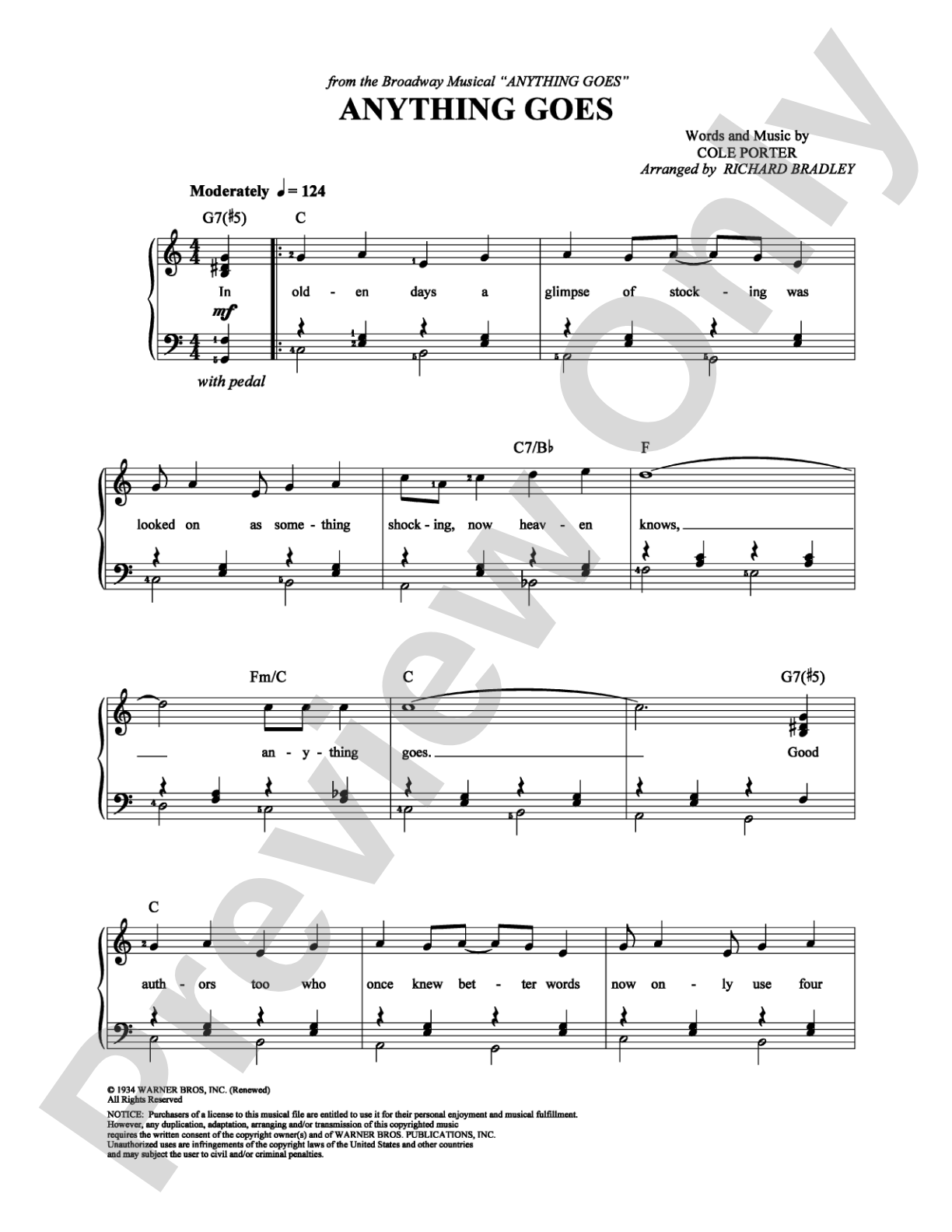
Anything Goes: Easy Piano Digital Sheet Music

Anything Goes: Easy Piano Digital Sheet Music

Cole Porter, Frank Sinatra, Ethel Merman

Item: 00-PS-0008446

Digital Download
$3.99
Description

Anything Goes: Easy Piano Digital Sheet Music isn't in MakeMusic Cloud just yet...but it could be. Let us know you'd like to see it, and you'll help shape what comes next. In the meantime, start a free trial and dive into thousands of interactive titles your students can play along with today.

Sample Audio
No sample audio found.
Sample Video
Additional Details
SKU: 00-PS-0008446

More about this title

About the Artist: Frank Sinatra

Frank Sinatra (1915-1998) defined the popular song for generations of listeners and musicians. His phrasing, breath control, and interpretive approach to melody remain foundational to how singers and pianists approach the American songbook. Studying his recordings alongside the sheet music reveals how deeply he understood harmonic structure and rubato, making his interpretations essential reference points for students learning to accompany jazz standards and popular classics.

Why we love this

Sinatra's signature tune gives pianists an accessible entry point into the rhythmic swagger and harmonic sophistication of Cole Porter's writing. The easy arrangement preserves the essential character of the original while keeping hand positions and reach demands manageable for intermediate players, making it a confident addition to recitals or casual performance contexts.

What to expect

Buoyant and playful. The piece captures the optimism and wit of the original lyrics, with enough harmonic color to feel sophisticated while remaining approachable. Playing it feels like stepping into a mid-century cocktail lounge where everything is assured and nothing is rushed.

Who it's for

Pianists at the high elementary through early intermediate level who want to play a recognized standard with personality and style. Teachers looking for repertoire that connects students to the classic American songbook and rewards expressive phrasing over technical complexity.

How to get the most out of it

  • Keep the rhythmic pulse relaxed and conversational rather than metronomic; Sinatra's phrasing floats slightly ahead of and behind the beat to create momentum.
  • Voice the accompaniment lightly so the melody sings through. The left hand should anchor the harmony without overwhelming the right hand's line.
  • Shape the melody with dynamic contours that rise toward the higher phrases and settle on the lower resolutions, following the text's emotional arc.
  • Let the syncopation breathe. These figures sit on either side of the beat intentionally, so clarity of rhythm matters more than strict metronomic precision.

How to use it

Program this alongside other Porter standards or American songbook selections to build a recital set with cohesion and charm. It works equally well as a light interlude in a mixed repertoire concert or as a standalone encore that leaves the audience smiling.

Skills your students will build

  • Reading syncopated rhythms in both hands simultaneously
  • Interpreting melody with rubato and phrase shaping
  • Understanding jazz harmony and seventh chord voicings
  • Balancing accompaniment texture with melodic prominence
  • Connecting to the lyrical content of a song-based piece

You May Also Like