Any Way You Want It: 2nd Percussion Sheet Music Preview

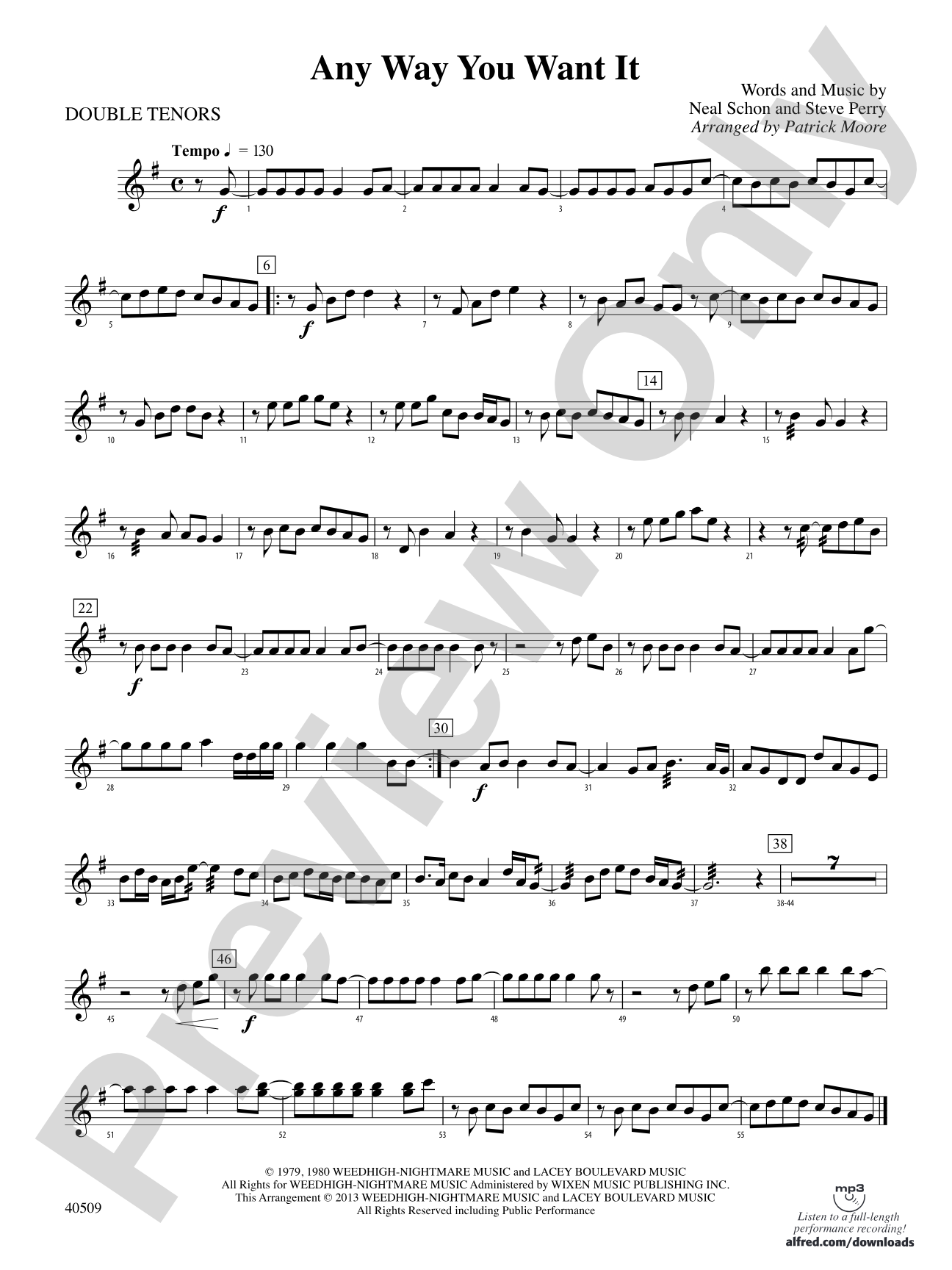
Any Way You Want It: 2nd Percussion

For a Minimum of Five Steel Drums, Plus Drumset, and Optional Bass Guitar

Words and music by Neal Schon and Steve Perry [Journey] / arr. Patrick Moore

Item: 00-PC-0016031_PC2

Digital Download
$3.00
Description
"Any Way You Want It," by Journey, was released in 1980 as the opening track of their album titled Departure. It was also re-recorded with Arnel Pineda and Deen Castronovo for their 2008 album Revelation. The song peaked at No. 23 on the Billboard Hot 100 and is now available for your steel drum band. This is a perfect selection for those looking to program a nice opener or closer.

Don't just read it, hear it, play along with it, and watch your students grow with it. In MakeMusic Cloud, Any Way You Want It: 2nd Percussion comes alive with professional accompaniment, adjustable tempo, and built-in practice tools that turn solo practice into real progress.

Sample Audio
No sample audio found.
Sample Video
Additional Details
Series: Alfred's Pop Steel Drum Ensemble Series
Publisher: Alfred Music
Page Count: 18
SKU: 00-PC-0016031_PC2
Instrumentation: Steel Drum Ensemble

More about this title

About the Composer: Neal Schon

Neal Schon co-founded Journey in 1973 and has served as the band's primary guitarist and a principal songwriter throughout their four-decade career. His compositions have defined arena rock and pop-rock from the 1970s onward, blending accessible melodies with strong harmonic structure and dynamic arrangement potential. Schon's work remains a staple of music education settings because it rewards both ensemble precision and individual musicianship.

Why we love this

This arrangement transforms a classic rock opener into an immediate energy boost for any steel drum ensemble. The instrumentation sits perfectly at Grade 3, giving students authentic Journey without overwhelming technical demands, and the familiar melody ensures audience connection from the first measure.

What to expect

Bright, propulsive, and instantly recognizable. The steel drum arrangement captures the song's original radio-ready punch while adding the warmth and shimmer that makes steel drums distinctive. From the first note, your ensemble sounds polished and confident.

Who it's for

Steel drum ensemble directors seeking a recognizable, high-energy opener or closer that engages audiences without requiring advanced technique. Students at the Grade 3 level who want to perform a song they know and love, with parts that challenge rhythm reading and ensemble blend rather than individual virtuosity.

How to get the most out of it

  • Balance the steel drum voices so the lead melody cuts through clearly while the harmonic foundation stays solid; the ensemble sound depends on restraint from the lower parts.
  • Lock the rhythmic foundation early in rehearsal. This song's drive comes from locked percussion parts, so mark the steady pulse in each section and drill it separately before combining voices.
  • Shape the opening eight measures with slight dynamic swell to build momentum. Journey's original opening is understated; let your ensemble's energy grow naturally into the main groove.
  • Pay attention to the recorded arrangement by Patrick Moore for phrasing cues on repeats and transitions; his voicing choices reveal where the energy should peak and where to pull back.

How to use it

Open a concert with this track to set an immediate upbeat tone and draw the audience into the program. It also works exceptionally well as a closer on a pops or informal concert, where the familiar melody becomes a crowd-pleasing finale. Consider pairing it with other Journey arrangements or classic rock covers to build a cohesive pop-rock segment.

Skills your students will build

  • Reading rhythmic patterns in rock grooves (quarter notes, eighth notes, syncopation)
  • Balancing melody and accompaniment in ensemble texture
  • Maintaining steady pulse across repeated sections and dynamic changes
  • Responding to conductor cues for energy and phrasing adjustments
  • Adapting articulation and dynamics to steel drum timbre

You May Also Like