
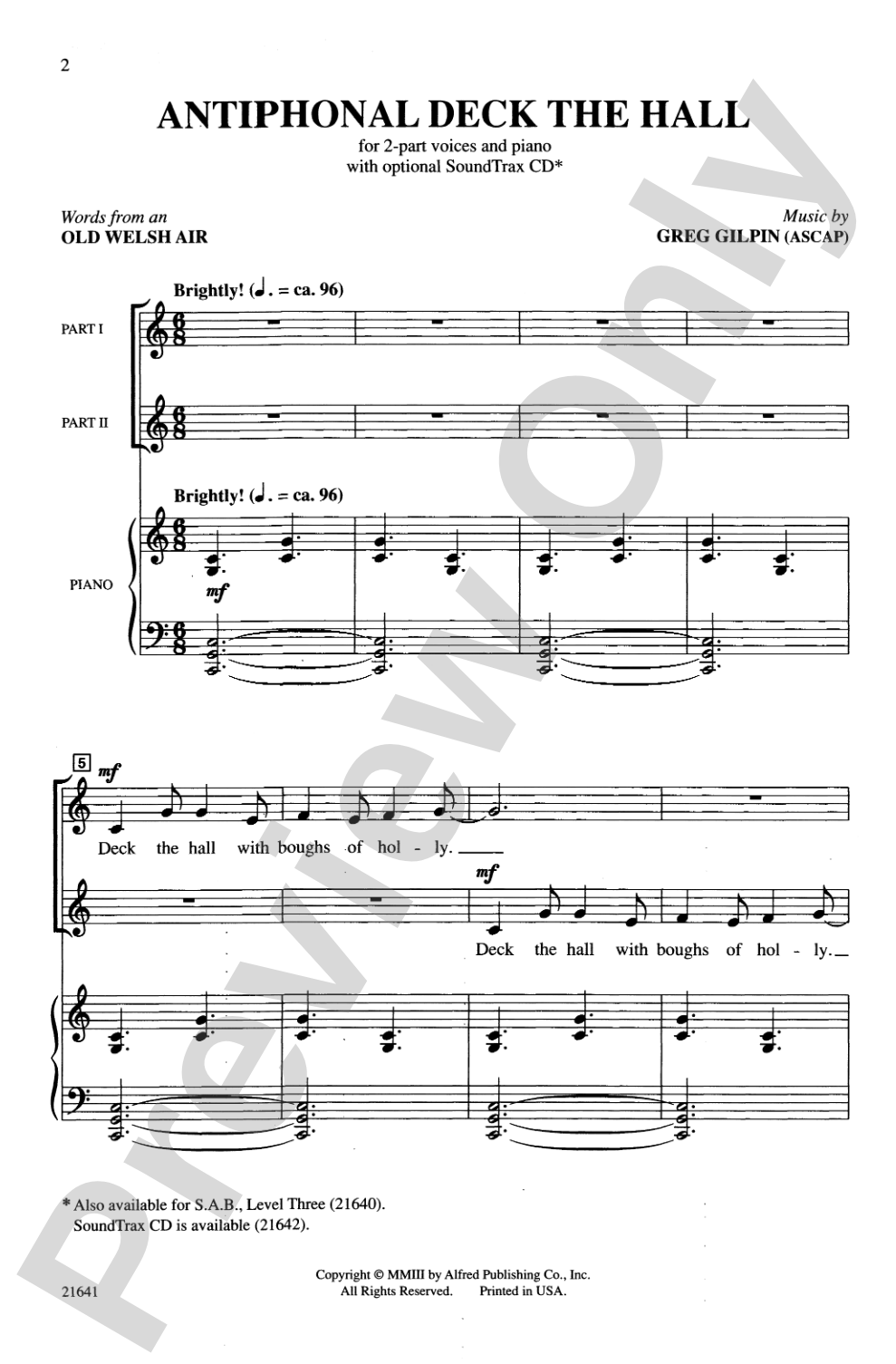

Antiphonal Deck the Hall: 2-Part Choral Octavo
Words from an Old Welsh Air, music by Greg Gilpin
Item: 00-PO-0002897
$2.25
Minimum order quantity: 20 copies
Pickup currently not available
Related Items
Antiphonal Deck the Hall: SATB Choral Octavo |
$2.05
|
View | |
Antiphonal Deck the Hall: SAB Choral Octavo |
$2.25
|
View | |
Antiphonal Deck the Hall: SATB Choral Octavo |
$2.05
|
View | |
Antiphonal Deck the Hall: SAB Choral Octavo |
$2.25
|
View | |
Antiphonal Deck the Hall: 2-Part Choral Octavo |
$2.25
|
View | |
Antiphonal Deck the Hall: Choral Octavo SoundTrax CD |
$27.99
|
View |
Description
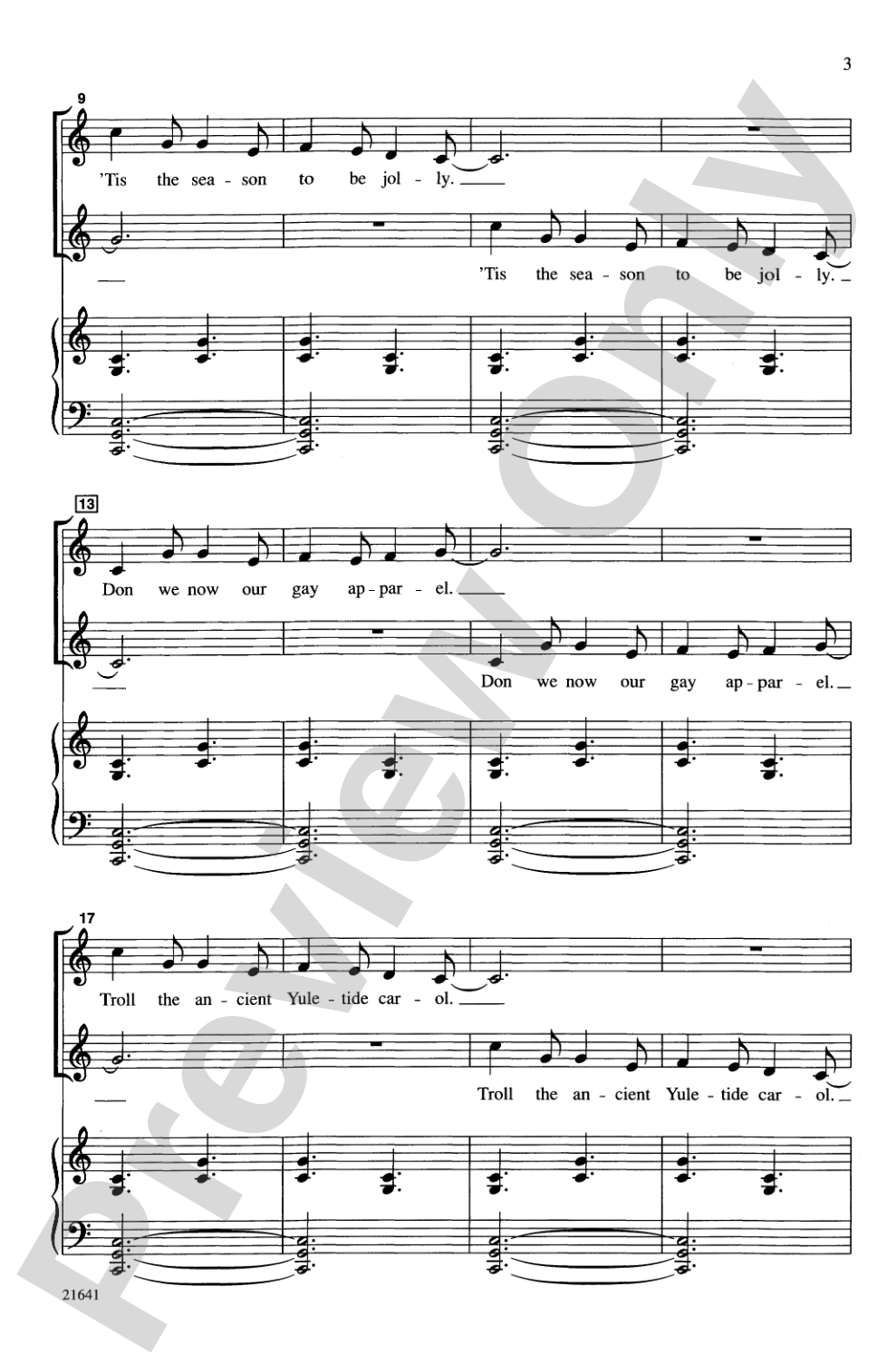
The traditional strains of Deck The Hall are set in a lilting six-eight tempo and echoed from part to part in this festive carol by Greg Gilpin. With a new polyphonic "fa-la-la-la" sequence and a delightful accompaniment, this is sure to be a holiday hit with your choir and audience alike. Don't miss the optional shimmering SoundTrax CD with a Mannheim Steamroller appeal.


Antiphonal Deck the Hall: 2-Part Choral Octavo isn't in MakeMusic Cloud just yet...but it could be. Let us know you'd like to see it, and you'll help shape what comes next. In the meantime, start a free trial and dive into thousands of interactive titles your students can play along with today.
Request This Title
Tell us you want it.
Start Your Free Trial
Explore everything that's ready to play right now.
Sample Audio
1
Audio File
--:--
0:00
0:00
Sample Video
No sample videos found.
Additional Details
Series:
Alfred Archive Edition: Alfred Choral Designs
Publisher:
Alfred Music
Page Count:
12
SKU:
00-PO-0002897
More about this title
About the Composer: Greg Gilpin

Greg Gilpin brings two decades of choral composition and conducting expertise to his work with Alfred Choral Designs. His compositions have been performed at major concert halls across North America and internationally, including Carnegie Hall, Lincoln Center, the Sydney Opera House, and Royal Festival Hall. As Director of Educational Choral Publications for Shawnee Press, Gilpin has shaped the landscape of accessible choral repertoire for student singers and community ensembles.
Beyond the concert hall, Gilpin is an active member of ACDA and NAfME and has expanded his creative reach into film scoring and collaborative arrangements with professional opera singers. His award-winning work spans multiple genres and contexts, reflecting a deep commitment to making meaningful music available to singers of all levels.
Why we love this
Gilpin's gift for melodic accessibility shines here. The antiphonal writing creates genuine musical conversation between the two parts without requiring advanced reading skills, and the six-eight lilt gives the familiar carol fresh rhythmic energy that audiences recognize immediately. The optional recorded accompaniment lets smaller programs or less experienced pianists deliver a polished, fully orchestrated sound.
What to expect
Warmth meets sparkle in this reimagining. The six-eight meter creates a gentle sway, almost processional, while the "fa-la-la-la" exchanges add contemporary shimmer and joy. Audiences hear the beloved melody they know, but delivered with fresh rhythmic vitality and harmonically sophisticated support.
Who it's for
This arrangement suits treble choirs, mixed groups willing to divide into two accessible parts, and holiday programs seeking accessible yet musically interesting carols. The straightforward part-writing welcomes less experienced singers while offering conductors a chance to explore antiphonal technique without complexity.
How to get the most out of it
- Shape the "fa-la-la-la" sequence as a true echo. The second part should match the dynamic and articulation of the first part's phrase, creating clarity in the dialogue rather than simply doubling.
- Lean into the six-eight pulse with a gentle lilt in the phrasing. Avoid driving the tempo forward; let the lilting meter breathe naturally through the carol.
- Balance the two parts so that whichever group begins a phrase can be heard clearly, then let the responding part emerge without overshadowing. This supports the antiphonal design.
- If using the recorded accompaniment, rehearse with it early. The Mannheim Steamroller-style orchestration sets a specific harmonic color that should influence your vocal tone and blend.
How to use it
Program this as a centerpiece in a winter concert's lighter second half, pairing it with more austere or reverent carols to show range within your season's selections. The festive energy and clear narrative arc between the parts make it an excellent anchor for a set of holiday songs that celebrate both tradition and arrangement craft.
Skills your students will build
- Reading and sustaining two independent melodic lines simultaneously
- Responding to antiphonal cues and maintaining ensemble precision in call-and-response texture
- Singing in six-eight meter with proper pulse and lilt
- Achieving blend and balance between parts in homophonic and dialogic passages
- Interpreting stylized articulation (the 'fa-la-la-la' sequences) with clarity and uniformity