
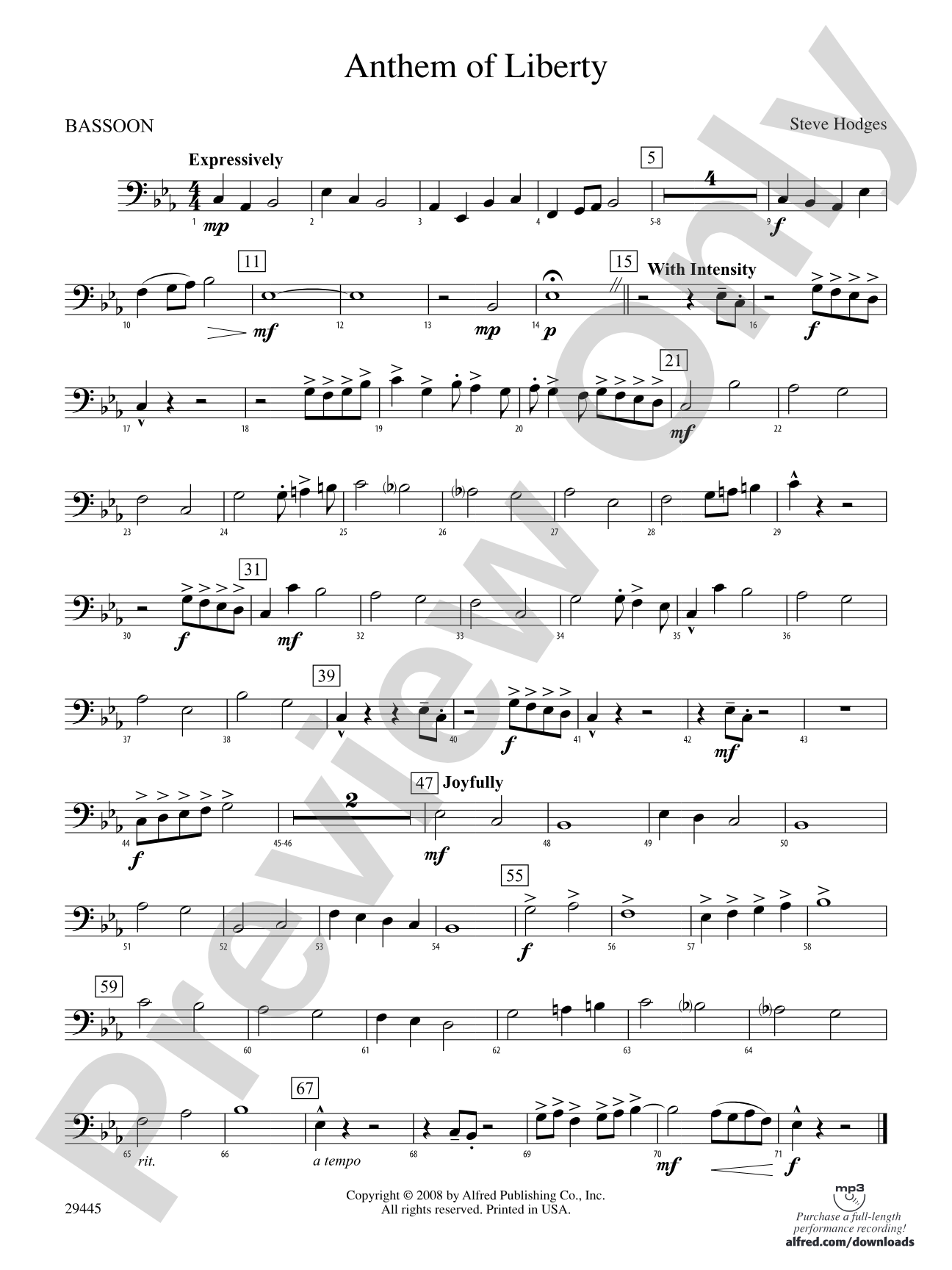

Anthem of Liberty: Bassoon
Arr. Steve Hodges
Grade: 1.5 (Easy)
Item: 00-PC-0001402_B1
$3.00
Pickup currently not available
Description
Anthem of Liberty is introduced with a warm major-key chorale presented by the woodwinds and then again by the brass. This leads to an intense second presentation in the relative minor, featuring exciting rhythmic motives passed from section to section. Following a dynamic transition, the initial chorale is again presented in a majestic manner over the driving double-time percussion and is complemented with active woodwind countermelodies. From the sensitive introduction to the stirring conclusion, this piece provides many expressive opportunities for the young musicians. (2:40)


Don't just read it, hear it, play along with it, and watch your students grow with it. In MakeMusic Cloud, Anthem of Liberty: Bassoon comes alive with professional accompaniment, adjustable tempo, and built-in practice tools that turn solo practice into real progress.
Open in the Player
Jump straight in and assign it today.
Start Your Free Trial
Open this title and explore the full library in minutes.
Sample Audio
1
Audio File
--:--
0:00
0:00
Sample Video
No sample videos found.
Additional Details
Series:
Challenger Band Series
Publisher:
Alfred Music
Page Count:
130
SKU:
00-PC-0001402_B1
More about this title
About the Arranger: Steve Hodges

Steve Hodges holds degrees from Western Oregon University (Bachelor of Science) and Central Washington University (Master of Music Education). Over forty years in public school music education shaped his understanding of what young musicians need to grow and succeed.
Since 1986, Hodges has composed and arranged more than 120 concert band works published by Alfred Music, with additional choral arrangements released through Staff Music and Shawnee Press. His music reaches international audiences and has been performed at festivals, state conventions, and honor band events across North America. Television networks including TBS and ESPN have featured his compositions. As an ASCAP member, Hodges continues to write from his home in The Dalles, Oregon, where he remains active in community music and delighted to hear his grandchildren perform his works in their school bands.
Why we love this
Hodges crafts each section transition with intention, giving young conductors genuine interpretive choices without overwhelming them. The architecture of this piece rewards ensemble cohesion: the opening chorale presents pure sonority, the minor key section demands precision and rhythmic independence, and the final chorale transforms through clever layering rather than sheer volume. You'll find your students genuinely engaged in the musical narrative, not just reading notes.
What to expect
The piece unfolds like a conversation across generations. It opens with lyrical warmth, pivots into driving intensity with interweaving rhythms, then arrives at something majestic and celebratory. Throughout, the music breathes and responds; it never feels mechanical or overstuffed.
Who it's for
Beginning and early intermediate concert bands ready for patriotic programming with genuine musical content. This Grade 1.5 work suits young ensembles developing sectional independence and expressive control without requiring advanced technical facility.
How to get the most out of it
- Shape the initial woodwind chorale with warmth and clarity; this is your tonal foundation. Let the brass echo it with similar attention to balance, not as a response but as confirmation.
- In the minor key section, isolate the rhythmic motives during sectional rehearsals so each part understands exactly when it passes the figure. Crisp attacks and releases keep momentum alive.
- The transition into the final chorale needs a conductor's clear gesture. Marking this point in parts helps sections lock in during the shift to double-time percussion and countermelodies.
- Balance the active woodwind countermelodies against the chorale in the final section; they should dance around the melody, not compete with it.
How to use it
Ideal for summer and Fourth of July concerts where patriotic repertoire makes sense programmatically. At 2 minutes 40 seconds, it works equally well as a standalone feature or as part of a larger patriotic set. The piece also serves contest and festival contexts where young bands benefit from accessible but musically substantial arrangements.
Skills your students will build
- Sectional rhythmic independence and the ability to maintain a line while others pass contrasting motives
- Dynamic control and expressive phrasing in chorale-based writing
- Ensemble balance across woodwind, brass, and percussion sections with competing melodic and harmonic material
- Reading and executing transitions smoothly, particularly tempo and stylistic shifts