
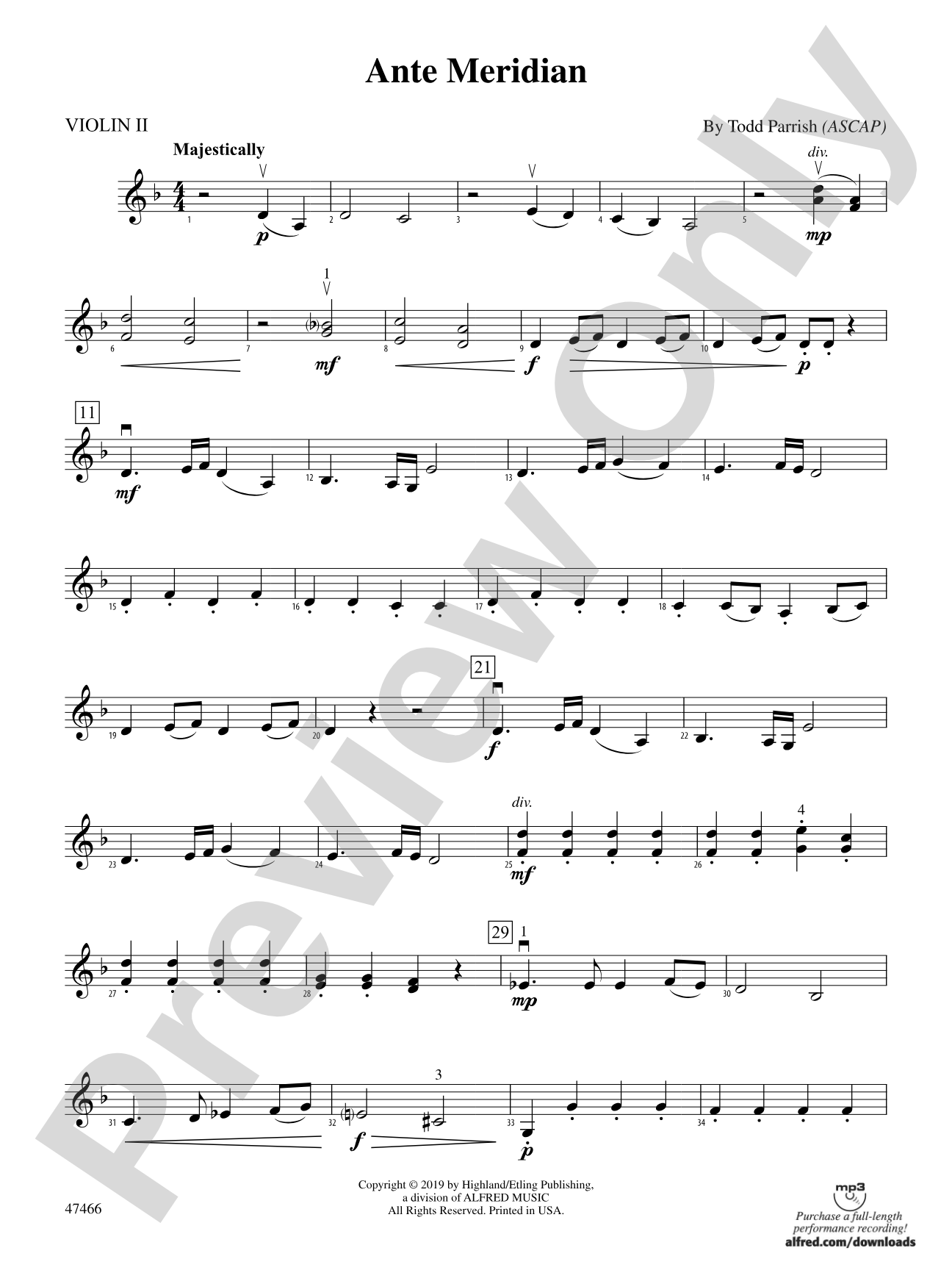

Ante Meridian: 2nd Violin
By Todd Parrish
Grade: 2.5
Item: 00-PC-0017995_VN2
$5.99
Pickup currently not available
Description
Inspired by a painting of the same name, this engaging work by Todd Parrish features memorable rhythmic patterns of sixteenth notes, flat-key fingerings, and varied articulations. The original painting evokes the awesome, eternal nature of the sea that could occur on any given morning. Imagine crashing waves!


Don't just read it, hear it, play along with it, and watch your students grow with it. In MakeMusic Cloud, Ante Meridian: 2nd Violin comes alive with professional accompaniment, adjustable tempo, and built-in practice tools that turn solo practice into real progress.
Open in the Player
Jump straight in and assign it today.
Start Your Free Trial
Open this title and explore the full library in minutes.
Sample Audio
1
Audio File
--:--
0:00
0:00
Sample Video
Additional Details
Series:
Highland/Etling String Orchestra
Publisher:
Alfred Music
Page Count:
124
SKU:
00-PC-0017995_VN2
More about this title
About the Composer: Todd Parrish
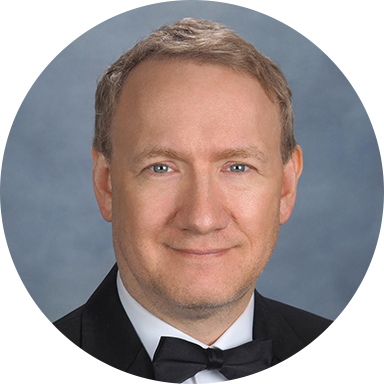
Todd Parrish brings two decades of orchestral teaching experience across Illinois, Virginia, and Florida to his work as both a conductor and composer. He holds a Bachelor of Music Education from ORU in Tulsa, where he studied violin and piano, and a Master of Music in Orchestral Conducting from the University of Arizona, where he worked with conductor Jindong Cai and studied string quartet with cellist Nancy Green. His studies extended through conducting workshops in Colorado, South Carolina, Maine, and Aix-en-Provence, France.
Parrish has established himself as a prolific composer and arranger with over forty published works distributed through Alfred Music Publishing, Wingert-Jones Publications, and Carl Fischer Music. Since 2013, he has served as orchestra editor for multiple publishers, including his role as orchestra editor for Carl Fischer Music beginning in 2018. He continues to guest conduct and arranges classical music alongside his original compositions from his home in Orlando, Florida.
Why we love this
Parrish captures the raw energy of crashing waves through rhythmic vitality without overcomplicating the string writing. The piece balances accessibility at grade 2.5 with genuine musical substance, making it rewarding for both students discovering programmatic narrative and directors seeking concert material that engages audiences. The varied articulations and flat-key fingerings keep young musicians engaged while building practical skills they'll use throughout their string careers.
What to expect
The music conjures the restless motion of morning waves, with sixteenth-note patterns that pulse and build like water gathering force. There's an elemental quality to the work that feels expansive and immediate, as if the whole ensemble is witnessing something eternal and powerful unfold.
Who it's for
String orchestras in grades 4-6 and early middle school programs looking for a piece that connects musical technique to visual inspiration. Directors who want their students to understand how composers translate images into sound will find Parrish's approach both accessible and engaging at this level.
How to get the most out of it
- Shape the sixteenth-note patterns as waves rolling in and out rather than mechanical repetition; think of natural dynamics that swell and recede with the imagined seascape
- Establish clear articulation consistency across all sections to maintain the rhythmic drive without sacrificing the oceanic fluidity Parrish intends
- Use the flat keys as an opportunity to check intonation in the ensemble; the extended range often reveals tracking issues that concert performance demands reveal
How to use it
Program this as a concert opener or closer where it can anchor the audience's attention through pure rhythmic energy and vivid imagery. It pairs well with other programmatic works or classical arrangements, providing contrast through its contemporary harmonic language while remaining approachable for young audiences.
Skills your students will build
- Rhythmic precision in sixteenth-note passages at varied tempos
- Intonation in flat-key signatures (multiple flats)
- Articulation control across bowing and dynamics
- Understanding how musical narrative connects to visual and natural imagery
- Ensemble blend while maintaining individual part clarity in rhythmic textures