Another Day Sheet Music Preview

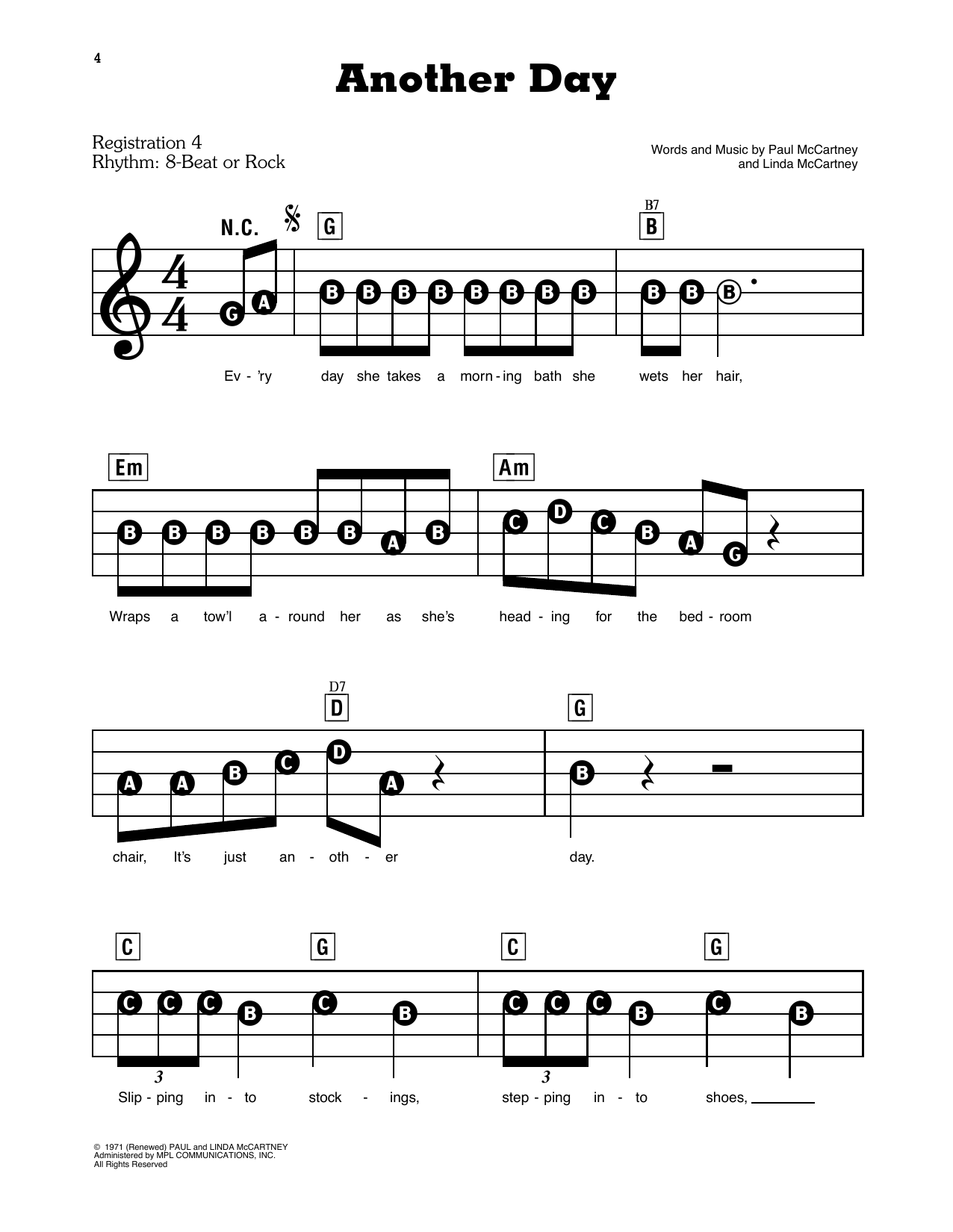
Another Day: E-Z Play Today

As performed by Paul McCartney

Item: 35-DS01046561

Digital Download
$4.99
Description

Another Day: E-Z Play Today isn't in MakeMusic Cloud just yet...but it could be. Let us know you'd like to see it, and you'll help shape what comes next. In the meantime, start a free trial and dive into thousands of interactive titles your students can play along with today.

Sample Audio
No sample audio found.
Sample Video
Additional Details
Publisher: Hal Leonard
Page Count: 5
SKU: 35-DS01046561

More about this title

About the Artist: Paul McCartney

Paul McCartney wrote and recorded "Another Day" as a solo single in 1971, demonstrating his gift for crafting memorable melodies and intricate arrangements outside the Beatles framework. His work across multiple instruments and his instinct for song structure have made him one of the most studied songwriters in music education, offering students direct access to pop music composition at its most sophisticated.

Why we love this

This E-Z Play arrangement makes a genuinely sophisticated pop song accessible to early intermediate pianists without sacrificing the melodic appeal that made it a chart success. Students encounter real harmonic movement and a memorable hook that rewards careful voicing and phrasing, giving them a taste of why McCartney's writing matters to musicians across all genres.

What to expect

Bright and approachable on first glance, but with enough harmonic sophistication to sustain interest across multiple playings. The melody sits naturally under the fingers while the accompaniment creates forward motion and contemporary resonance without demanding virtuosity.

Who it's for

Early intermediate pianists who want to explore pop repertoire with harmonic substance, and teachers looking for songs that bridge classical technique and contemporary music literacy. Solo performers preparing for recitals, accompaniment practice, or simply the joy of playing a song that matters culturally.

How to get the most out of it

  • Shape the melody line with clear dynamic contours; the hook needs to breathe rather than sit flat across four bars.
  • Balance the accompaniment so it supports rather than overwhelms the vocal melody, especially in passages where both hands move together.
  • Keep the tempo steady and slightly buoyant; the groove depends on rhythmic consistency, not rushing through phrases.
  • Listen to the original recording to internalize the style and tone, then find your own interpretive entry point rather than copying it exactly.

How to use it

Pair this with other singer-songwriter material from the 1970s to show students how pop music evolved beyond the group ensemble sound. It works well as a solo piece for student recitals or as part of a themed concert exploring melody-driven composition.

Skills your students will build

  • Reading and interpreting lead sheet notation with chord symbols
  • Balancing melody and accompaniment textures
  • Pedal control in pop and rock idioms
  • Understanding phrase structure in contemporary songwriting
  • Translating recorded performance style into scored notation

You May Also Like